
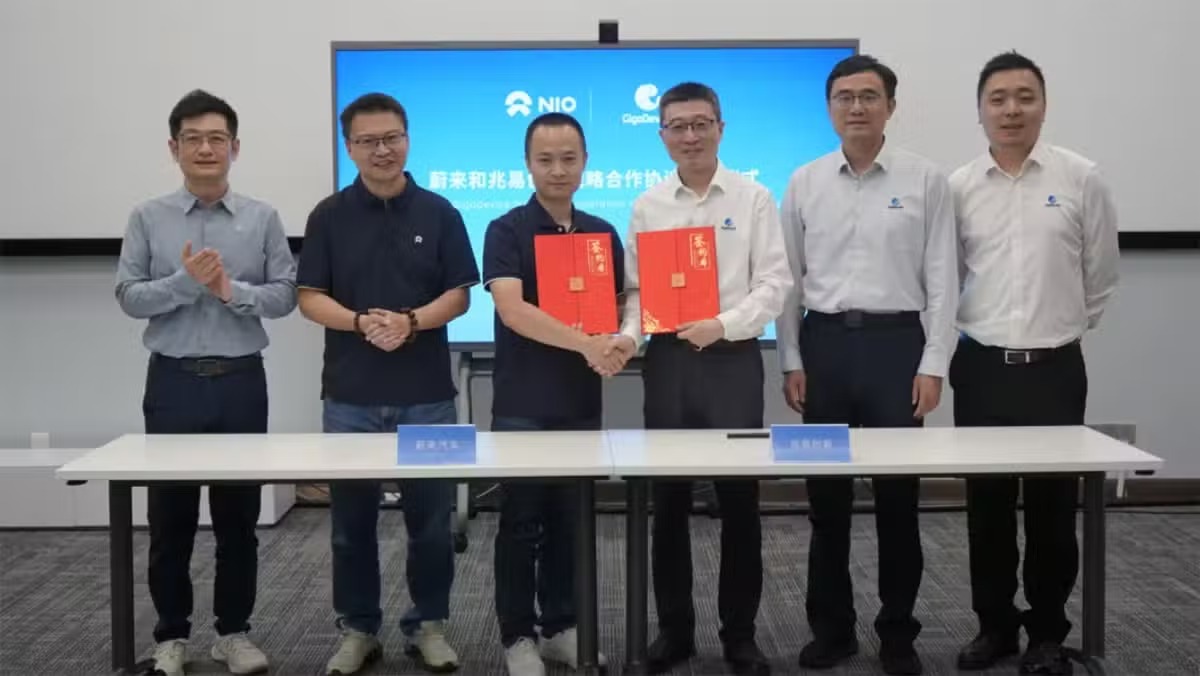
Nio has entered into a strategic partnership with Chinese semiconductor supplier GigaDevice to jointly develop automotive-grade chips and support the next generation of intelligent electric vehicles.
The agreement, announced by GigaDevice on Friday, focuses on collaborative innovation in automotive semiconductors, with the two companies aiming to accelerate the development of advanced chips for smart cockpits, intelligent driving systems, and future vehicle electronic architectures.
Joint Development of Automotive Chips
Under the partnership, GigaDevice will leverage its expertise in chip design and large-scale semiconductor manufacturing to provide high-performance automotive-grade memory and microcontroller products for Nio’s future vehicle lineup.
The Beijing-based semiconductor company is a major supplier of NOR Flash memory and microcontroller units (MCUs), technologies widely used across automotive, industrial, and consumer electronics applications.
According to GigaDevice, its automotive-grade chip products and system solutions are designed to meet the growing reliability and performance requirements of next-generation smart electric vehicles.
Nio will contribute vehicle engineering expertise, platform development capabilities, and market insights to support chip architecture design, technical specifications, performance optimization, and vehicle-level validation.
Focus on Smart Cockpit and Autonomous Driving Applications
The collaboration will primarily target core vehicle applications, including intelligent cockpit systems and advanced driver assistance technologies.
Industry Push for Standardization
The partnership comes as Chinese automakers face increasing pressure to reduce costs and improve supply chain efficiency amid fierce competition in the electric vehicle market.
Nio founder, chairman, and chief executive officer William Li has repeatedly called for greater standardization of automotive components, particularly semiconductors and battery cells, to help reduce costs across the industry.
“The complex variety of chips significantly drives up manufacturing costs.”
Speaking at the China EV100 Forum in April, Li said Nio’s newly launched ES9 SUV uses more than 1,000 different semiconductor types and over 4,000 chips in total, illustrating the growing complexity of modern vehicle electronics.
He argued that reducing the number of chip variants used by automakers could generate more than 100 billion yuan ($14.8 billion) in cost savings across China’s automotive industry.
Reducing Supply Chain Complexity
According to Li, Nio is working internally to reduce the number of semiconductor types used across its vehicles to approximately 400.
The company believes broader industry cooperation on chip standardization could help address supply-demand imbalances, lower procurement costs, and shorten development cycles for future vehicle programs.
The issue has become increasingly important as automakers introduce new models at a faster pace, creating what some industry observers describe as a “new car death valley effect” in which rapid product launches contribute to excess investment and supply chain inefficiencies.
Strengthening China’s Automotive Semiconductor Ecosystem
For GigaDevice, the partnership represents an opportunity to expand its presence in the fast-growing automotive semiconductor sector.
The company, which debuted on the Hong Kong Stock Exchange earlier this year, was the world’s second-largest supplier of NOR Flash memory for automotive, industrial automation, and networking applications in 2025, according to its listing documents.
Both companies said the collaboration aims to create mass-production automotive chip solutions that can serve as industry benchmarks while accelerating the commercialization of new technologies for intelligent electric vehicles.