
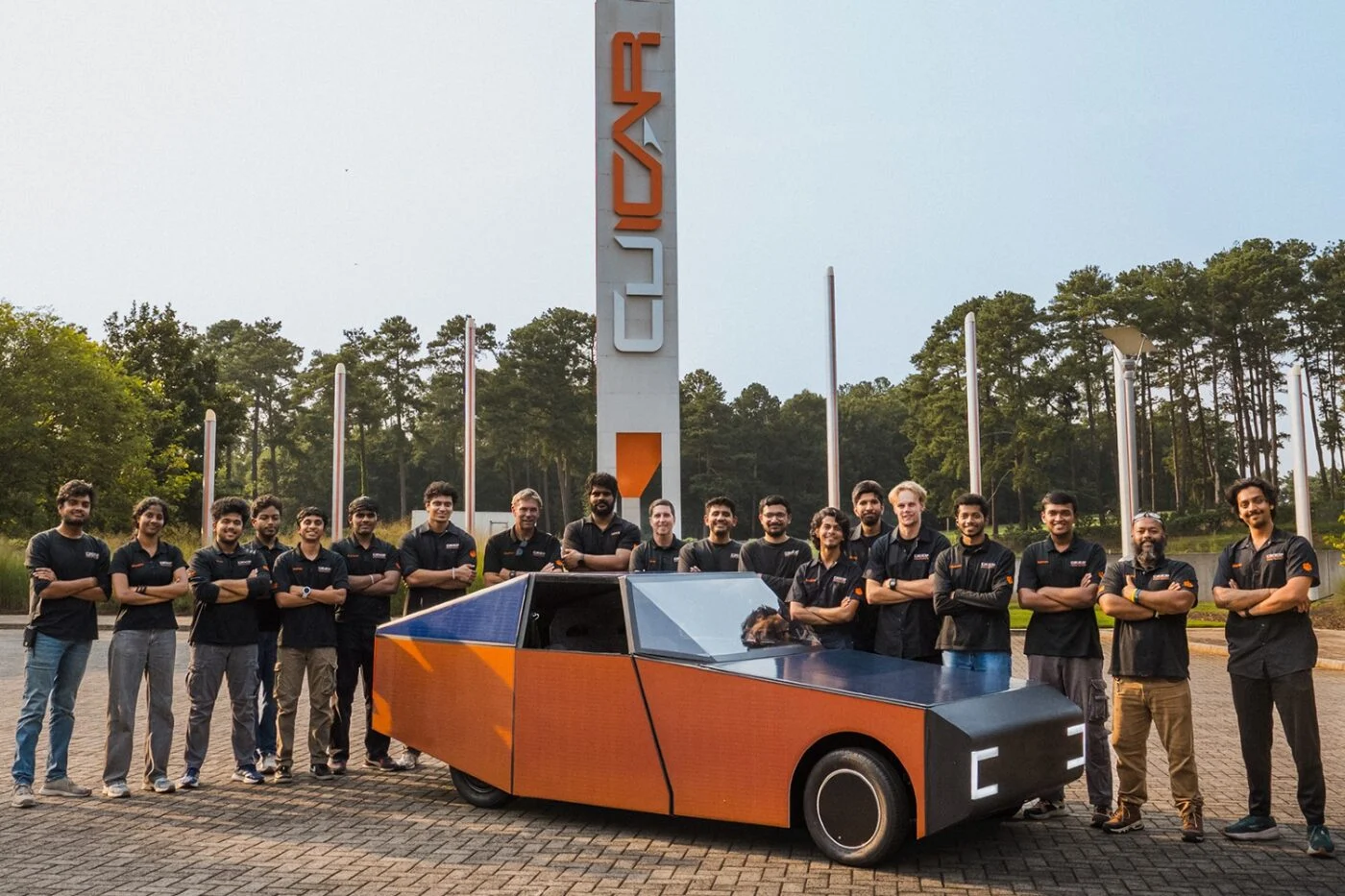
Clemson University students have developed Deep Orange 17, a solar-powered electric vehicle prototype designed to generate more energy than it consumes during a typical urban commute.
The two-door coupé, nicknamed Luminetta, was developed by 16 students who recently completed Clemson’s Master of Science in Automotive Engineering program. The project was carried out with support from BMW’s research and development team and Germany’s Fraunhofer Institute for Solar Energy Systems ISE.
Solar Power Integrated Into Vehicle Design
Deep Orange 17 incorporates more than 1,700 photovoltaic cells into its exterior surfaces. The solar system is designed to generate electricity while the vehicle is parked or moving, making solar power a central part of the prototype’s energy strategy rather than an auxiliary charging feature.
The photovoltaic technology was developed with Fraunhofer ISE. A protective outer film covers the cells, while the system is designed to continue harvesting solar energy under shaded conditions.
The team assessed solar conditions in Greenville, South Carolina, as well as Frankfurt, Madrid and Mumbai to evaluate how the concept could perform in different environments.
Based on a daily commute of about 12 miles, or 20 kilometres, Clemson researchers estimate that the vehicle could generate enough surplus solar energy across the four locations to provide an average of approximately 31 miles, or 50 kilometres, of additional driving range.
Lightweight Construction Supports Efficiency
The prototype’s energy performance also relies on its low weight and aerodynamic design. Clemson said Deep Orange 17 weighs about 550 kilograms, significantly less than a typical production vehicle.
The aerodynamic shape draws inspiration from the characteristics of the boxfish, with the design intended to reduce energy consumption while supporting the vehicle’s solar-powered operating concept.
The university has not disclosed detailed specifications for the electric drivetrain.
BMW Partnership Continues
Deep Orange 17 is the latest prototype developed through Clemson University’s Deep Orange program, which allows automotive engineering students to develop and build functional vehicle concepts.
BMW has been a long-standing partner of the program, and its research and development team contributed to the development of the latest vehicle.
Work on Deep Orange 17 began in autumn 2024, with the project combining research into solar energy, vehicle efficiency, lightweight materials and intelligent vehicle controls.
The prototype will remain at Clemson University’s International Center for Automotive Research, where it will provide a platform for additional research into sustainable mobility technologies.
Deep Orange 17 is also expected to be displayed at CES 2027 in Las Vegas, giving the student-developed vehicle an opportunity to demonstrate its solar-powered mobility concept to a wider technology and automotive audience.