
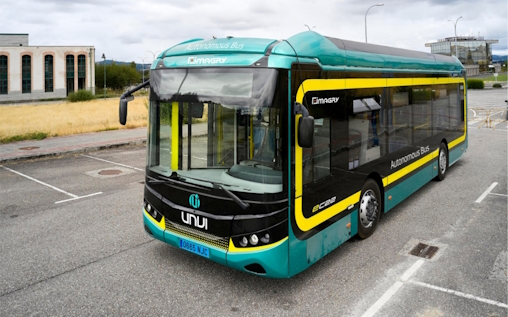
Software specialist Imagry and Spanish bus manufacturer UNVI are developing an autonomous electric bus that is scheduled to enter operation in Germany in the third quarter of 2026.
The jointly developed vehicle is a 10.3-metre battery-electric bus in the M3 class, with UNVI integrating Imagry’s autonomous driving technology. According to the companies, the bus is already being transported to its deployment location in Germany.
Imagry provides the software covering perception, motion planning and vehicle control. Its system does not rely on high-definition maps, instead using onboard sensors to understand the vehicle’s surroundings and navigate its environment. The companies say this approach can simplify the deployment of autonomous buses on new routes.
Autonomous Technology Moves Into Full-Size Bus
Imagry’s technology has already been tested on public roads using autonomous vehicles in Germany, the US, Japan and Israel.
The system is designed for Level 4 automated driving, under which vehicles can operate without a human driver within a defined operational area. The German project will provide an opportunity to demonstrate the technology in a full-size M3-class public transport vehicle rather than a smaller autonomous shuttle.
The bus is being prepared for European Whole Vehicle Type Approval (WVTA) and compliance with General Safety Regulation 2 (GSR2) requirements.
Imagry and UNVI said the integration of the autonomous driving system with the vehicle took less than three months. However, the companies have not disclosed the bus’s battery capacity, driving range or charging specifications.
They have also not specified the German deployment location or whether the vehicle will initially operate fully driverless or under supervised trial conditions.
UBSI is supporting the project as an interface between UNVI and Imagry. Its responsibilities include procurement, homologation, regulatory affairs, leasing and fleet operations.
UNVI Targets Wider Autonomous Bus Applications
UNVI plans to extend its partnership with Imagry to additional vehicle configurations. Beyond conventional public transport services, the companies see potential applications for autonomous buses at airports, universities and hospitals.
The partnership comes as international regulators move towards establishing common rules for higher levels of automated driving.
In July, the United Nations Economic Commission for Europe (UNECE) adopted the first internationally harmonised regulatory framework for automated driving systems at SAE Level 4, with support from the EU, US, China and Japan.
The framework requires manufacturers to establish a Safety Management System and demonstrate system performance through simulations and testing. It does not replace national approval procedures but is intended to provide a common regulatory foundation.
The new UNVI bus will initially operate under existing WVTA and GSR2 requirements. The partners expect the emerging international ADS framework to provide additional support for the deployment of higher-level automated driving technology over time.
The German project will therefore test not only Imagry’s autonomous driving technology in a full-size electric bus, but also how the technology can be integrated into existing European vehicle approval and public transport frameworks.