
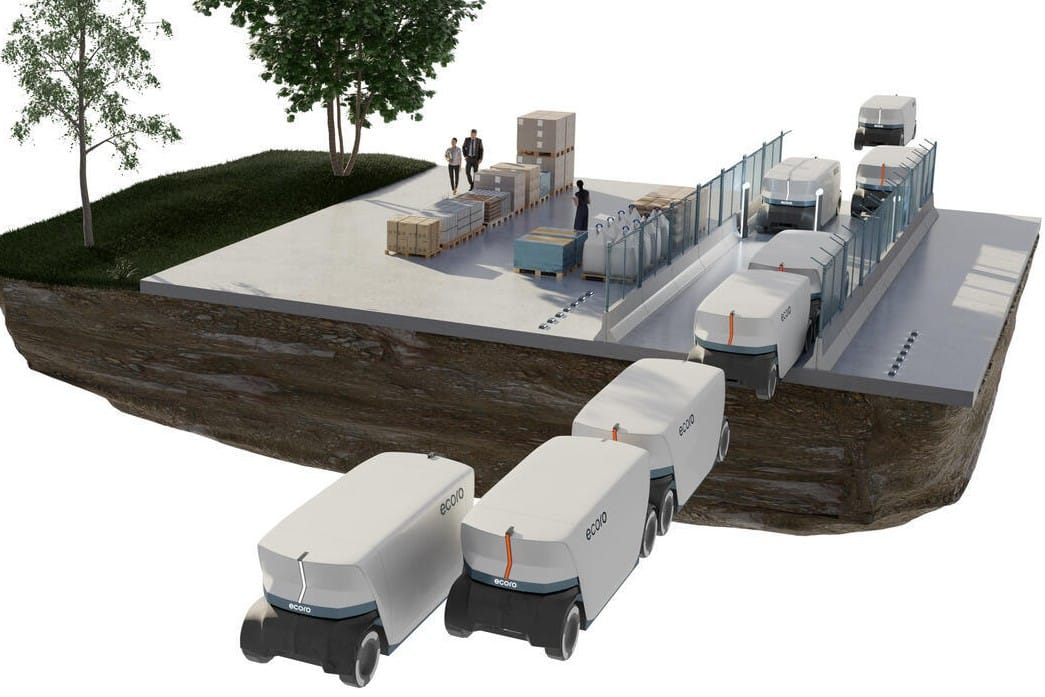
German universities and industry partners have launched a research project aimed at easing urban congestion by enabling temporary, virtual road sections reserved for automated logistics vehicles.
The project, known as ViDeLL—short for Virtual Dedicated Logistics Lanes—is led by TH Köln in collaboration with RWTH Aachen and several industry partners. It focuses on developing concepts that allow existing road space to be dynamically allocated to automated freight vehicles without the need for permanent physical lanes.
“The projected increase in freight transport will lead to complete congestion on our roads in the foreseeable future,” said Professor Achim Kampker, head of the Chair of Production Engineering of E-Mobility Components at RWTH Aachen. He added that the project is therefore concentrating on logistics traffic flows, particularly in urban last-mile delivery, retail logistics, and industrial transport between production sites located within cities.
A central element of ViDeLL is the idea of software-defined logistics lanes, created through intelligent road markings, infrastructure sensors, and a central control system. These virtual lanes could be activated temporarily and exclusively for automated logistics vehicles, depending on traffic conditions and demand.
See also: Germany’s RWTH Aachen Advances Testing of Modular Autonomous Electric Bus-Cable Car Concept
Munich-based startup Ecoro, one of the project partners, is contributing its autonomous electric freight shuttle to the research. The vehicle can transport up to four pallets with a payload of 2.4 tonnes and reach speeds of up to 60 km/h. While similar in concept to automated guided vehicles used in factories, the shuttle is designed for outdoor and public-road use.
“Flexible virtual solutions using optical components are economically attractive, as they enable efficient use of existing road space and require significantly fewer construction measures than physical lanes for specific vehicle groups,” said Tarik Hadzovic, project manager at the PEM Chair of RWTH Aachen.
See also: RWTH Aachen Researchers Complete Project on Faster, Lower-Cost Battery Production
Beyond technical development, the project will examine interactions between automated logistics vehicles and other road users, develop safety concepts, and assess regulatory challenges. The consortium also plans to propose recommendations for adapting existing traffic regulations to accommodate virtual lanes.
The ViDeLL project is funded by the German state of North Rhine-Westphalia and the European Union under the ERDF Innovation Competition “NeueWege.IN.NRW.” It is scheduled to run until December 31, 2028. Additional partners include sensor specialist ETO and RWTH Aachen spin-off PEM Motion.