
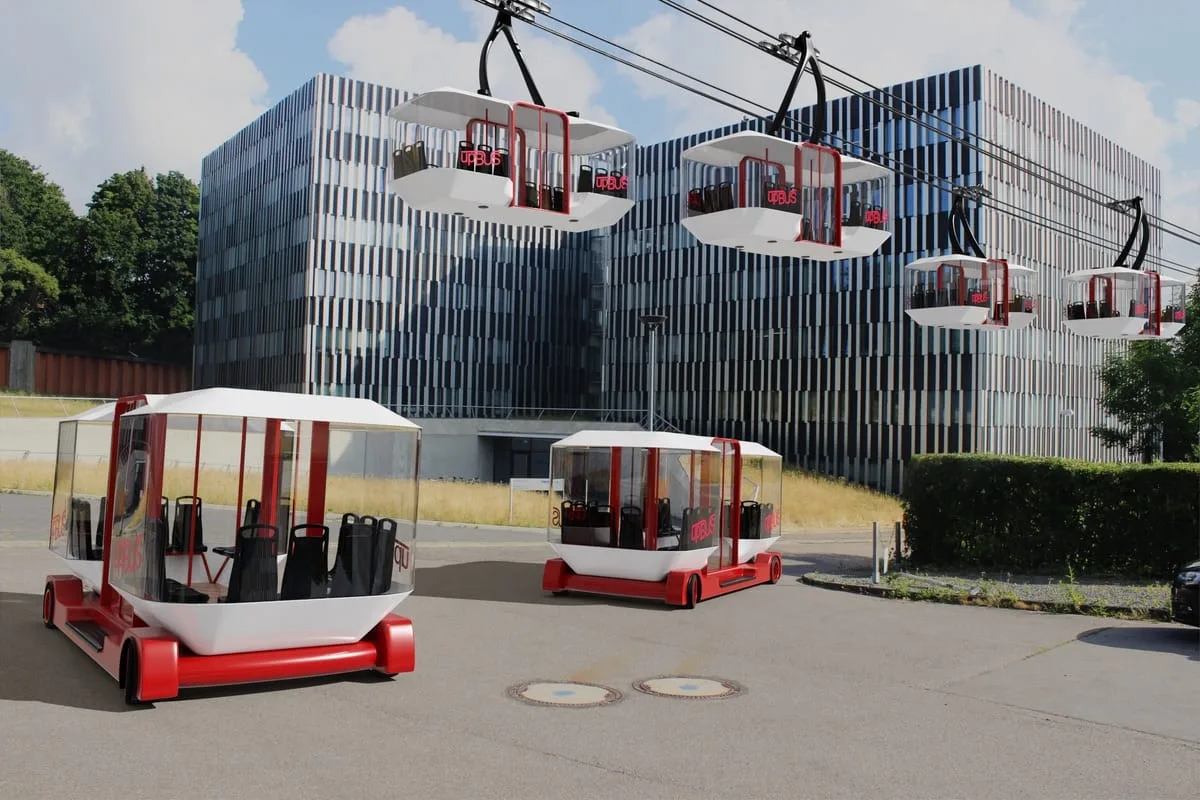
Researchers at RWTH Aachen University have reached a critical milestone in their ongoing development of a modular autonomous electric bus that can transition onto a cable car system to glide over traffic congestion. The project, called upBUS, is designed to merge the strengths of electric buses and cable cars into a unified, intermodal transport solution.
A key test setup has now been completed by the university’s ‘Production Engineering of E-Mobility Components’ (PEM) department, enabling prototyping work to move into a new phase. The first trial using a so-called “primotype” is planned for August 2025. The upBUS project, backed by €3.2 million in federal funding from Germany’s Ministry for Economic Affairs and Climate Protection, involves collaboration with the Institute for High Frequency Electronics (HFE), the Institute for Structural Mechanics and Lightweight Construction (SLA), and the municipality of Simmerath.
“The greatest technical challenge lies in the high degree of modularity,” said Prof. Achim Kampker, Director of PEM. “As a cable car, the upBUS can bridge traffic bottlenecks or areas with difficult landscapes and then continue seamlessly as a bus without passengers having to change,” he added. The system is designed to transfer a shared passenger cell between a wheeled chassis and a cable-hung gondola, eliminating the need for travelers to switch vehicles.
The pre-series vehicle will initially be developed as a freight version for field testing, while a digital prototype for passenger transport is also underway. The cabin is expected to accommodate up to ten passengers and include features such as barrier-free access, infotainment systems, and automated doors—mirroring those of standard public transit vehicles.
The upBUS concept draws on the flexibility of autonomous electric buses to operate dense urban networks and the spatial advantages of aerial cable systems to bypass obstacles and congestion, offering a hybrid solution to urban mobility challenges.