



Researchers at RWTH Aachen University have successfully tested the first prototype of an electric vehicle that can operate both as an autonomous minibus and as part of an urban cable car system, marking a milestone in the federally funded upBUS research project.
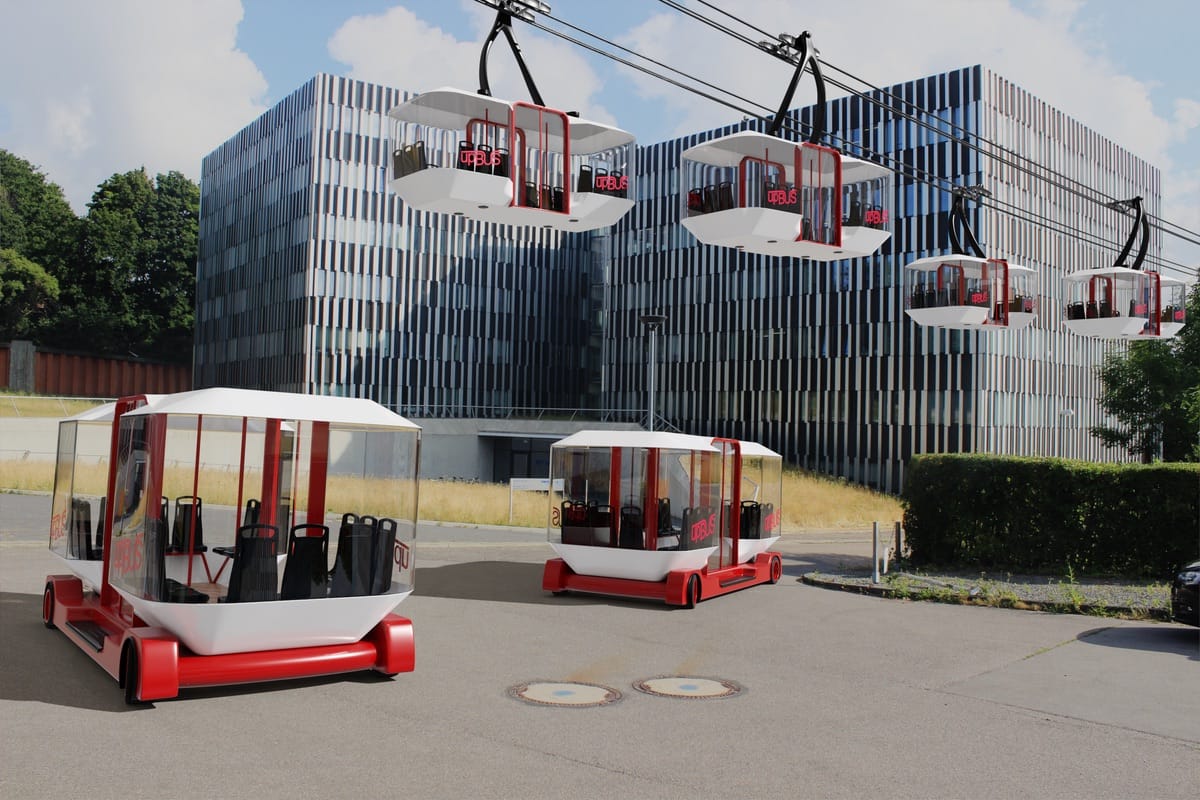
The upBUS concept centres on a battery-electric, self-driving minibus capable of docking onto a cable car line, allowing it to switch between road and aerial transport without passengers having to change vehicles. The project, which began in mid-2025, brings together several RWTH institutes and aims to address capacity constraints and congestion in urban public transport.
See also: RWTH Aachen Completes SeLv Project on Modular Electric Trucks With Fuel Cell Extenders
The initial tests focused on a “minimum viable product” and validated a fully automated coupling process developed at RWTH. Using a reduced cable car model with a guided sled spanning about 20 metres, researchers demonstrated that the passenger cabin can transition between the road-driving module and the cable car suspension within seconds while in motion.

“A key finding from this first phase is that the mechanisms and methods of the start-up ecosystem can be transferred very well to technology development in a research context,” said Kai-Uwe Schröder, head of the upBUS project. He said early testing exposed challenges that could not have been anticipated during planning, increasing the project’s overall chances of success.
See also: RWTH Aachen Researchers Complete Project on Faster, Lower-Cost Battery Production
Based on the results, the participating institutes — including RWTH’s Institute for Structural Mechanics and Lightweight Design, the Chair of High-Frequency Electronics and the Chair of Production Engineering of E-Mobility Components — are now refining their technologies. Full-scale field tests are planned for summer 2026 to demonstrate a reproducible and safe coupling process at operating speeds.
“In this project, we are combining the robustness and elegance of cable cars with the intelligence and comfort of autonomous driving,” said Renato Negra, head of the Chair of High-Frequency Electronics.
A follow-on project is expected to establish a pilot route in the municipality of Simmerath, which is involved in the initiative. An initial feasibility study has already found the concept to be technically, spatially and environmentally viable, with further analysis planned to assess economic performance and broader impacts.
See also: RWTH Aachen Launches Project to Develop Battery Cells with Over 80% Recycled Content
“Our current public transport system is reaching its limits,” said Achim Kampker, head of the Chair of Production Engineering of E-Mobility Components. He said the upBUS concept adds an additional layer to transport networks, reducing congestion, easing land-use pressures and cutting emissions.
The upBUS project has been under development for several years, with early scaled models built in 2019 and a cable-to-road transition trial conducted in Austria in 2021. In 2024, the initiative received €3.2 million in funding from Germany’s former Federal Ministry for Economic Affairs and Climate Action. By the end of the programme, researchers plan to build a pre-series freight prototype and a parallel digital prototype for passenger transport, with cabins designed to carry up to ten people.


