

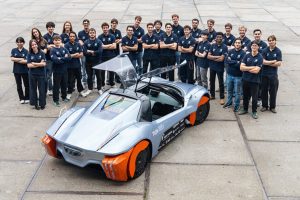



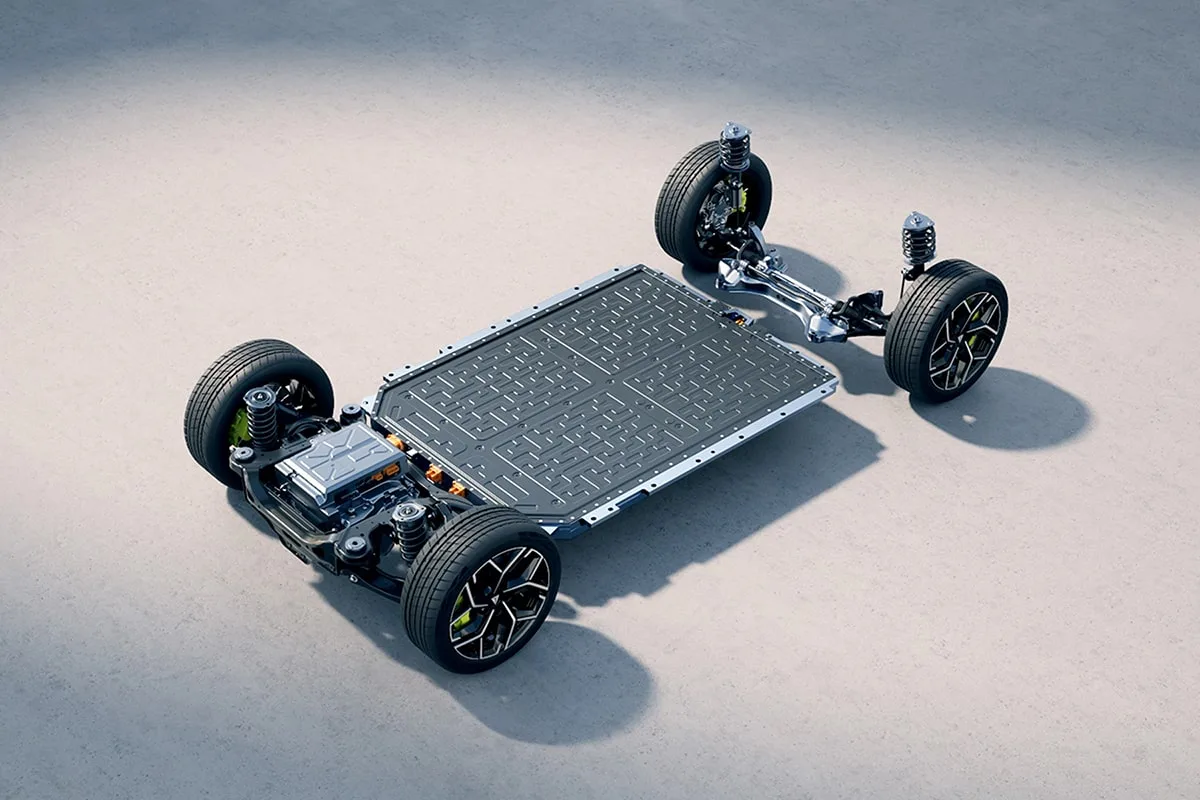
The Chair of Production Engineering of E-Mobility Components (PEM) at RWTH Aachen University has completed its three-and-a-half-year ‘PEAk-Bat’ research project aimed at reducing the cost and time required for battery production. The project focused on developing a module-to-chassis system that integrates the battery structure directly into the vehicle body.
To validate the concept, researchers built ten vehicle bodies with structural battery systems and submitted them for testing by project partners TÜV Rheinland and Magna. The PEM team also created and validated several simulation models.
See also: RWTH Aachen Launches Project to Develop Battery Cells with Over 80% Recycled Content
According to the project outline, the decision to adopt a cell-to-pack approach was based on efforts to increase both mass-related and spatial energy density, enabling efficiency improvements of up to 20% while reducing the number of components compared with traditional battery designs that rely on cell, module and pack layers.
Funded by the German Federal Ministry for Economic Affairs and Energy, the PEAk-Bat project involved industrial partners including Ford and Trumpf. Their joint objective was to develop structural battery systems that reduce manufacturing complexity and cost, supporting earlier commercial deployment.
See also: RWTH Aachen’s PEM Finds Electrification of Road Construction Sites Both Feasible and Sustainable
Alongside hardware development, researchers produced new guidelines on battery safety, published as the Methodology for Analyzing Changes to Battery Systems and Evaluating the Resulting Testing Requirements.
A key focus was early validation using artificial intelligence to reduce the need for physical testing. “Early validation of battery systems using artificial intelligence helps to reduce critical errors in the production process and lower the costs of prototypes,” said PEM Director Professor Achim Kampker.
See also: RWTH Aachen Unveils Virtual Modelling Tool for Battery Cell Production
In the project documentation, the team noted that AI-assisted testing “is made possible by saving test times, which results in faster development of new types of battery systems and thus earlier market entry.” PEM Management Member Professor Heiner Heimes added: “The time saved on testing allows for faster development of innovative battery systems and, as a result, earlier market launch.”


