

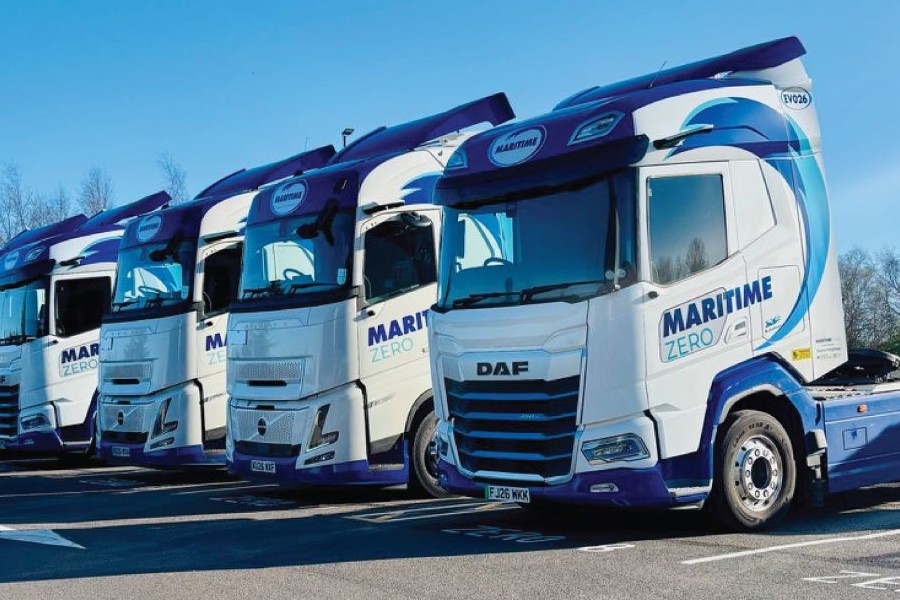
UK-based logistics provider Maritime Transport said it has deployed 19 battery-electric trucks at its Wakefield and Birmingham sites, as part of plans to expand its fleet to 56 vehicles across 13 depots and rail terminals by the end of the year.
The newly delivered units include models from Volvo Trucks, Mercedes-Benz Trucks and DAF Trucks. Maritime said the vehicles are expected to achieve ranges of between 300 and 500 kilometres per charge depending on duty cycles, making them suitable for a range of regional operations.
To support the rollout, the company is developing what it described as one of the UK’s largest independent heavy goods vehicle charging networks. Once completed, the network is expected to have a total installed capacity exceeding 22 megawatts and the ability to charge up to 100 electric HGVs simultaneously. Maritime said it also plans to make the infrastructure available to third parties to “unlock wider adoption of eHGVs across the sector.”

The deployment forms part of the UK government-backed Zero Emission HGV and Infrastructure Demonstrator (ZEHID), funded by the Department for Transport and delivered in partnership with Innovate UK. The programme includes sub-projects such as ZENFreight, Electric Freightway and eFREIGHT 2030, with Maritime participating across all three.
The first phase began in January at the Wakefield depot, where nine Mercedes-Benz eActros 600 vehicles were deployed under the ZENFreight project and charged via on-site infrastructure with up to 400 kW capacity. The trucks are being used for container and curtain-sided trailer operations, providing operational data across different use cases.
In March, Maritime added four electric trucks from Volvo and six from DAF at its Birmingham Rail Freight Terminal under the Electric Freightway project. Further expansion plans include additional deployments at Wakefield, Doncaster iPort and the London Distribution Park in Tilbury, as well as increased fleet capacity in Birmingham and Manchester.
The large-scale rollout is being implemented by Maritime ZERO, a subsidiary focused on zero-emission road transport. The company said its model integrates long-distance rail freight with electric trucks for last-mile and regional delivery operations.
“ZERO uses a hub-and-spoke model integrating long-distance rail with eHGVs completing onward journeys from inland terminals and port locations,” Maritime said in a statement.
“Bringing our first eHGVs into operation, together with the charging infrastructure behind them, is a really important milestone for Maritime and the result of a huge collaborative effort across our business and with our partners,” said Tom Williams, Deputy Managing Director of Maritime Transport.
“Maritime’s investment in eHGVs and charging infrastructure is an important step forward for the UK logistics sector, and through ZEHID is helping show how zero-emission road freight can begin to be integrated into real-world operations,” said Simon Buckley of Innovate UK. “It also underlines the importance of combining vehicle deployment with the right infrastructure and operational planning if this technology is to move into more widespread use.”
The ZEHID programme, launched in October 2023 with total funding of 200 million pounds ($250 million), aims to accelerate the adoption of zero-emission trucks in the UK. By March 2026, “almost 300 zero-emission trucks will be deployed” through the initiative, according to the Department for Transport.
Separately, the government has introduced additional support under the Zero Emissions Truck and Van programme, offering subsidies of up to 40% of vehicle costs, or as much as 81,000 pounds per truck, to encourage wider adoption.