
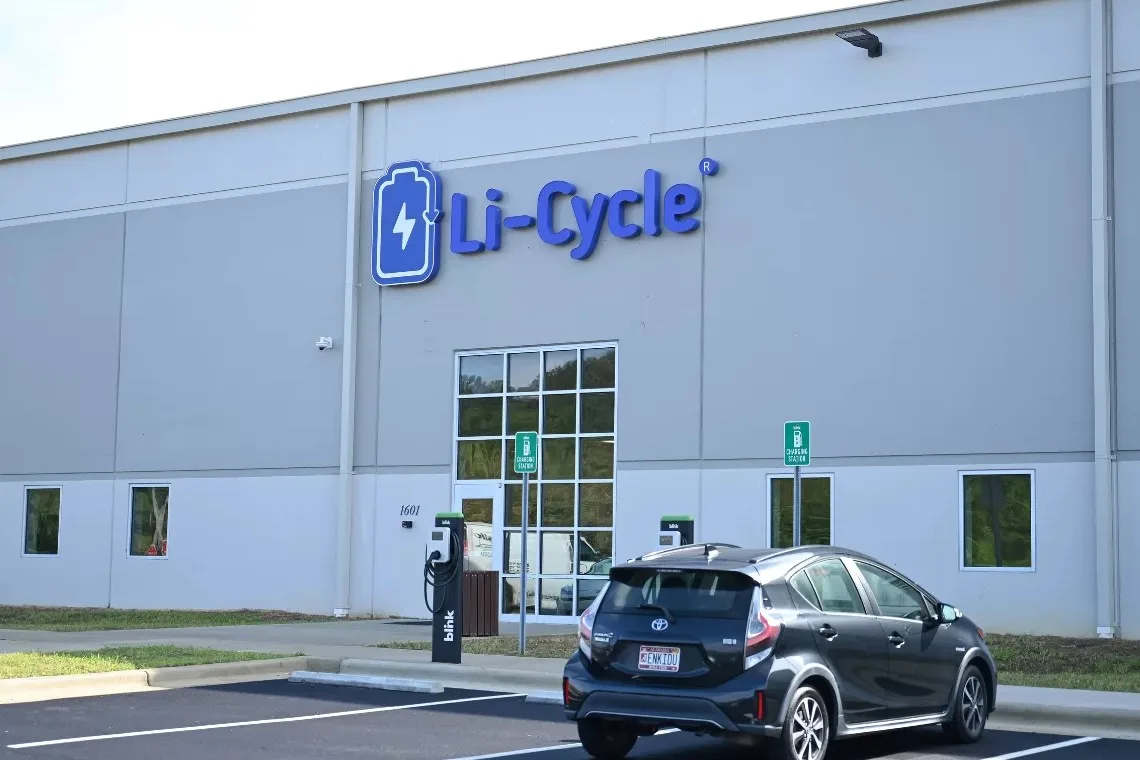
Canadian battery recycler Li-Cycle has filed for bankruptcy protection in both Canada and the United States after months of financial strain, marking a significant downturn for the once high-valued firm as it begins the process of selling its business or assets.
The Toronto-based company confirmed it has commenced proceedings under Canada’s Companies’ Creditors Arrangement Act (CCAA) in the Ontario Superior Court of Justice, alongside Chapter 15 filings in the U.S. Bankruptcy Court for the Southern District of New York. These filings cover its North American operations, including spoke facilities in Arizona, Alabama, and New York, as well as the Rochester, New York hub. Alvarez & Marsal Canada has been appointed as the court-appointed monitor to oversee the process.
Li-Cycle, once valued at over $2 billion, specialises in recovering battery materials through a two-stage process—first creating ‘black mass’ from spent batteries and production waste at regional spoke sites, followed by material extraction at centralized hub facilities.
The company has struggled with surging costs and construction delays, particularly at its Rochester hub project, which was paused in November 2023 after exceeding budget and timeline projections. Since March, Li-Cycle has been actively seeking a buyer, and discussions with Swiss commodities giant Glencore have progressed into a potential acquisition deal.
Li-Cycle has secured $10.5 million in debtor-in-possession financing and received a stalking-horse bid from Glencore valued at a minimum of $40 million. The bid includes all major North American facilities and the Magdeburg plant in Germany. Li-Cycle stated that its German operations are expected to maintain sufficient working capital to continue during the proceedings, even as it looks to wind down subsidiaries elsewhere in Europe.
In 2023, the U.S. Department of Energy approved a $475 million loan for the Rochester project, but Li-Cycle was unable to draw on the funds due to unmet preconditions.
“This restructuring process and the potential transaction with Glencore could allow core parts of our operations to continue and provide a path forward,” a company spokesperson said.
If successful, the deal could position Glencore to take over key battery recycling infrastructure across North America and Germany, as Li-Cycle navigates one of the most high-profile collapses in the battery materials sector to date.