
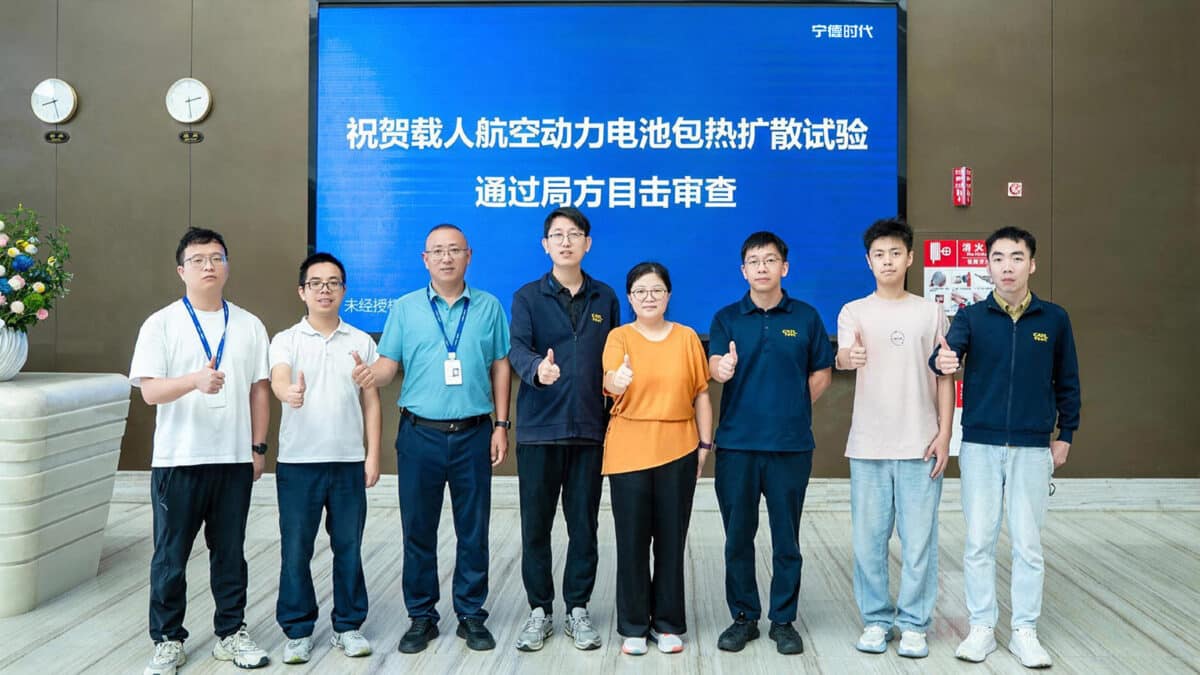
CATL, the world’s largest power battery maker, said its aviation battery system for passenger eVTOL (electric vertical takeoff and landing) aircraft has passed a verification test without thermal runaway propagation after two adjacent cells were intentionally triggered.
The company said the result makes the system the world’s first aviation battery using prismatic cells with an energy density of up to 350 Wh/kg to pass such a test.
During the verification, CATL simultaneously triggered two adjacent cells at different locations within the battery pack, including cells positioned in the middle and at the corners. The company said no thermal runaway propagation occurred.
The production, inspection and testing of both the cells and battery system were witnessed by designated representatives of the Civil Aviation Administration of China (CAAC), according to CATL. The company said the achievement provides a foundation for its eVTOL battery system to meet civil aviation safety requirements.
Dual-Cell Test Raises Aviation Battery Safety Standard
Thermal runaway propagation is one of the key safety challenges associated with high-energy-density batteries, with the risk particularly significant in aviation applications where battery failures can have severe consequences.
Battery systems are typically tested to determine whether thermal runaway spreads after a single cell is intentionally triggered. CATL’s test involved triggering two adjacent cells simultaneously, creating a more demanding condition for the battery system.
The successful result demonstrates the company’s focus on preventing a localized cell failure from spreading through the wider battery pack.
CATL said its aviation battery system is now ready for mass production. The technology will initially be deployed in passenger eVTOL aircraft developed by Autoflight, an eVTOL manufacturer backed by CATL.
CATL Expands Into Electric Aviation
The battery manufacturer is expanding beyond conventional electric vehicles into several emerging electrification markets, including electric vessels and electric aviation.
CATL and Shanghai-based Autoflight signed a strategic investment agreement in August 2024. CATL became an exclusive strategic investor in Autoflight through an investment worth hundreds of millions of dollars, marking the first publicly disclosed CATL investment in an eVTOL company.
The partnership has since expanded beyond battery technology. In November 2025, the companies jointly unveiled a floating vertiport, a battery-powered vessel integrating an eVTOL takeoff and landing platform with photovoltaic energy storage and charging systems.
The companies described the project as the eVTOL industry’s first integrated sea-air solution, combining electric aviation infrastructure with marine transportation and renewable energy systems.
Autoflight was founded in 2017 and is among the earliest companies operating in China’s eVTOL sector. Its cumulative commercial orders reached 2,000 aircraft as of November 2025.
High-Energy Batteries Target Emerging Aircraft Market
The development highlights the increasing importance of battery energy density and safety as eVTOL manufacturers move toward commercial passenger operations.
At 350 Wh/kg, CATL’s aviation battery system is designed to provide the energy performance required for aircraft applications while addressing the stricter safety requirements associated with passenger aviation.
The successful dual-cell thermal runaway test could therefore represent an important step toward commercial deployment of battery-powered aircraft, although eVTOL manufacturers must still satisfy broader certification, operational and infrastructure requirements before large-scale passenger services can begin.
CATL is already the dominant supplier in the global EV battery market. According to South Korean market research firm SNE Research, CATL recorded 242.7 GWh of global EV battery installations during the first half of 2026, up 25.3% year on year, giving it a 39.9% share of the global market.
The company’s expansion into aviation represents another attempt to apply its battery manufacturing and safety expertise to markets beyond electric passenger cars and commercial vehicles.