



Hyundai Motor Company has outlined its growth strategy through 2030, maintaining a target of 5.55 million annual vehicle sales while aiming for electrified models to account for 60% of sales across the Hyundai and Genesis brands.
More Than 100 Models Planned
Hyundai plans to launch or update more than 100 vehicle models globally by 2030. The company did not provide a specific battery-electric vehicle sales target, but said the 60% electrified sales target will include full hybrids.
Hyundai Starts Ioniq 3 EV Production in Turkey After €250 Million Plant Upgrade
The strategy applies to Hyundai and Genesis and does not cover Kia, which operates under a separate product roadmap.
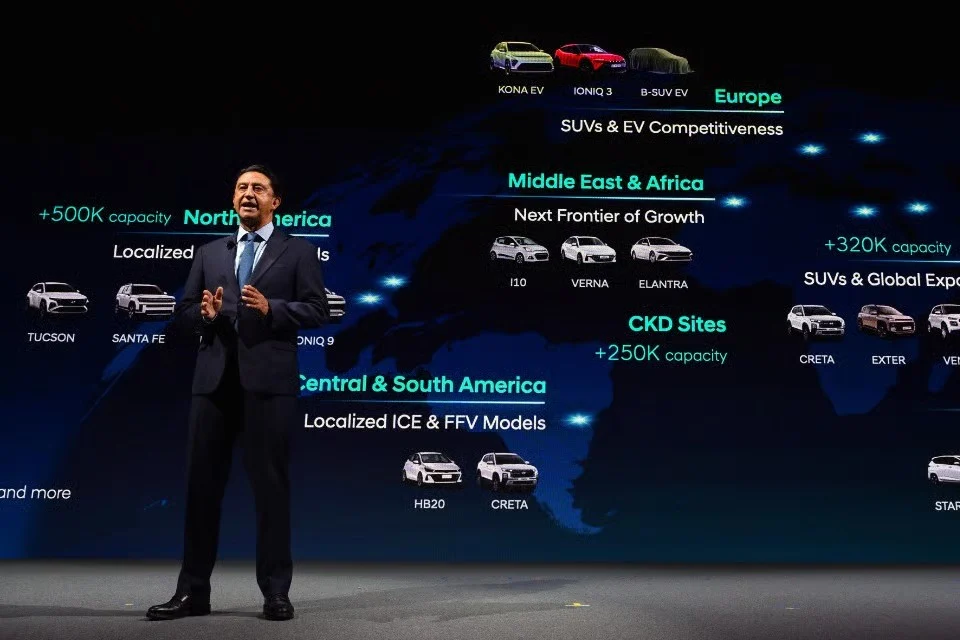
Hyundai plans to focus much of its product expansion on North America and South Korea, with 58 and 49 new or updated models respectively. Europe will receive 41 models, followed by India with 26 and China with 22.
Seven new vehicles are scheduled to launch within the next eight months, including the Ioniq 3 in Europe, an A-segment electric SUV for India and Hyundai’s first range-extender electric vehicle (EREV).
Santa Fe to Lead EREV Strategy
Hyundai’s first EREV will be the Santa Fe EREV, scheduled to launch in the first half of 2027 in North America.
The vehicle is expected to offer more than 600 miles, or about 965 kilometres, of range and will be produced at Hyundai Motor Manufacturing Alabama.
Genesis GV90 Debuts as Hyundai Luxury Brand’s Largest Electric SUV
Hyundai plans to follow the initial model with additional EREVs, including a vehicle for China.
The company is also expanding into new segments, including body-on-frame vehicles, a midsize pickup and light commercial vehicles.
Europe Drives EV Expansion
Hyundai plans to expand its battery-electric vehicle offering particularly aggressively in Europe, targeting a fully electrified portfolio covering 85% of the market by 2030.
Five new electric SUVs and light commercial vehicles are planned for the region, alongside the Ioniq 3 and a B-segment electric SUV.
Hyundai is targeting more than 420,000 battery-electric vehicle sales in Europe in 2030, compared with 116,000 in 2025.
Hyundai Appoints Former Nvidia Executive To Lead Autonomous Driving Development
In North America, the company plans to offer more than 10 hybrid models by 2030, with hybrids expected to represent around half of sales in the near term.
In China, Hyundai plans to increase localisation through local development, production and partnerships. The company intends to introduce additional products from the Ioniq V onwards, including an EV and EREV by 2027.
In India, the company plans to expand its SUV portfolio, starting with a new electric SUV in the fourth quarter.
New Battery Technologies
Hyundai said it has developed its own battery cells for use in the Santa Fe EREV. The company said these high-performance cells can deliver more than twice the output of its previous high-nickel cells while reducing charging time by 40%.
The EREV concept is designed to use less than half the battery capacity of a comparable battery-electric vehicle while maintaining comparable battery performance and electric driving characteristics.
For future battery-electric models, Hyundai plans to use medium-nickel NCM cells, which it expects to reduce battery costs by around 30%.
SK On and Hyundai Begin Battery Cell Production at $5 Billion Georgia Plant
The company is also developing an improved cloud-based battery management system intended to extend battery life by an average of 20% by 2028.
A new Thermal Runaway Protection system is scheduled to debut on the Genesis GV90.
Genesis Expansion
Hyundai’s premium Genesis brand aims to expand into more than 40 markets and reach annual sales of 350,000 vehicles by 2030.
Genesis plans to operate more than 270 sales outlets globally, representing an increase of around 50%.
The brand is expanding its electrified portfolio with the GV60, Electrified GV70, Electrified G80 and full-size electric GV90. The GV80 Hybrid is scheduled to follow in the fourth quarter as Genesis’ first full hybrid.
Genesis also plans to introduce an EREV SUV in early 2027 with a targeted range exceeding 640 miles, or approximately 1,000 kilometres.
Manufacturing Capacity Expansion
Hyundai Motor Company plans to increase global production capacity by 1.27 million vehicles by 2030.
The planned expansion includes 500,000 units of additional capacity in North America, 320,000 in India, 250,000 through completely knocked-down (CKD) sites and 200,000 in South Korea.
Hyundai Reports 76% Renewable Energy Use Across Overseas Operations in 2025
The North American expansion includes a previously announced 200,000-unit capacity increase at Hyundai Motor Manufacturing Alabama, while the Korean expansion will include the company’s new electric vehicle plant in Ulsan.
“Our fundamentals have never been stronger. Hyundai Motor Group is the third-largest automotive group and the second-most profitable, which gives us the ability to invest while others are pulling back,” said José Muñoz, President and CEO of Hyundai Motor Company.
“We are bringing more than 100 new models to market by 2030 with multiple powertrain options and raising our operating margin above 9 percent.”
Muñoz added that Hyundai is using partnerships to expand new technologies while pursuing opportunities in physical AI, robotics and autonomous ride-hailing.


