





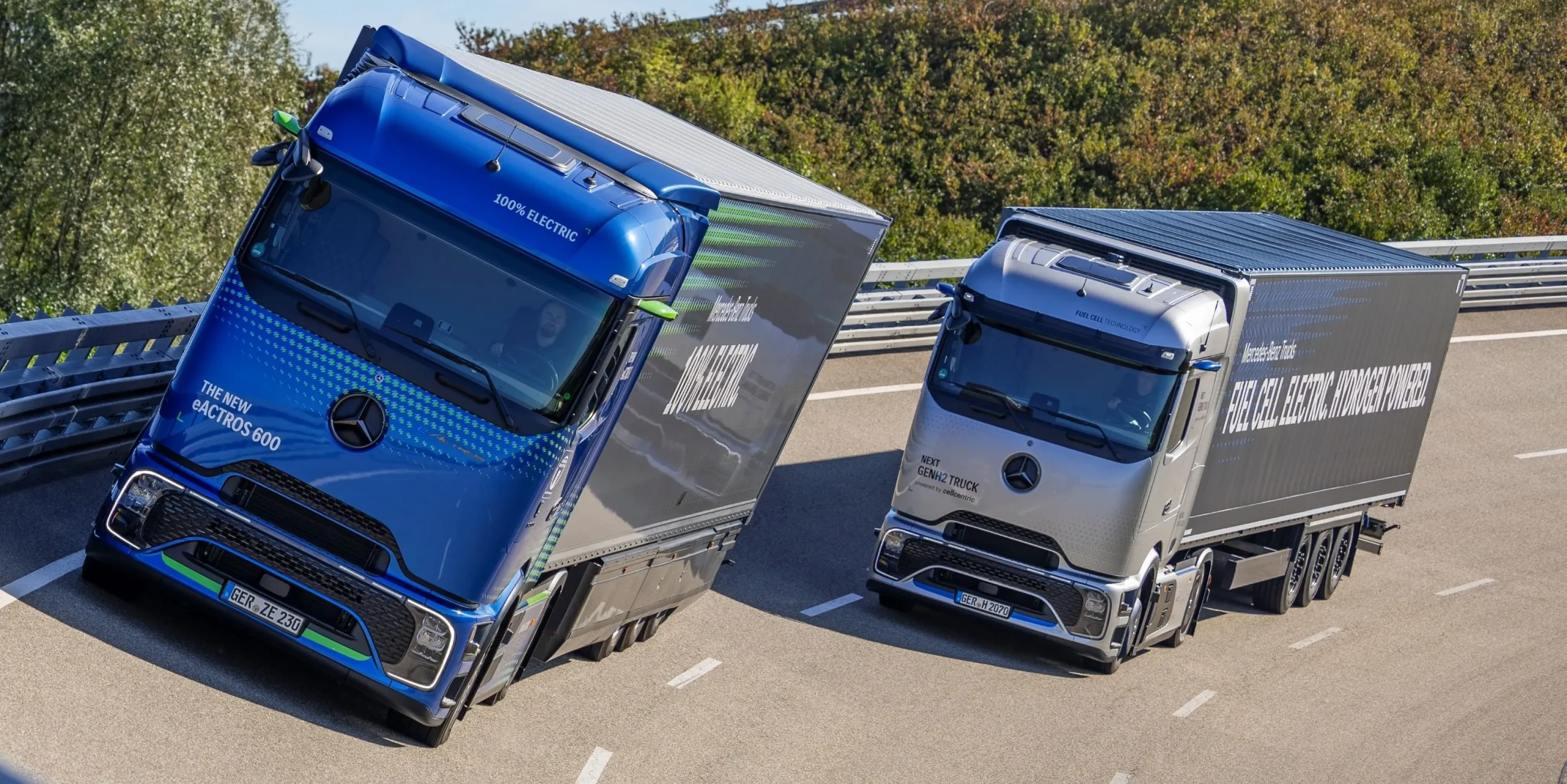
Daimler Truck has highlighted the similarities and differences between its battery-electric eActros 600 and hydrogen-powered NextGenH2 Truck, underscoring the company’s dual-track approach to decarbonizing long-haul freight transport.
While the two trucks share the same in-house developed electric drive axle, they store and replenish energy in fundamentally different ways. The eActros 600 relies on a large 621 kWh lithium-iron-phosphate (LFP) battery pack, while the NextGenH2 Truck uses liquid hydrogen fuel cells supported by a smaller 101 kWh buffer battery.
The battery-electric eActros 600 entered series production in 2024 and is already operating in customer fleets, whereas the hydrogen-powered NextGenH2 Truck remains under development, with small-series deployment scheduled to begin at the end of 2026.
Shared Electric Drivetrain
Despite using different energy sources, both trucks are built around the same Mercedes-Benz Trucks electric drive axle, or eAxle, which integrates electric motors, power electronics and a four-speed transmission into a compact unit positioned between the rear wheels.
The vehicles also share several key components, including the aerodynamically optimized ProCabin, Multimedia Cockpit Interactive 2, high-voltage electrical architecture, and advanced safety systems such as Active Brake Assist 6, Active Sideguard Assist 2 and Front Guard Assist.
According to Daimler Truck, both models deliver the characteristics typically associated with electric vehicles, including instant torque, smooth acceleration, reduced noise levels and regenerative braking.
eActros 600 Built Around High-Capacity Battery System
The eActros 600 derives its name from its battery system, which exceeds 600 kWh of capacity. The truck carries three LFP battery packs rated at 207 kWh each, providing a total installed capacity of 621 kWh.
Daimler Truck says more than 95% of the battery’s capacity is usable, thanks to the chemistry used in the packs. The company also targets a service life of up to 1.2 million kilometres over ten years while maintaining more than 80% battery health.
According to Daimler Truck, the eActros 600 offers a driving range of approximately 500 kilometres on a single charge at a gross combination weight of around 40 tonnes. With intermediate charging during legally required driver breaks, the company says the truck can cover well over 1,000 kilometres during a working day.
The vehicle is designed for a gross combination weight of up to 44 tonnes and can achieve a payload of approximately 22 tonnes in Europe, depending on national regulations.
NextGenH2 Truck Uses Liquid Hydrogen
The NextGenH2 Truck takes a different approach by storing energy in the form of liquid hydrogen cooled to approximately -253°C. Two insulated tanks mounted behind the cab can hold up to 85 kilograms of liquid hydrogen.
Electricity is generated onboard through fuel cell systems that combine hydrogen with oxygen from the atmosphere, producing only water vapour as a by-product. The generated electricity powers the same eAxle used in the battery-electric truck.
The hydrogen-powered truck also incorporates a 101 kWh battery that serves as a buffer system, helping manage power peaks during acceleration, supporting performance on steep gradients and recovering energy during braking.
Daimler Truck states that the NextGenH2 Truck is capable of travelling well beyond 1,000 kilometres on a single refuelling stop. Refuelling is expected to take approximately 10 to 15 minutes, offering operational advantages for long-distance routes where charging infrastructure may be limited.
Different Strengths for Different Applications
Daimler Truck describes the two technologies as complementary rather than competing solutions.
The eActros 600 is positioned for predictable routes where charging can be planned around operations and driver rest periods. The battery-electric model benefits from growing charging infrastructure and is already available in series production.
The NextGenH2 Truck is intended for applications where long driving ranges and rapid refuelling are critical. However, its deployment remains dependent on the development of hydrogen infrastructure, which is still in its early stages.
The company believes that the diversity of freight transport operations requires multiple zero-emission technologies rather than a single solution.
By developing battery-electric and hydrogen-powered trucks in parallel, Daimler Truck aims to address a wide range of transport requirements while supporting the industry’s transition away from fossil fuels.


