
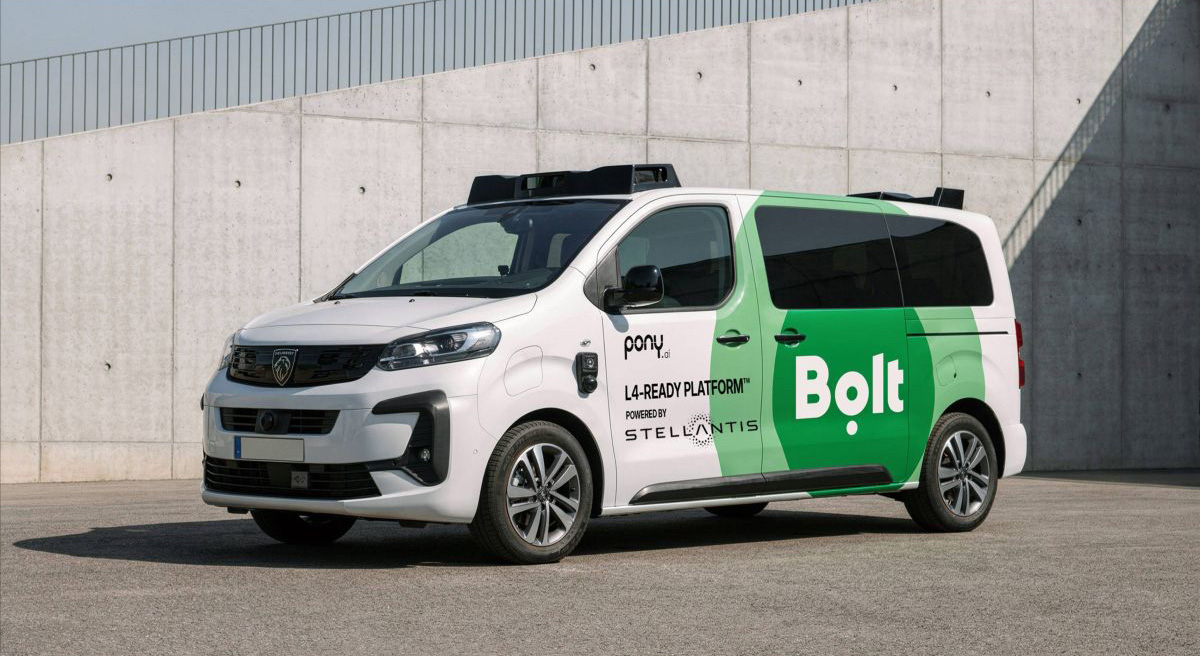
European mobility platform Bolt, autonomous driving technology company Pony.ai, and global automaker Stellantis have announced the launch of an autonomous mobility pilot program in Luxembourg aimed at advancing driverless transportation services in Europe.
The initiative will evaluate the safety, operational performance, and regulatory readiness of Pony.ai’s seventh-generation autonomous vehicle technology within Luxembourg’s public road environment. The testing program will utilize a midsize van built on Stellantis’ L4-Ready Platform™, combining autonomous driving software with production vehicle engineering and manufacturing capabilities.
The partners said they are currently preparing the pilot, which is intended to function as a “living lab” for autonomous mobility services.
Testing Autonomous Ride-Hailing Operations
The pilot will examine a broad range of technologies and operational processes needed to support commercial autonomous mobility services in urban environments.
Areas of focus include vehicle deployment, integration with ride-hailing platforms, fleet management, operational procedures, and coordination with regulatory authorities.
The companies aim to use the program to validate the systems and workflows necessary for future driverless transportation services while assessing how autonomous vehicles interact with real-world traffic conditions in Luxembourg.
The project builds on previously announced collaboration plans between the three companies and is expected to support broader autonomous mobility deployment efforts across Europe.
Combining Expertise Across the Mobility Ecosystem
The pilot brings together capabilities from different parts of the transportation value chain.
Bolt will contribute its ride-hailing platform and marketplace operations expertise, helping to evaluate how autonomous vehicles can be integrated into commercial mobility services.
Stellantis will provide vehicles based on its L4-Ready Platform™ architecture, along with engineering and manufacturing support.
Pony.ai will supply its seventh-generation autonomous driving technology and operational experience gained through autonomous vehicle deployments in multiple markets.
The companies said the objective is to achieve driverless operational readiness by the conclusion of the pilot program.
Bolt’s First Autonomous Mobility Pilot
The Luxembourg project marks Bolt’s first autonomous mobility pilot and represents a significant step in the company’s strategy to explore autonomous transportation services across Europe.
“Autonomous mobility technology is already transforming transportation around the world, and as the only independent, European-founded ride-hailing platform competing globally, we want to be at the forefront of scaling this revolutionary technology in Europe,” said Markus Villig, Founder and CEO of Bolt.
“We welcome Luxembourg’s progressive approach to testing this technology and we are excited to work closely with our European partner Stellantis, and global software leader Pony.ai to launch further pilots in the future.”
Luxembourg Positioned as European Testbed
Pony.ai highlighted Luxembourg’s regulatory framework as an important factor in selecting the country for the pilot.
“Luxembourg’s forward-looking regulatory environment provides a strong foundation for autonomous mobility testing in Europe,” said Dr. James Peng, Founder and CEO of Pony.ai.
“Together with Bolt and Stellantis, we look forward to validating Pony.ai’s technology in local traffic scenarios and supporting the responsible development of autonomous mobility across the region.”
The country has increasingly positioned itself as a hub for mobility innovation, supporting testing programs for emerging transportation technologies.
Stellantis Advances Driverless Strategy
For Stellantis, the pilot forms part of a broader strategy to expand autonomous mobility solutions through partnerships and scalable vehicle platforms.
“Autonomous mobility can make transportation more accessible and affordable for customers,” said Ned Curic, Chief Engineering and Technology Officer at Stellantis.
“At Stellantis, our L4-Ready Platforms™ are designed to deliver flexible, scalable solutions across multiple vehicle segments. By working with partners like Bolt and Pony.ai, we aim to bring driverless mobility into everyday life in a way that is safe, efficient and easy to use.”
The pilot reflects growing industry efforts to move autonomous driving technologies beyond controlled testing environments and toward commercial deployment in urban transportation networks.
If successful, the Luxembourg program could provide a foundation for future autonomous ride-hailing services in European cities, helping the partners evaluate both technical performance and operational requirements before broader deployment.