
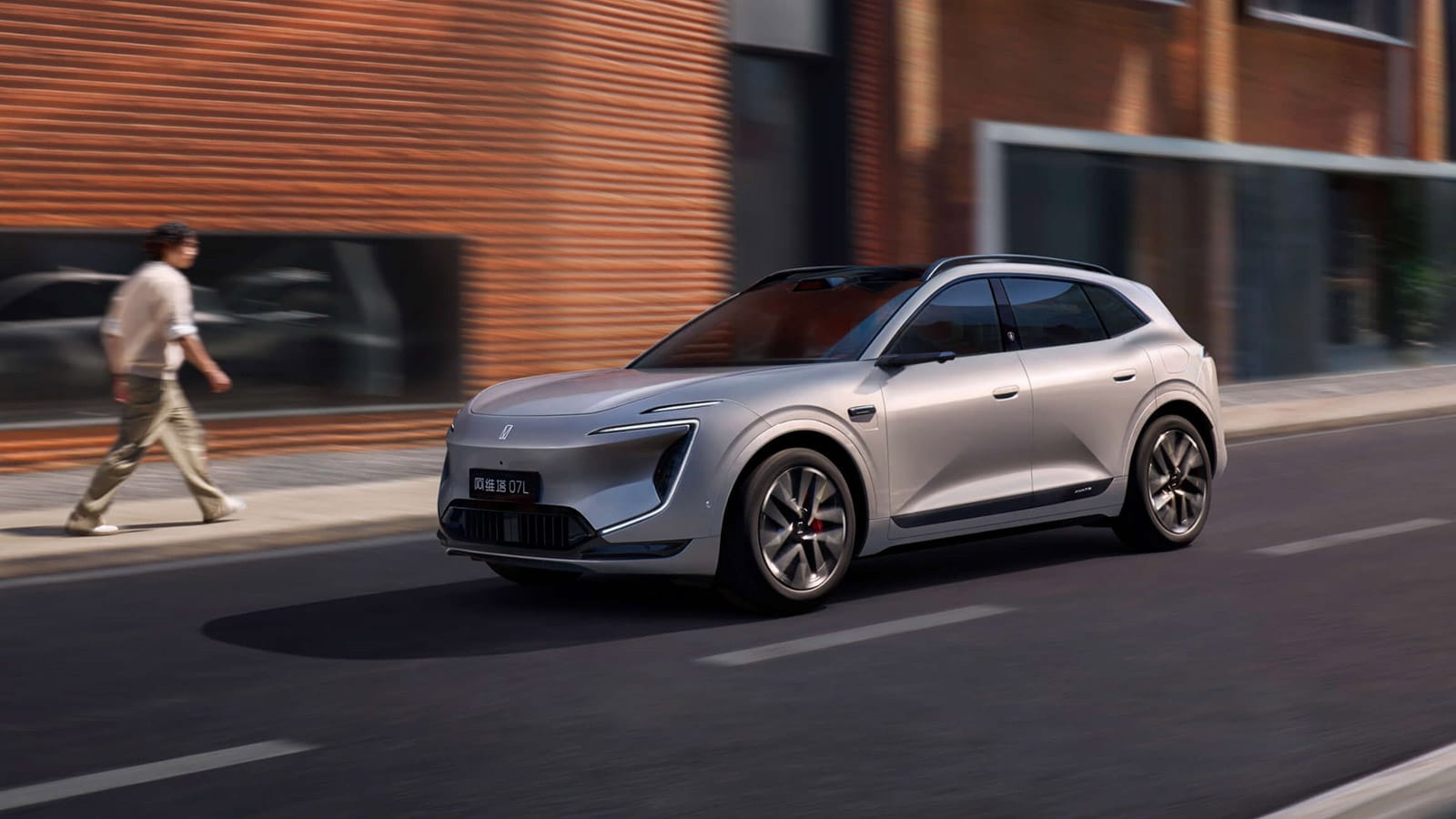
Avatr Technology has launched the five-seat Avatr 07L electric SUV in China, with prices starting at 229,900 yuan ($33,860) as the company looks to expand its presence in the highly competitive premium electric vehicle market.
The new model is available in three versions priced at 229,900 yuan, 249,900 yuan and 279,900 yuan. Limited-time benefit prices reduce those figures to 219,900 yuan, 239,900 yuan and 269,900 yuan, respectively.
The launch follows pre-sales that began on July 17. Avatr added an entry-level Elite all-electric version for the official launch, lowering the starting price by 20,000 yuan compared with the previously announced range.
Longer Wheelbase and Larger Cargo Capacity
The Avatr 07L measures 4,910 mm long, 1,980 mm wide and 1,650 mm tall, with a 2,990 mm wheelbase. The Ultra version has a height of 1,670 mm.
Compared with the existing Avatr 07, the new model is 85 mm longer and has a wheelbase extended by 50 mm. The additional length is designed to provide greater rear-seat space and increased luggage capacity.
The SUV offers a 100-liter front trunk and a 735-liter rear cargo area. Folding the rear seats expands total cargo capacity to 1,645 liters.
Up to 712 kW From Three Electric Motors
The Elite and Max+ versions use a single rear-mounted electric motor producing up to 305 kW, or about 409 hp. Both versions can accelerate from 0 to 100 km/h in 5.9 seconds.
The range-topping Ultra adopts a tri-motor all-wheel-drive configuration with a combined peak output of 712 kW and maximum torque of 996 Nm. It can accelerate from 0 to 100 km/h in 3.7 seconds.
All three variants use an 89.33 kWh CATL Shenxing battery. Depending on configuration, the Avatr 07L offers a CLTC driving range of up to 725 km or 650 km.
The battery supports 5C fast charging, while the vehicle’s 800-volt silicon carbide architecture enables charging from 0% to 80% in 20 minutes. A 30% to 80% charge can be completed in less than 10 minutes.
Huawei Technology Drives Advanced Assistance
Intelligent driving technology remains a major focus of the Avatr 07L. All versions are equipped with Huawei’s Qiankun ADS 5 driver-assistance system and the latest-generation HarmonySpace cockpit.
The Max+ and Ultra variants receive the higher-spec ADS Max system and a roof-mounted 896-channel LiDAR. The Elite version uses the ADS Pro enhanced system with an in-cabin LiDAR sensor.
Avatr says its 896-channel LiDAR is the highest-specification LiDAR currently used in mass production and can detect objects as small as 14 cm from a distance of up to 120 meters.
The SUV is also among the first vehicles to support RCA roaming cruise assist, allowing drivers to activate NCA-assisted driving without first entering a navigation route.
Parking-spot-to-parking-spot navigation assistance is available on the Max+ and Ultra versions, while the Elite does not offer the function.
Smart closed air springs and Avatr’s magic carpet suspension system are also reserved for the two higher-end variants.
Premium Cabin and High-End Hardware
Inside, the Avatr 07L features a 15.6-inch central control display and a 35.4-inch 4K panoramic screen. The cabin also offers a zero-gravity front passenger seat with dual 120-degree semi-reclining positions.
The model is positioned in China’s increasingly competitive 250,000-yuan to 300,000-yuan electric SUV segment. One of its key rivals is the Xiaomi YU7.
Avatr Technology, backed by Changan Automobile, Huawei and CATL, is using the 07L to strengthen its sales momentum. The company sold 35,250 vehicles during the first seven months of 2026, equivalent to an average of about 5,040 vehicles per month.
The existing Avatr 07 will remain available following a lineup adjustment, while the company has confirmed that an extended-range version of the 07L will be introduced later.
The launch also comes as Avatr advances its plans for a Hong Kong listing. The company refiled its Hong Kong initial public offering application at the end of June after its previous prospectus, submitted in November 2025, expired in May following the end of its six-month validity period.