
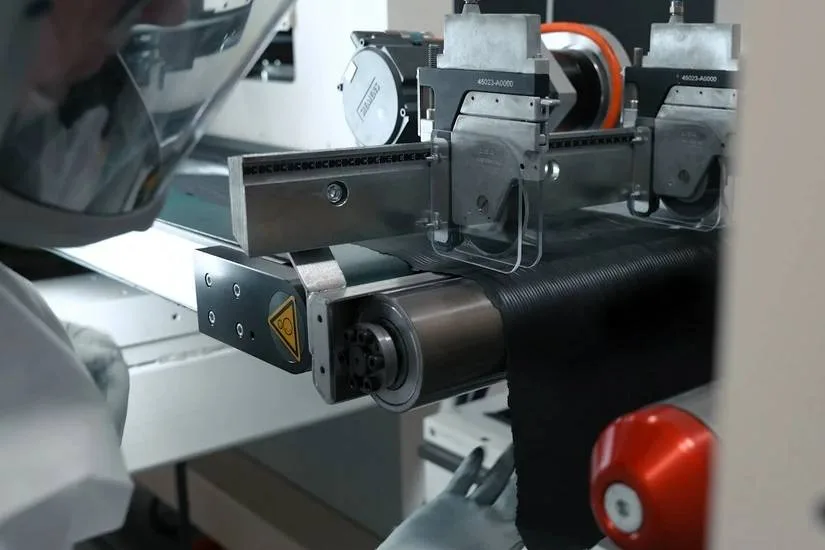
German mechanical and plant engineering specialist Dürr announced that its new dry coating technology for battery electrodes, X.Cellify DC, is now ready for industrial pilot projects. The company says the method significantly reduces active material waste and could transform how lithium-ion and future solid-state batteries are produced.
The X.Cellify DC process eliminates the need for solvents and drying ovens by using a dry powder mixture to create electrodes. This powder is pressed into a self-supporting film using the Activated Dry Electrode process developed by Dürr’s partner, LiCAP Technologies. The process covers all steps — from dosing and film formation to densification and lamination — enabling a fully dry manufacturing cycle. According to Dürr, the system can reduce production space by up to 65% and energy consumption by as much as 70%.
See also: Dürr and Grob Unveil Advanced Lithium-Ion Battery Cell Concept Factory at Battery Show Europe
The proof-of-concept line in Chassieu, France, has confirmed the technology’s reliability and scalability. The method forms a dry film through horizontal calender rollers before compressing it to the desired density and layering it onto collector foils. Since the carrier foil is only required in the final step, it can be reused in the process, minimising material waste.
Bernhard Bruhn, Vice President of Dürr’s Global Business Unit LIB, said the achievement marks a “major step forward” for the company. “We have demonstrated that the new kind of dry coating with free-standing film works reliably and delivers consistently good quality,” he said. Dürr is now seeking industrial partners for gigawatt-scale pilot projects across electric mobility and stationary storage applications.
See also: Dürr Unveils Enhanced GigaCoater for Cost-Effective Battery Cell Electrode Production
Dry coating has emerged as a key focus for automakers and battery producers aiming to reduce manufacturing costs and environmental impact. Volkswagen’s battery subsidiary PowerCo introduced its own dry coating process in 2023 with plans for commercialisation by 2026, while Tesla is also developing similar technology to streamline its next-generation cell production.