



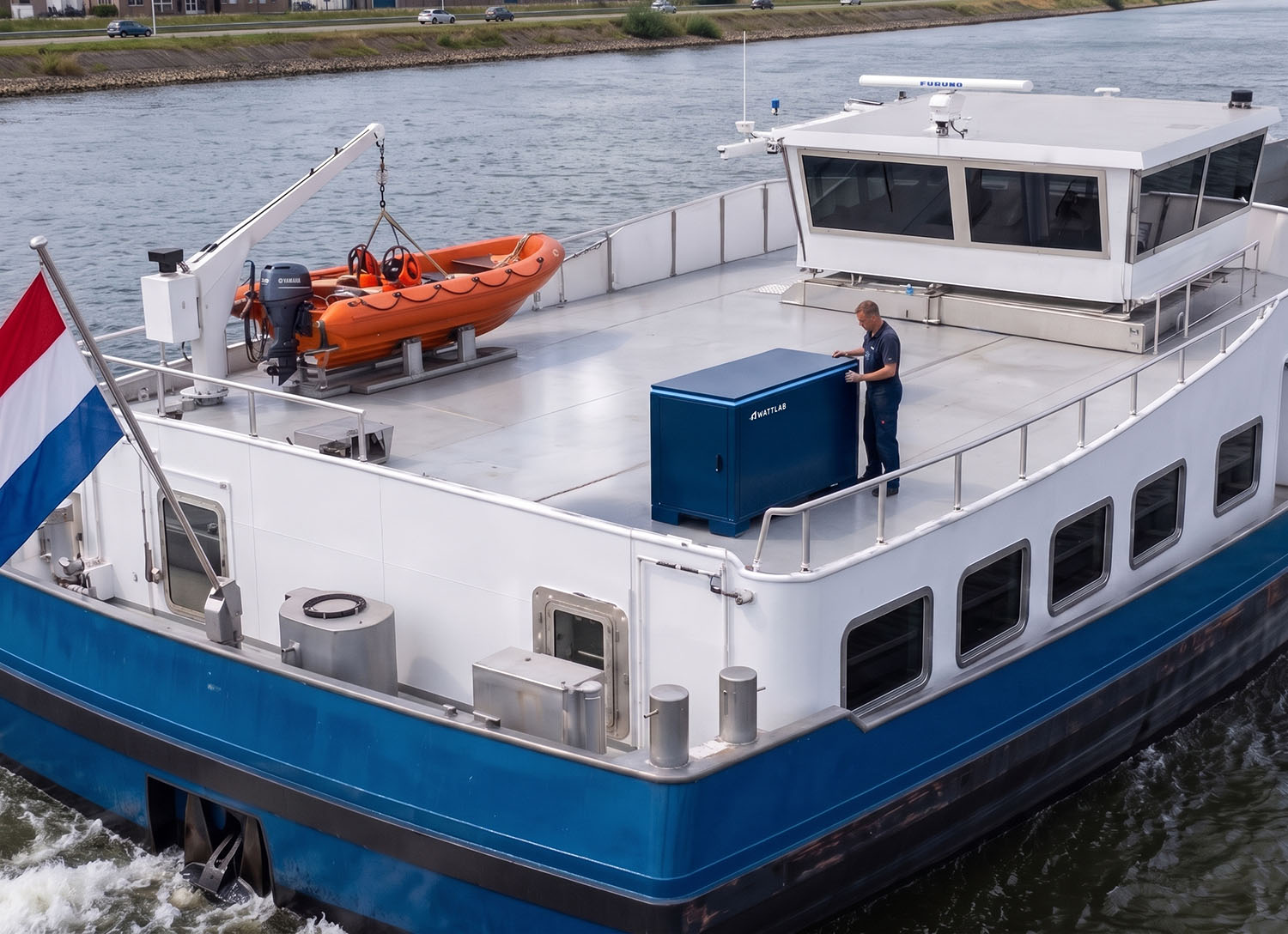
Dutch maritime technology company Wattlab has introduced WEstack, a standardized battery system designed for inland shipping vessels, as the company seeks to simplify the adoption of battery technology and support emissions reduction efforts in the sector.
The Rotterdam-based company said the system can be installed onboard within a single working day, significantly reducing the installation time typically associated with marine battery projects.
Wattlab said WEstack is intended to address two of the main barriers to battery adoption in inland shipping: high installation costs and lengthy integration processes.
Designed for Faster Installation
Unlike many marine battery systems that are custom-built and require weeks of onboard installation work, WEstack is assembled and tested at Wattlab’s facilities before delivery.
Once delivered, the system only needs to be connected onboard, allowing installation to be completed in approximately one day, according to the company.
WEstack is available in four standardized configurations with capacities of 100 kWh, 200 kWh, 300 kWh and 400 kWh.
The company said the standardized design helps reduce manufacturing complexity, shorten delivery times and lower costs compared with tailor-made battery systems.
Reducing Generator Use
Wattlab said the system is designed to improve the efficiency of diesel-powered vessels by reducing reliance on generators operating at low loads.
“Generators on vessels operate most of the time at only 10 to 15 percent of their capacity,” said Bo Salet, founder and chief executive officer of Wattlab.
“That is extremely inefficient. At low loads, a generator consumes relatively large amounts of fuel. By adding a battery pack, the generator can charge the battery at its optimal operating point, after which the battery supplies power to the vessel.”
According to the company, integrating battery storage can reduce generator operating hours by as much as 80% to 90%.
Fuel Savings and Emissions Reduction
Wattlab said lower generator usage can lead to fuel savings, reduced maintenance requirements and lower carbon dioxide emissions.
The company also noted that battery-powered operation can improve onboard conditions by reducing noise, vibration and exhaust emissions.
The system is designed for installation on the aft deck and can be used in both new vessel construction projects and retrofits.
According to Wattlab, WEstack is suitable for a wide range of inland and coastal vessels, including cargo ships, tankers and smaller coastal transport vessels.
Supporting Future Port Requirements
The company believes battery systems could play a growing role as ports and regulators increasingly focus on reducing emissions and noise from shipping operations.
“More and more ports want to reduce emissions and noise pollution,” said Salet.
“With a battery system, vessels can operate silently and emission-free for much longer periods without relying on shore power.”
Focus on Energy Efficiency
Founded in 2017, Wattlab initially focused on solar energy systems for maritime applications and has deployed solar installations on inland shipping vessels.
The company is also developing Solar Flatrack solutions for seagoing vessels.
Salet said improving energy efficiency remains one of the most practical approaches for reducing emissions in the maritime sector.
“Alternative fuels are likely to remain scarce and expensive for the foreseeable future,” he said.
“That is why we believe energy efficiency is the fastest and most cost-effective route to reducing emissions in the sector.”
The launch comes as the shipping industry explores a range of technologies, including batteries, alternative fuels and hybrid propulsion systems, to meet increasingly stringent environmental requirements and decarbonization targets.