


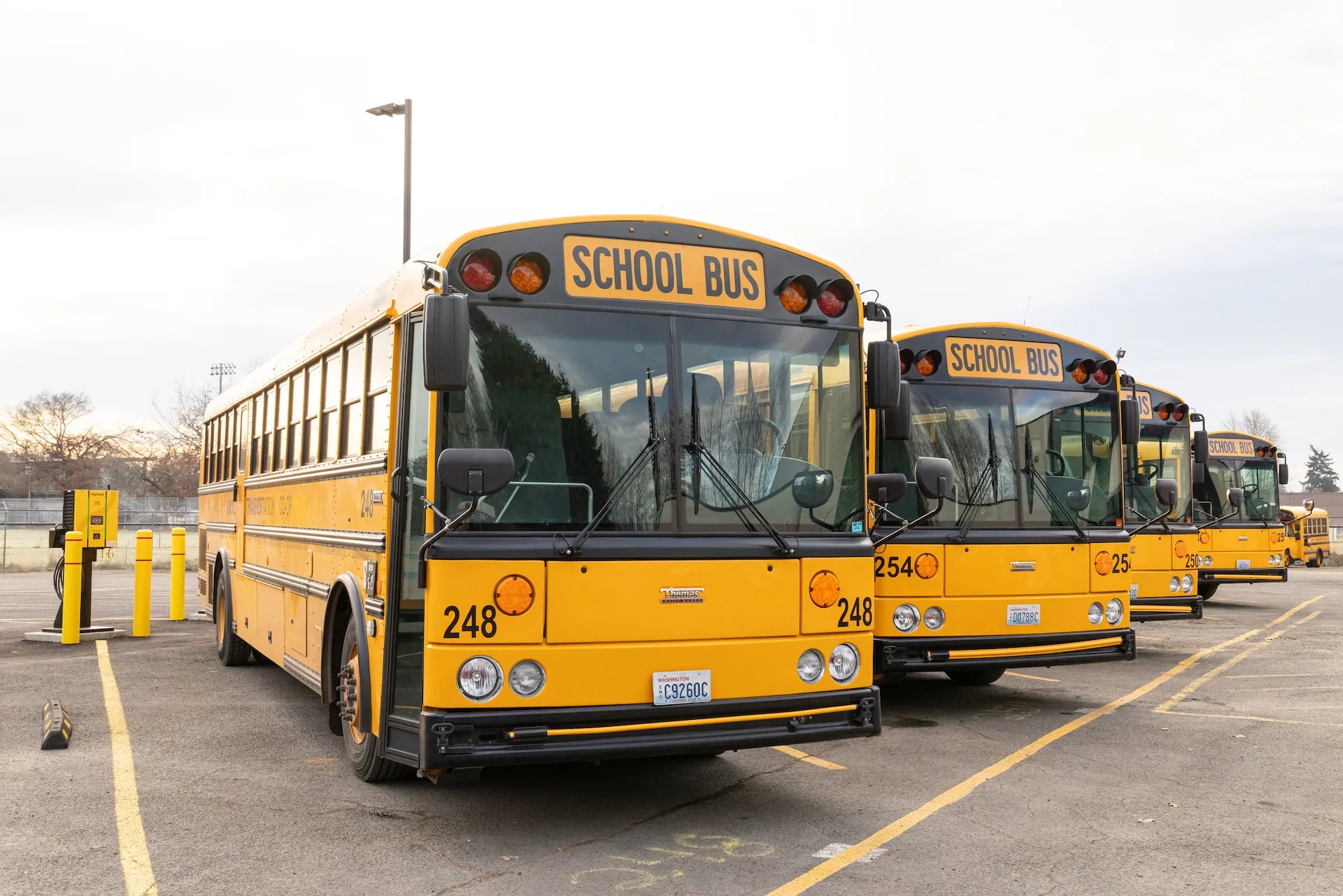
KWRL Transportation Cooperative has placed 14 electric school buses into service across four school districts in Washington state, marking one of the region’s larger coordinated deployments of zero-emission student transportation, project partners said.
The buses, Thomas Built Jouley battery-electric models supplied through a regional dealer network, are now operating in the Kalama, Woodland, Ridgefield and La Center school districts. KWRL will manage the fleet from depots in Woodland and Ridgefield, where 16 Zerova 30-kilowatt chargers have been installed to support daily operations.
See also: Zenobē Partners to Electrify Copiague School Bus Fleet in New York
The electric buses are expected to transport between 1,000 and 1,200 students each day, covering roughly 700 miles across the four districts. Woodland Public Schools and KWRL estimate the project will deliver about $400,000 in total operational savings, including roughly $200,000 per year from lower diesel fuel and maintenance costs.
The deployment is supported by Highland Electric Fleets, which is providing vehicles, charging infrastructure and ongoing fleet support under its Electrification-as-a-Service model. The approach allows school districts to adopt electric buses without directly owning or managing the full scope of charging and maintenance infrastructure.
See also: InspireNOLA Deploys 42 Electric School Buses, Replacing Diesel Fleet in New Orleans Area
“This project is a testament to the power of partnership,” said Shannon Barnett, transportation director at KWRL. “Moving this venture from the application phase to daily operations was a shared endeavor, and it simply would not have been possible without the collaboration of our dedicated partners.”
Funding for the project came from multiple public sources. The U.S. Environmental Protection Agency awarded $2.8 million through its Clean School Bus Rebate Program, while nearly $3.0 million was provided by the Washington Department of Ecology to support vehicle purchases and infrastructure. Clark Public Utilities contributed an additional $300,000 toward charging infrastructure at the Ridgefield depot.
See also: New Jersey Awards Nearly $32 Million for Electric School Buses and Public Charging Projects
Highland Electric Fleets said the transition to electric buses offers both operational and health benefits. Chief Executive Duncan McIntyre said replacing diesel buses reduces student exposure to exhaust emissions and can lower the risk of pediatric asthma, while also providing quieter operation along school routes.
KWRL Transportation Cooperative provides shared transportation, maintenance and administrative services to participating districts, a model encouraged by Washington state to help smaller and rural school systems achieve cost efficiencies. The cooperative said the electric bus program is expected to serve as a foundation for further fleet electrification in the region.


