





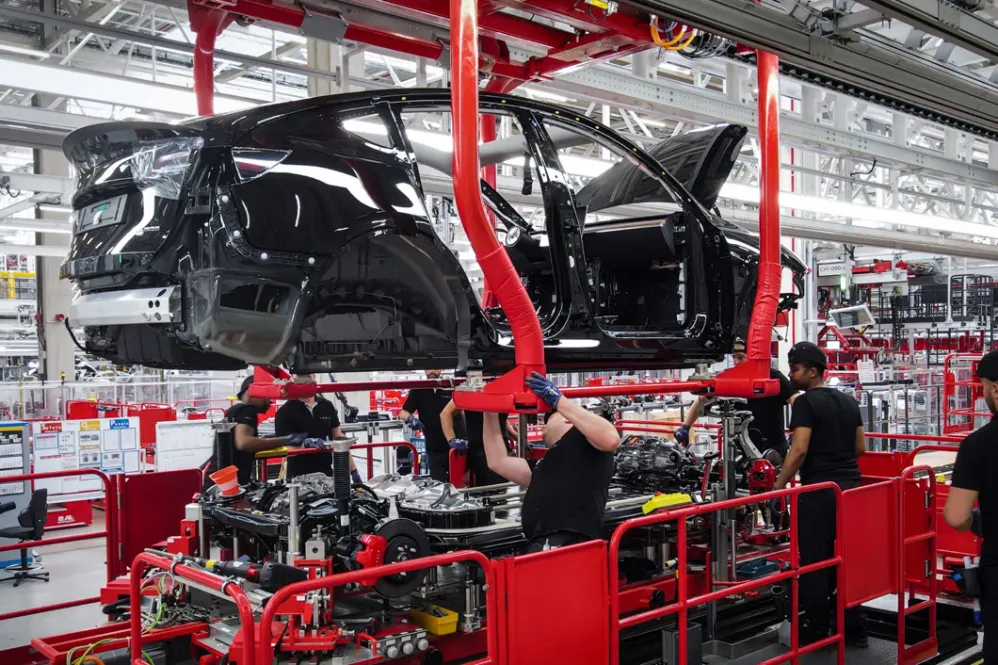
Tesla said on Wednesday it has not significantly reduced its workforce at its Berlin-area factory, pushing back against a German media report that claimed a sharp decline in staffing at the site.
In an emailed statement cited by Reuters, Tesla said there has been no meaningful change in the number of permanent employees at the Grünheide plant compared with last year and that the company has no plans to cut headcount. “Compared to 2024, there has been no significant reduction in the number of permanent staff. Nor are there any such plans,” the company said.
See also: Musk Warns of Slow Initial Ramp for Tesla Cybercab and Optimus Production
The statement followed a report by the German business daily Handelsblatt, which said Tesla’s workforce at the factory had fallen by about 1,700 employees, or roughly 14%, since 2024. Handelsblatt cited internal documents related to upcoming works council elections that showed current employment of 10,703 people, compared with 12,415 at the time of the previous union election two years earlier.
Tesla disputed that interpretation, saying overall operations at the plant have remained stable. “The message from factory management remains: the situation and outlook at the gigafactory are stable – especially with regard to employee jobs,” the company said.
See also: Tesla Targets Nine-Month Design Cycle for Custom AI Chips, Musk Says
The automaker added that some degree of workforce fluctuation is typical at a relatively young factory, noting that demand for temporary workers has declined as the site moved beyond its initial production ramp-up into a more stable operating phase.
Giga Berlin, which opened in March 2022, produces only the Model Y and supplies around 30 markets across Europe and beyond, including Canada. Tesla said it is preparing to increase production at the plant in 2026 after steadily ramping output through 2025.
Plant manager André Thierig has said production rose quarter by quarter last year, with the factory now building more than 5,000 Model Y vehicles per week, equivalent to about 250,000 units annually. Tesla also expects new German electric vehicle incentives in 2026 to support demand and plans deeper localisation, including battery cell production in Germany with up to 8 gigawatt-hours of annual capacity starting in 2027.


