



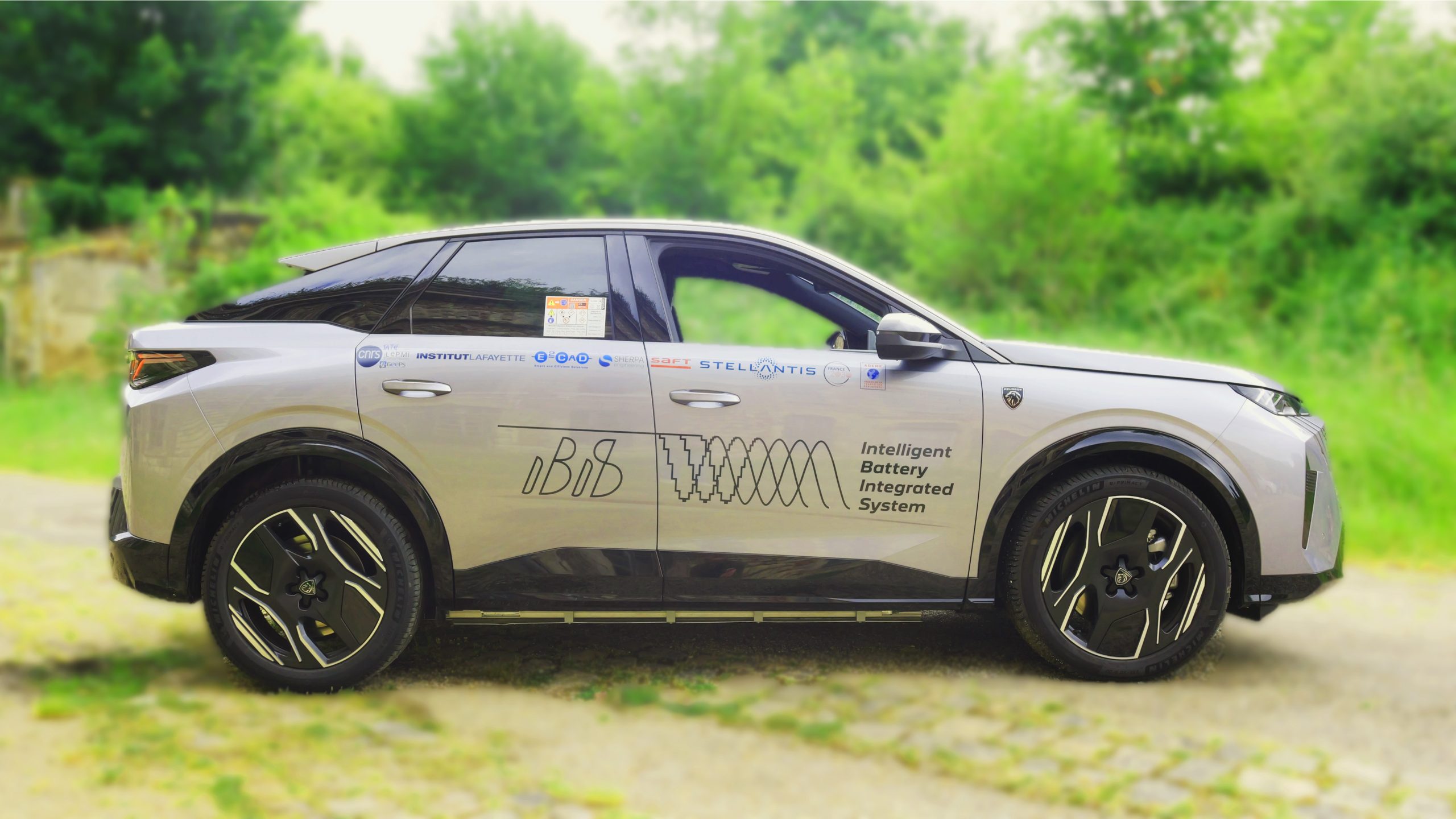
Stellantis, in partnership with Saft, a subsidiary of TotalEnergies, has unveiled an electric vehicle prototype featuring an advanced battery system that integrates inverter and charger functions directly into the pack. The Intelligent Battery Integrated System (IBIS) is designed to deliver faster charging, reduced weight, and improved efficiency, the automaker said on Friday.
The French-based collaborative research project aims to develop a more efficient and cost-effective energy storage and conversion system for both mobile and stationary applications. Road testing is underway in a Peugeot e-3008 built on Stellantis’ STLA Medium platform, following years of design, modeling and simulation supported by E2-CAD, Sherpa Engineering, and French research institutions including CNRS, Université Paris-Saclay and Institut Lafayette.

Stellantis said the system improves efficiency by up to 10% and power output by about 15% without increasing battery size. It reduces vehicle weight by around 40 kg, frees up to 17 liters of space, and cuts charging times by roughly 15%. The company added that maintenance is simplified and second-life reuse of batteries is more feasible due to fewer reconditioning requirements.
“This project reflects our belief that simplification is innovation. By rethinking and simplifying the electric powertrain architecture, we are making it lighter, more efficient, and more cost-effective,” said Ned Curic, Chief Engineering and Technology Officer at Stellantis.
Hervé Amossé, Executive Vice President Energy Storage Systems at Saft, said: “The IBIS project is a powerful testament to Saft’s innovation leadership. By embedding IBIS technology into our next-generation applications, we’re unlocking a new era of intelligent, flexible, and sustainable energy solutions.”
An initial IBIS demonstrator for stationary use has been in operation since mid-2022, validating technical concepts and securing patents. The shift to a mobile prototype marks a new phase, with broader real-world testing beginning in June 2025 under France’s “France 2030” program. Stellantis said the IBIS could be integrated into production vehicles by the end of the decade.
Beyond automotive applications, the technology could extend to sectors such as rail, aerospace, marine and data centers, underscoring its potential role in a wider electrification strategy.


