



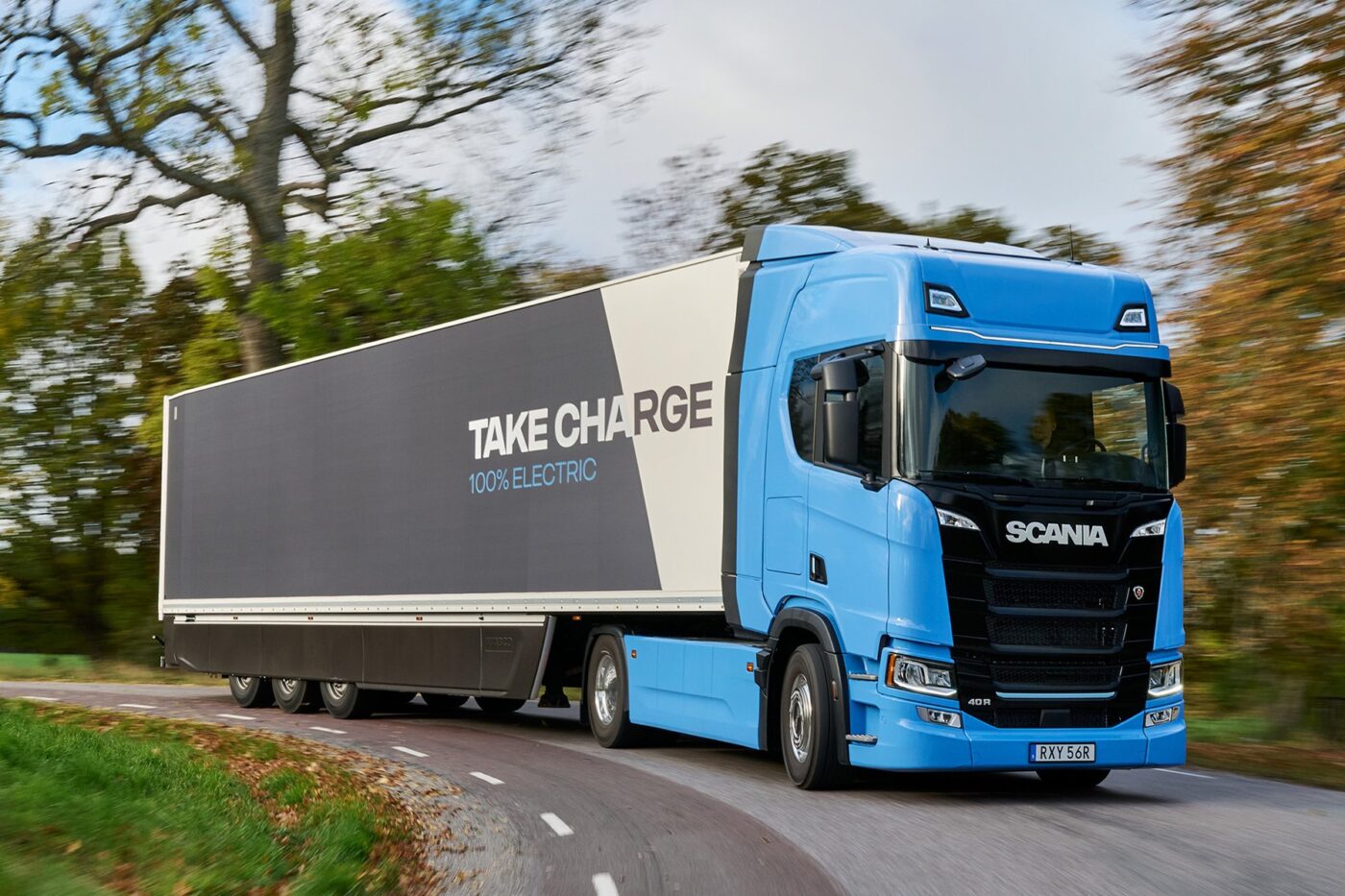
Scania has begun offering a new battery configuration for its battery-electric trucks that adds a seventh battery pack beneath the driver’s cab, increasing energy capacity and enabling driving ranges that can exceed 800 kilometres in certain applications.
The Swedish manufacturer also confirmed that its Megawatt Charging System (MCS) option, first announced in 2025, is now available for customers to order, marking another step in the company’s electrification strategy for heavy-duty transport.
The latest development follows changes to Scania’s battery sourcing plans. The company had originally intended to use battery cells from Northvolt and target energy capacities of up to 728 kWh. Following Northvolt’s insolvency, however, Scania shifted to battery technology supplied by sister company MAN.
The battery packs are assembled by MAN at its Nuremberg facility and feature nickel-manganese-cobalt (NMC) chemistry. Each battery pack provides a gross capacity of 89 kWh and a usable capacity of 80 kWh.
Until now, Scania’s electric truck range has been limited to a maximum of six battery packs, delivering up to 534 kWh gross capacity or 480 kWh usable capacity. Vehicles equipped with six battery packs have typically been quoted with driving ranges of around 500 kilometres, depending on vehicle specification, payload and operating conditions.
Scania has now confirmed the availability of new five-pack and seven-pack configurations, offering net battery capacities of 400 kWh and 560 kWh respectively. The additional battery pack is installed beneath the cab, allowing operators to increase energy storage without significantly affecting vehicle versatility.
The company said the largest battery configuration can deliver ranges “well beyond 800 km on a single charge” in some operating scenarios.
However, Scania did not specify the test methodology used to determine the range figures. Similar claims recently published by sister company MAN for its electric trucks were based on internally calculated maximum values achieved under favorable operating conditions rather than certified testing procedures.
Scania emphasized that the new battery arrangements are designed to help fleet operators balance range requirements and payload capacity more effectively.
For the 400 kWh version, the company said the truck can achieve a range of approximately 350 kilometres while maintaining maximum legal payload limits. Under European Union regulations, battery-electric trucks are permitted an additional two tonnes of gross vehicle weight compared with diesel-powered vehicles.
The manufacturer said the flexible battery layout also allows the vehicles to accommodate a wide variety of body types and transport applications.
“With the right battery set-up, MCS and a good charging strategy […] our customers can easily solve the range versus payload question,” said Tobias Ejderhamn, Global Manager of Transformation & New Business at Scania.
Scania said the introduction of both the new battery module and MCS charging capability broadens the options available to operators transitioning to electric transport.
“Scania can now offer transport operators a comprehensive path to electrification and sustainable transport; one that is reliable, seamless, and commercially viable,” said Lars Gustafsson, Head of Solutions Management at Scania.
“With these two new additions to customers’ armoury it has become even easier and more attractive to make the change to electric transport,” Gustafsson added.
Alongside the product announcements, Scania recently demonstrated bidirectional charging using the MCS standard. During testing, one of the company’s battery-electric trucks supplied electricity back to the grid at up to 1,000 amperes and 750 kW.
The company said the demonstration showed how electric trucks could play a broader role in energy management beyond transportation.
“Electric trucks will not only consume electricity, they can also become an active resource in the energy system,” Ejderhamn said.
“This shift transforms the fleet operator’s role from solely providing transport services to also offering energy flexibility,” he added.
According to Scania, the tested system enables real-time communication between the vehicle, charging infrastructure and energy management platforms, allowing charging and discharging operations to be adjusted dynamically according to grid conditions and transport schedules.
Yorben Muller, Product Manager Charging at Traton, said the demonstration represents an important step for integrating heavy-duty electric vehicles into future energy systems.
“What makes this significant is not only the bi-directional energy flow itself, but the ability to combine megawatt charging with intelligent energy management,” Muller said.
“To our knowledge, this is one of the world’s first demonstrations of vehicle-to-grid functionality using MCS for heavy commercial vehicles. The truck, charger and energy system can communicate with each other in real time, creating the foundation for heavy electric vehicles to become active and controllable assets in the energy system,” he added.
The demonstration follows a separate vehicle-to-grid trial conducted by MAN through the SPIRIT-E project, which recently achieved 325 kW of grid feed-in power using the CCS charging standard rather than MCS.
As truck manufacturers continue to develop higher-capacity batteries and faster charging technologies, the industry is increasingly focusing on enabling long-distance electric freight transport while also exploring opportunities for commercial vehicles to support electricity grid stability.


