
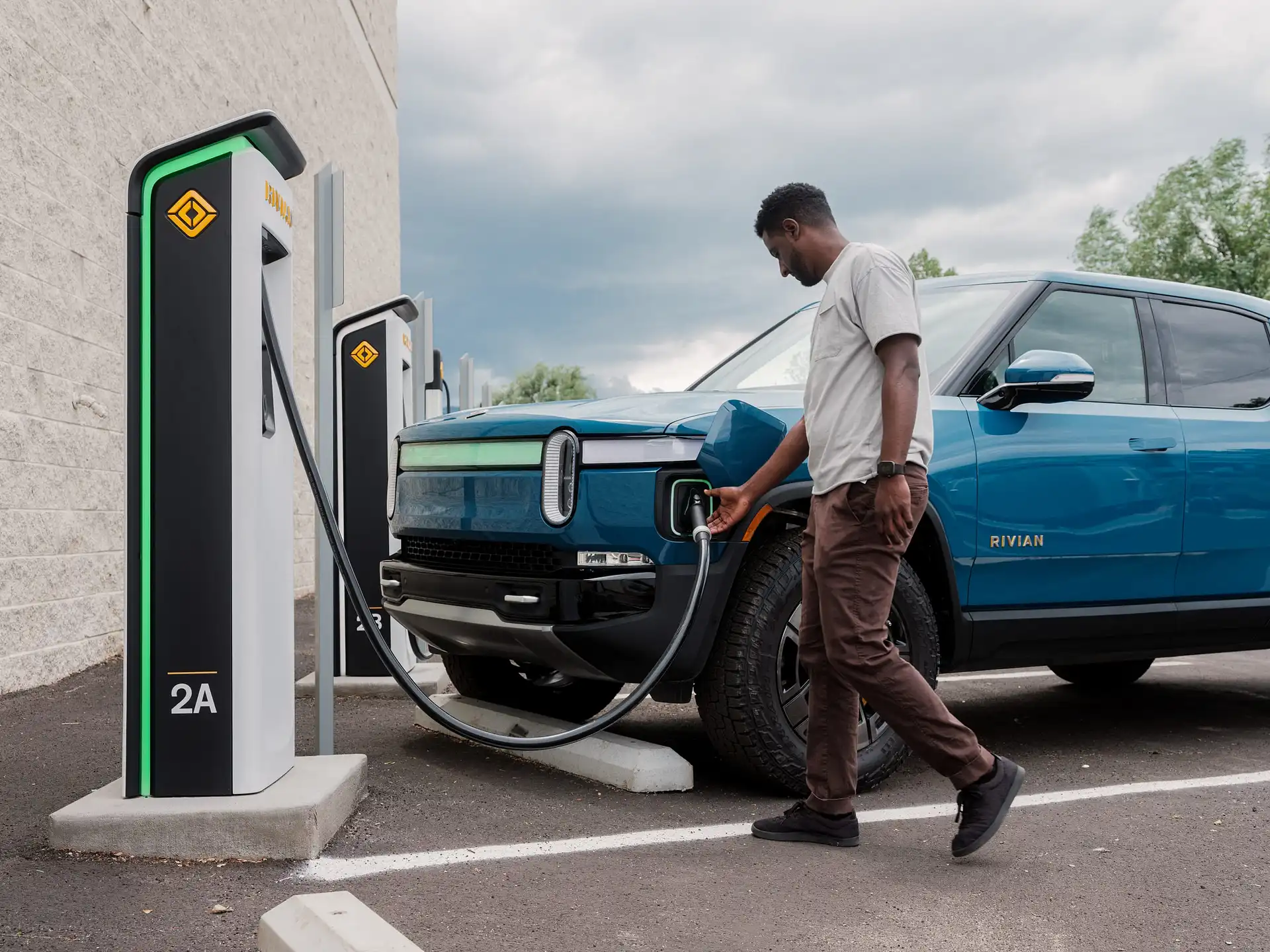
Rivian Chief Executive RJ Scaringe said the electric vehicle maker is working to develop batteries that can charge faster without sacrificing driving range or durability, as consumer demand for more convenient charging grows.
Speaking on the Plugged-In Podcast, Scaringe said the company’s battery research aims to reduce charging times while maintaining energy density. “We try to find the right balance on those. But we’re increasingly focusing on fast charging without losing energy density as we’ve known it thus far,” he said.
The Rivian CEO noted that quicker charging can often undermine long-term battery performance. “We can fast-charge really quickly, but you kill the durability of the cell,” he said. “Over the course of, let’s say, 1,000 charge cycles, you could lose 20, 25% of the original capacity of the cell.”
Chinese automakers, including BYD, have unveiled vehicles capable of charging at significantly higher rates, but many of those models have limited range. Scaringe said Rivian is pursuing chemistry adjustments such as silicon anodes and new packaging methods to improve both performance and cost efficiency.
For example, Rivian’s upcoming R2 crossover will use larger single-layer battery cells that also serve as a structural part of the vehicle. Scaringe said this design has cut “a tremendous amount of cost out,” as overhead components that don’t add energy value are reduced.
On solid-state technology, which has been widely touted as a breakthrough, Scaringe struck a cautious tone. “I think there’s a lot of noise in solid state around commercial readiness that’s maybe an exaggeration of reality,” he said, adding that mass production remains the key hurdle.
Rivian continues to rely on the two dominant chemistries in the EV market: high-nickel cells and lithium-iron phosphate (LFP). While LFP has gained traction in China and Europe for its lower cost and resilience, Scaringe said U.S. adoption will likely remain low. “The United States, because of our trade relationships with China, has very, very low LFP penetration,” he said. “I think it will likely stay low in the United States, unless we see a shift in trade policy.”