
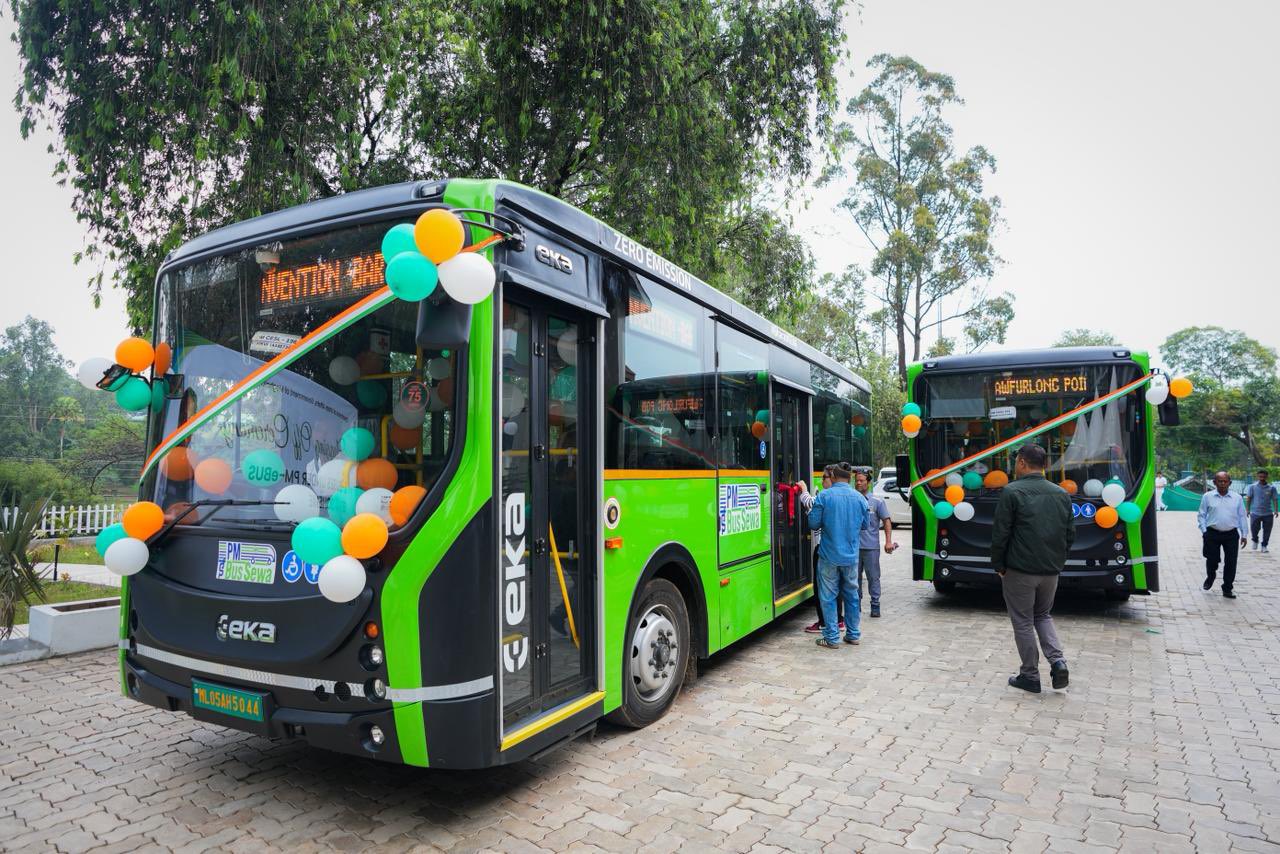
The northeastern Indian state of Meghalaya has introduced its first fleet of electric buses in the capital city of Shillong, marking a significant step toward cleaner public transportation and reduced urban congestion.
Five battery-electric buses supplied by Pune-based manufacturer EKA Mobility have entered service in Shillong under the Indian government’s PM e-Bus Sewa Scheme. The deployment represents the first use of electric buses in the hill city, a major tourist destination in Northeast India.
State officials said the initiative is intended to encourage greater use of public transport while reducing dependence on private vehicles.
EKA Mobility Supplies Seven-Metre Electric Buses
The newly deployed fleet consists of EKA Mobility’s EKA 7M electric bus model, a compact seven-metre vehicle designed for urban and regional transit operations.
The bus measures 6,950 mm in length, 2.19 metres in width and 2.8 metres in height, with a wheelbase of 4.3 metres.
According to local reports, the vehicles operating in Shillong feature a 2×2 seating configuration accommodating 22 passengers.
The EKA 7M is powered by a 124 kW electric motor and equipped with a 100 kWh lithium iron phosphate (LFP) battery pack.
EKA Mobility rates the vehicle for a driving range of approximately 160 kilometres per charge, although local reports indicate the buses may achieve between 180 and 200 kilometres under operating conditions in Shillong.
The buses are also equipped with air conditioning, air suspension and foldable accessibility ramps to improve passenger comfort and accessibility.
Supporting Sustainable Urban Mobility
The electric buses have been introduced under the PM e-Bus Sewa Scheme, a nationwide initiative aimed at accelerating the adoption of electric public transportation across India.
Meghalaya Chief Minister Conrad K. Sangma said the project forms part of broader efforts to improve mobility in Shillong.
“The ultimate objective of this entire exercise is to determine how we can decongest Shillong and encourage people to use public transportation instead of relying on private vehicles.”
Shillong has experienced increasing traffic congestion in recent years due to rapid urban growth and rising vehicle ownership.
Officials believe expanding public transportation options will help reduce pressure on the city’s road network while lowering emissions.
Part of a Nationwide Electric Bus Program
The PM e-Bus Sewa Scheme aims to deploy 10,000 electric buses across 169 cities throughout India.
Under the program, the central government provides operational support of 20 rupees per kilometre for seven-metre electric buses for up to ten years or until March 2037.
The scheme also offers substantial financial assistance for charging infrastructure and depot development.
For hilly state capitals such as Shillong, the government provides up to 100% support for behind-the-meter power infrastructure and up to 90% support for civil depot infrastructure until March 2027.
Expanding Electrified Public Transport
The launch of electric bus services in Meghalaya reflects a broader trend across India, where cities are increasingly adopting battery-electric buses to reduce emissions, improve air quality and modernize public transport fleets.
As one of the first northeastern states to introduce electric buses under the PM e-Bus Sewa Scheme, Meghalaya is expected to use the initial deployment to evaluate operational performance and passenger response before considering larger-scale fleet expansion.
The introduction of the five EKA Mobility buses represents an early step in the state’s transition toward cleaner and more sustainable urban transportation.