
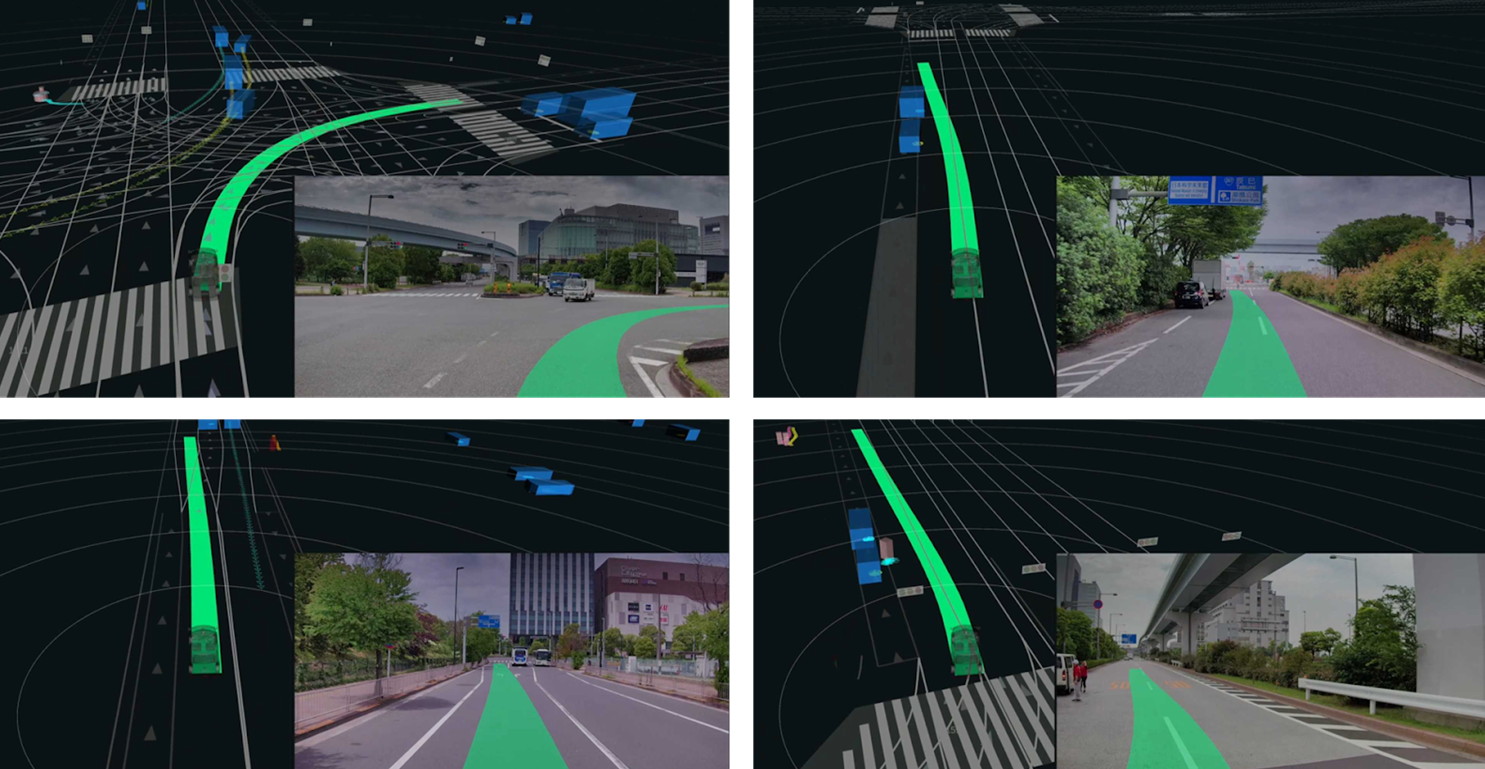
TIER IV, a Japanese developer specializing in open-source autonomous driving systems, has unveiled a new end-to-end architecture designed to enable Level 4 and beyond autonomous capabilities. The company plans to begin large-scale demonstrations of the technology in early 2026 across 50 locations in Japan, aiming to evaluate its performance in real-world mobility services.
The newly developed system combines machine learning based on diffusion models with traditional rule-based components. This hybrid architecture allows the vehicle to perform sequential driving tasks, such as object prediction and trajectory generation, while mimicking human-like driving behavior in complex scenarios. The approach is intended to improve the system’s adaptability and safety when navigating unpredictable environments.
To support the development process, TIER IV is using its open-source Autoware platform and advanced simulation environments. These tools enable the automatic generation of synthetic training data, which is combined with real-world driving information to build scalable and high-performing models. The software architecture will be publicly available through Autoware, furthering the company’s open-source mission.
Looking ahead, TIER IV plans to expand its dataset, refine its AI models, and apply the technology to a wide range of use cases, including private passenger vehicles and commercial fleets. The company sees Level 4+ autonomy as a potential solution to regional transportation issues and broader societal challenges, including labor shortages and urban-rural mobility gaps.