
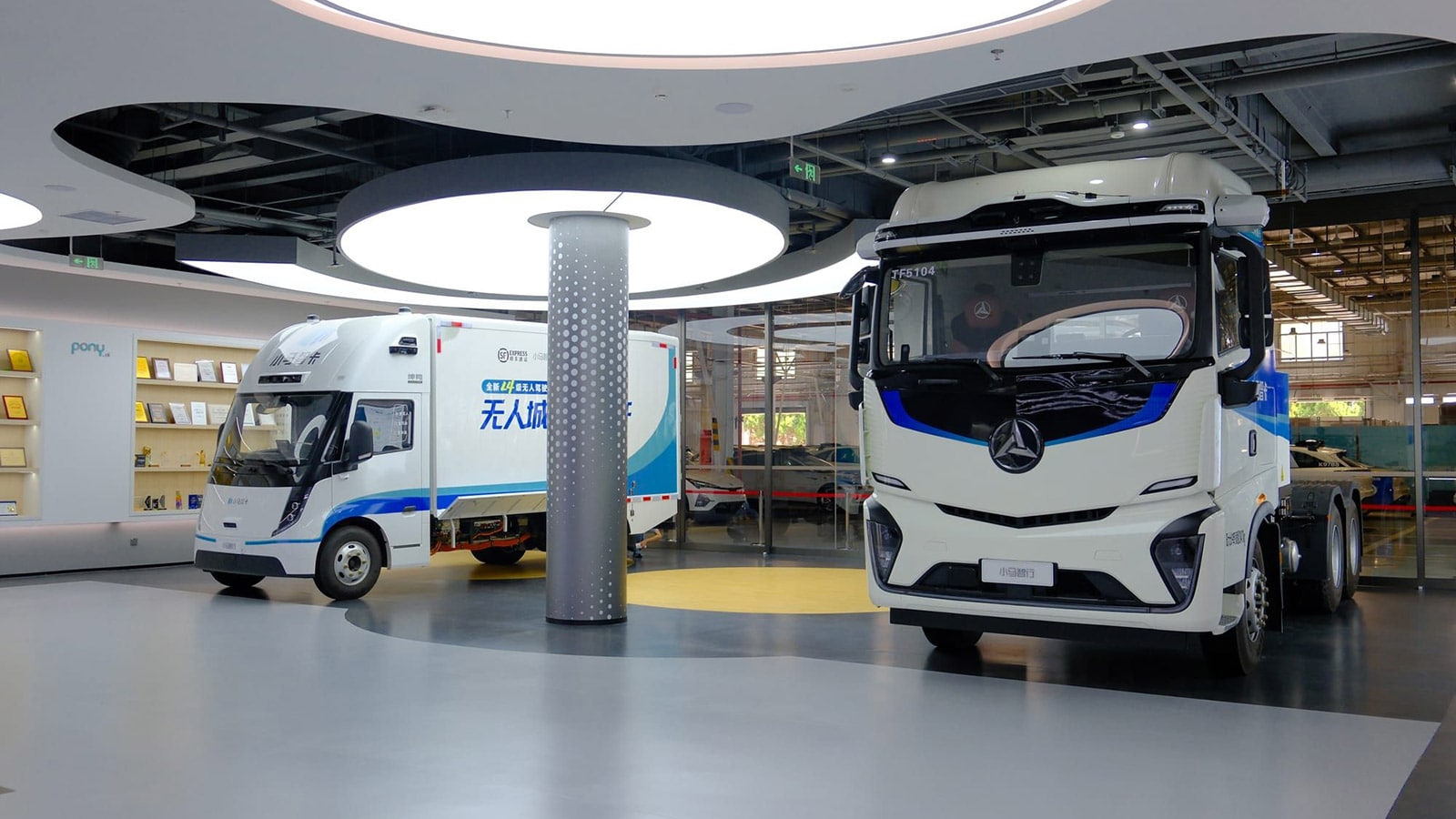
Pony AI plans to deploy between 500 and 1,000 fourth-generation (Gen-4) autonomous heavy-duty trucks in China over the next two to three years as the company moves toward larger-scale commercial operations.
The Chinese autonomous driving company will initially focus the robotruck programme on long-haul freight, bulk commodity transportation and port logistics, He Xing, Pony AI’s vice president and head of its robotruck business, said at a media briefing on Aug. 3.
The company is pursuing a larger long-term target for lighter vehicles, aiming to deploy 100,000 Level 4 (L4) autonomous light-duty trucks by 2030.
Gen-4 Trucks Move Into Production
Pony AI entered autonomous trucking in 2018 with largely hand-built prototype vehicles. Subsequent generations have increasingly incorporated automotive-grade components and manufacturing processes through partnerships with established truck manufacturers.
The company said lower hardware costs have been a key factor behind its decision to expand deployment. Hardware costs for the Gen-4 heavy truck are about 70% below those of the previous generation, while the vehicle is designed to operate for up to 20,000 hours or 1 million kilometres.
“We had been waiting for the right moment,” He said. “Our truck technology had already reached a high level, but the cost of building an L4 robotruck remained high.”
Pony AI’s trucking operations have already moved beyond technology testing. By November 2025, the company was operating about 200 autonomous trucks and had transported more than 1 billion ton-kilometres of freight.
Robotruck revenue reached $10.2 million in the first quarter of 2026, an increase of 31% from a year earlier, with growth driven mainly by expanding commercial operations.
Gen-4 heavy trucks are now entering production and are expected to be delivered in batches for commercial deployment across multiple applications.
Shenzhen’s Mawan Port is among the first planned deployment locations. Pony AI has secured a project at the port and expects to introduce dozens of Gen-4 trucks into commercial service.
Light-Duty Trucks Set Longer-Term Goal
Pony AI is also developing autonomous light-duty trucks for a different segment of the logistics market.
These vehicles are intended to transport goods between distribution centres, retail locations, delivery outlets and cold-chain facilities, where operating conditions overlap with the urban environments already served by the company’s robotaxis.
Pony AI introduced its first L4 autonomous light-duty truck in April 2026. The vehicle was developed with CATL and uses the battery manufacturer’s Kunshi Chassis Platform, offering around 18 cubic metres of cargo capacity.
Initial vehicles have entered extensive road testing with logistics partners, covering applications such as express deliveries, retail distribution and food and beverage cold-chain transportation.
Pony AI estimates that fully driverless light-duty trucks could reduce operating costs per kilometre by 40% to 50% compared with conventional human-driven operations under its current operating assumptions.
The company said the vehicle can carry 2.6 times the cargo volume of typical low-speed autonomous delivery vehicles while travelling at speeds suitable for normal urban and intercity roads.
Shared Technology Supports Scaling
Pony AI’s broader autonomous vehicle strategy centres on using its Virtual Driver technology across robotaxis, heavy trucks and light-duty trucks.
The light-duty truck shares its core technology stack with the company’s seventh-generation robotaxi. Pony AI said the two platforms can also share charging facilities, ground-support infrastructure, service centres, fleet-management systems and remote-assistance capabilities.
The company estimates that technological and operational synergies between the two platforms exceed 90%.
Heavy-duty trucks require additional vehicle-specific adaptations because of their larger dimensions, greater weight, mechanical configurations and longer braking distances.
Pony AI uses operational data from different vehicle platforms within a common development cycle. Its PonyWorld 2.0 world model is designed to identify shortcomings in the Virtual Driver system and guide targeted data collection and development.
“Autonomous driving has to progress step by step — from technology driving product development, to the product enabling a business model, and ultimately to that model reshaping the industry,” He said.
Partnerships Support Commercial Deployment
Pony AI is relying on partnerships with vehicle manufacturers and logistics companies to accelerate commercialisation.
Gen-4 heavy trucks have been developed with manufacturers including Sany Truck, while the light-duty truck programme was developed with CATL. Pony AI also works with Sinotrans on long-haul freight and urban logistics applications.
The company is also evaluating international opportunities for autonomous trucks, particularly at ports and other controlled logistics environments.