
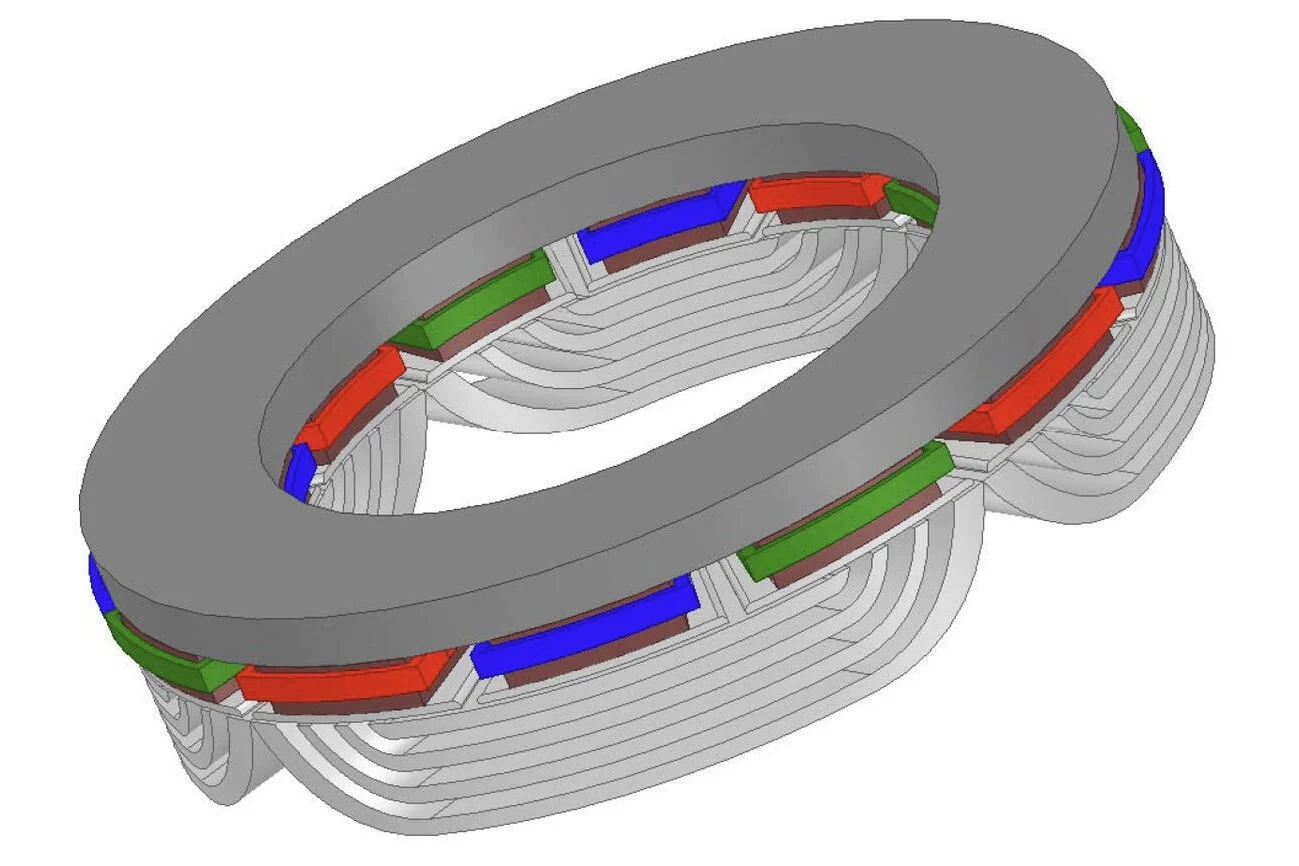
A consortium of German research institutions has launched a project to develop a magnet-free electric motor designed to reduce reliance on rare-earth materials while maintaining high torque density and efficiency.
The initiative, known as NAFTech—short for “Sustainable Axial-Flux Machines Considering Tolerance-Affected Manufacturing Technologies”—is funded by the German government and brings together experts from RWTH Aachen University, the University of Stuttgart and Friedrich-Alexander-Universität Erlangen-Nürnberg.
See also: RWTH Aachen-Led Project Tests Delamination Methods for Direct Battery Recycling
The project involves the Production Engineering of E-Mobility Components (PEM) at RWTH Aachen, the Institute for Electrical Energy Conversion (iew) at the University of Stuttgart, and the Chair of Manufacturing Automation and Production Systems (FAPS) at FAU Erlangen. It began at the start of 2025 and is scheduled to run until the end of 2027.
The primary objective is to develop an electric motor without rare-earth elements that still delivers high torque density, strong efficiency and a compact design. Current axial-flux machines meet many of these performance criteria but typically depend on rare-earth magnets, which are described by PEM as “those cost-intensive and increasingly scarce resources.”
See also: RWTH Aachen Tests Hybrid Bus-Cable Car Prototype in upBUS Mobility Project
While radial-flux synchronous reluctance machines (RF-SynRM) avoid rare-earth magnets, they involve trade-offs. According to PEM, “this entails compromises in terms of installation space and torque density.” The NAFTech consortium is therefore focusing on an axial-flux synchronous reluctance machine (AF-SynRM), intended to combine the benefits of both axial- and radial-flux concepts.
“Axial flow machines are currently characterized by relatively low production volumes, manufacturing processes that are not yet fully developed, and special requirements in terms of tolerances and design processes,” said Professor Achim Kampker, Head of PEM at RWTH Aachen.
See also: RWTH Aachen Completes SeLv Project on Modular Electric Trucks With Fuel Cell Extenders
To address these challenges, the project adopts what the partners describe as an integrated approach covering topology, multi-domain machine design and production methods. Data-driven optimisation of tolerance chains will support development, and specially constructed partial demonstrators will be used to validate simulated designs and assess manufacturing feasibility.
The researchers say the AF-SynRM concept could offer economic advantages, particularly for small and medium-sized enterprises (SMEs), by stabilising production costs and reducing exposure to volatile rare-earth prices. “A magnet-free motor reduces material costs by up to 50 percent, which can strengthen the competitiveness of SMEs and lower barriers to market entry,” Kampker said.
See also: RWTH Aachen Researchers Complete Project on Faster, Lower-Cost Battery Production
He added that regulatory requirements and efforts to cut carbon dioxide emissions are increasing pressure to develop more sustainable drive technologies. The consortium said early investment in magnet-free motor concepts could help companies gain a competitive edge in growing electrification markets.