




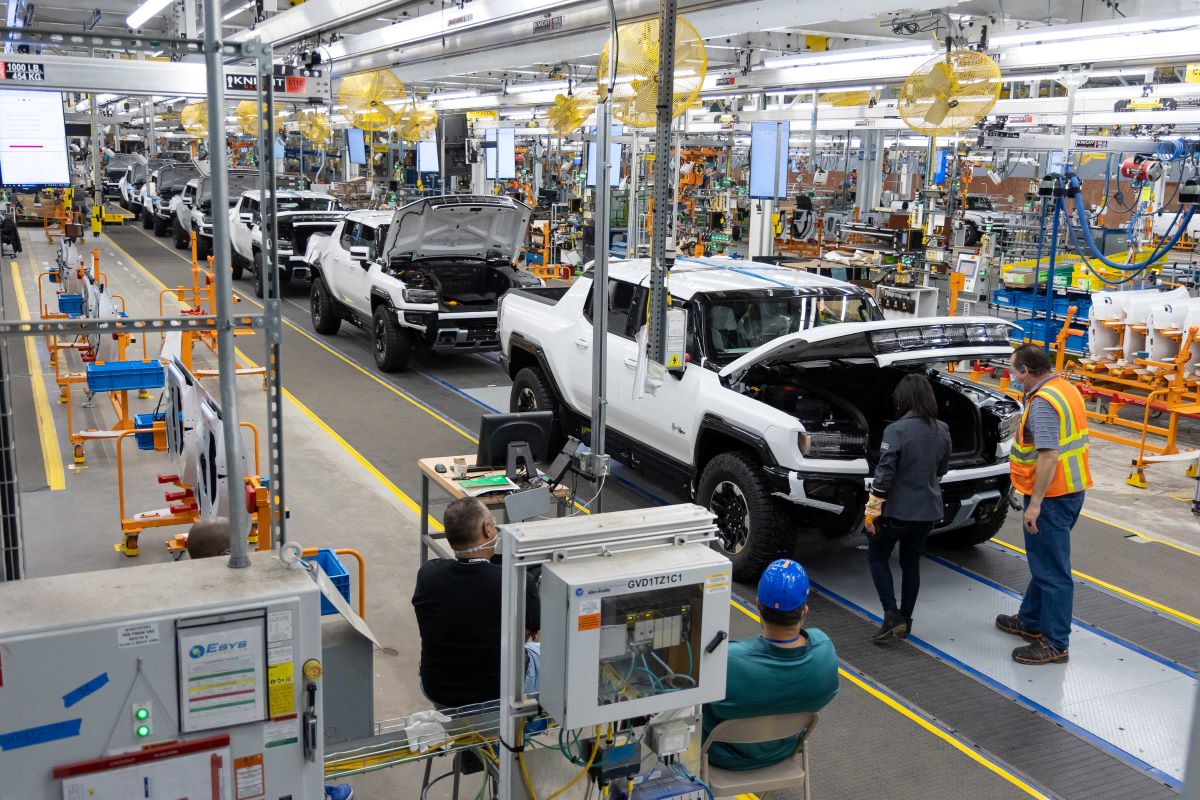
General Motors has placed about 5,500 employees on temporary or indefinite leave as it scales back electric vehicle (EV) production across several U.S. plants following the expiration of a key federal tax credit.
The company said the decision comes as part of “temporary adjustments to production to align to market dynamics,” after the U.S. government ended the $7,500 EV tax credit in September. GM had already announced in September that it would slow output of the GMC Hummer EV and Cadillac Escalade IQ at its Factory Zero plant in Detroit-Hamtramck, initially planning to suspend two shifts for just over a month.
See also: General Motors Eyes Faster EV Development as Chinese Automakers Set the Pace
According to Bloomberg, around 3,400 employees at Factory Zero have been affected, with only 1,200 expected to return to work. “The remaining 2,200 will be furloughed indefinitely,” the report said.
In addition, about 710 workers have been laid off at GM’s Spring Hill plant in Tennessee, where the company builds the Cadillac Lyriq and Vistiq. Production there will be reduced through the first half of 2026, and the facility will temporarily close for one week in both October and November.
The automaker also reduced staffing at its Ultium battery plant in Ohio, where 1,400 workers were impacted. GM spokesperson Kevin Kelly said that 850 employees will be recalled, while “the remaining 550 layoffs are indefinite.”
See also: General Motors to End BrightDrop Van Production at Ontario Plant Amid Weak Demand
Earlier reports suggested that GM’s Fairfax plant near Kansas City, where production of the next-generation Chevrolet Bolt is slated to begin later this year, has also been affected, with plans for a second shift now postponed “indefinitely.”
The production cutbacks underscore a broader deceleration in GM’s electric vehicle rollout. While the company had recorded steady EV sales growth before the tax credit expired on September 30, waning demand and shifting market conditions have prompted a reassessment of output targets.
See also: General Motors Lifts Full-Year Outlook, Trims Tariff Impact After Solid Q3 Results
In response, GM has moved toward a more diversified product strategy, increasing investment in both electric and internal combustion engine vehicles. The automaker said it will invest around $4 billion over the next two years to expand U.S. production capacity, particularly at plants in Michigan, Kansas, and Tennessee.
GM said the initiative aims to boost total output to more than two million vehicles per year, though it has not specified how production will be divided between EVs and traditional models.