



A research team at Fraunhofer IZM has developed a compact high-efficiency inverter for Mitsubishi Heavy Industries that delivers 500 kilowatts of output while occupying a volume of just one litre.
According to the researchers, the inverter achieves an efficiency of 99% and was designed to reduce both size and production costs compared with existing high-performance systems used in electric drivetrains.
The project was led by Wiljan Vermeer and the Power Electronic Systems group at Fraunhofer IZM, which focuses on power electronics and microintegration technologies.
See also: Fraunhofer-Led Difference Project Targets Improved Recycling of Cell-To-Pack Batteries
Inverters are critical components in electric vehicles because they regulate energy flow between the battery and electric motor, directly affecting efficiency and vehicle performance.
Fraunhofer IZM said the new inverter architecture relies on four main design innovations.
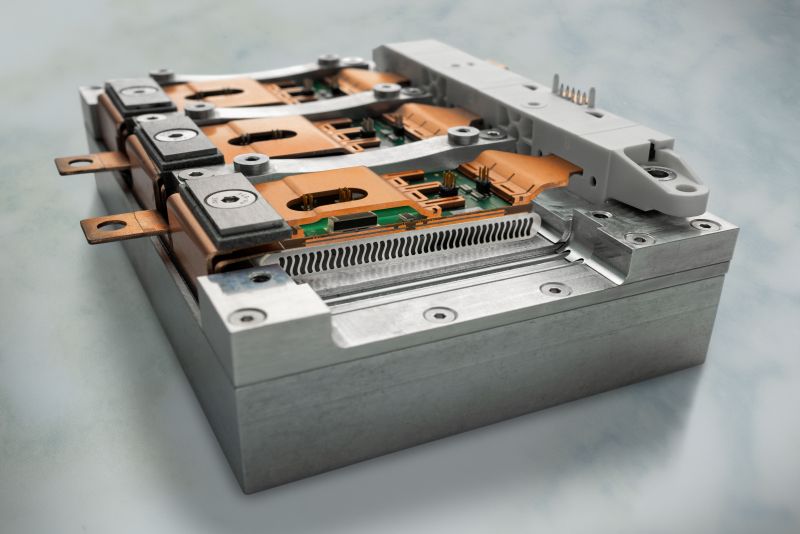
The first involves embedded power modules using silicon carbide semiconductors. Each module contains twelve SiC MOSFET switches integrated directly into the printed circuit board to minimise size and electromagnetic losses.
The inverter uses three such modules, one for each phase of the system.
See also: Fraunhofer Develops Electrochemical Method To Recover Battery Materials
“The end result is highly compact modules with an extremely small electromagnetic footprint,” Fraunhofer IZM said. “Their effective inductance is just one nanohenry – low enough to not limit the switching speed and allow switching at the MOSFETs’ limit, with 63 volts per nanosecond.”
The institute said faster switching speeds reduce energy losses and lower cooling requirements.
The second design feature involves flat aluminium cooling units produced through an extrusion process. The cooling system uses more than 40 thin fins to improve heat exchange while maintaining a compact profile and reducing manufacturing costs.
See also: Fraunhofer-Led Project Unveils High-Efficiency Megawatt Charging System
The third innovation is the use of laser welding instead of conventional screw connections for the electrical busbars.
“The contacts of the busbars were formed just so that we could laser-weld them directly onto the circuit board,” Wiljan Vermeer, project leader at Fraunhofer IZM, said in a statement.
“That means we could get rid of screws that would not only eat up valuable space but increase inductance as well,” Vermeer added.
The fourth technical element concerns the DC-link capacitors developed with PolyCharge.
See also: Fraunhofer ILT Highlights Role of Laser Technology in Scaling Solid-State Battery Production
Fraunhofer IZM said the NanoLam capacitors were specially configured and arranged alongside the busbars to achieve total inductance of only two nanohenries while maintaining a capacitance of 300 microfarads.
The research team added that the capacitor system was designed to manage thermal loads efficiently despite high power density.
“With its combination of innovative power electronics, capacitors, and cooling systems, the inverter takes 800-volt drive technology to a new level,” the researchers stated.
See also: Fraunhofer Launches Battery Recycling Project With Industry Partners
Fraunhofer IZM said the inverter’s 500-kW output exceeds many existing alternatives by a factor of five and surpasses previous state-of-the-art systems by roughly 2.5 times.
The prototype will be presented publicly by Vermeer at the PCIM Europe trade fair in Nuremberg from June 9 to June 11, 2026.