
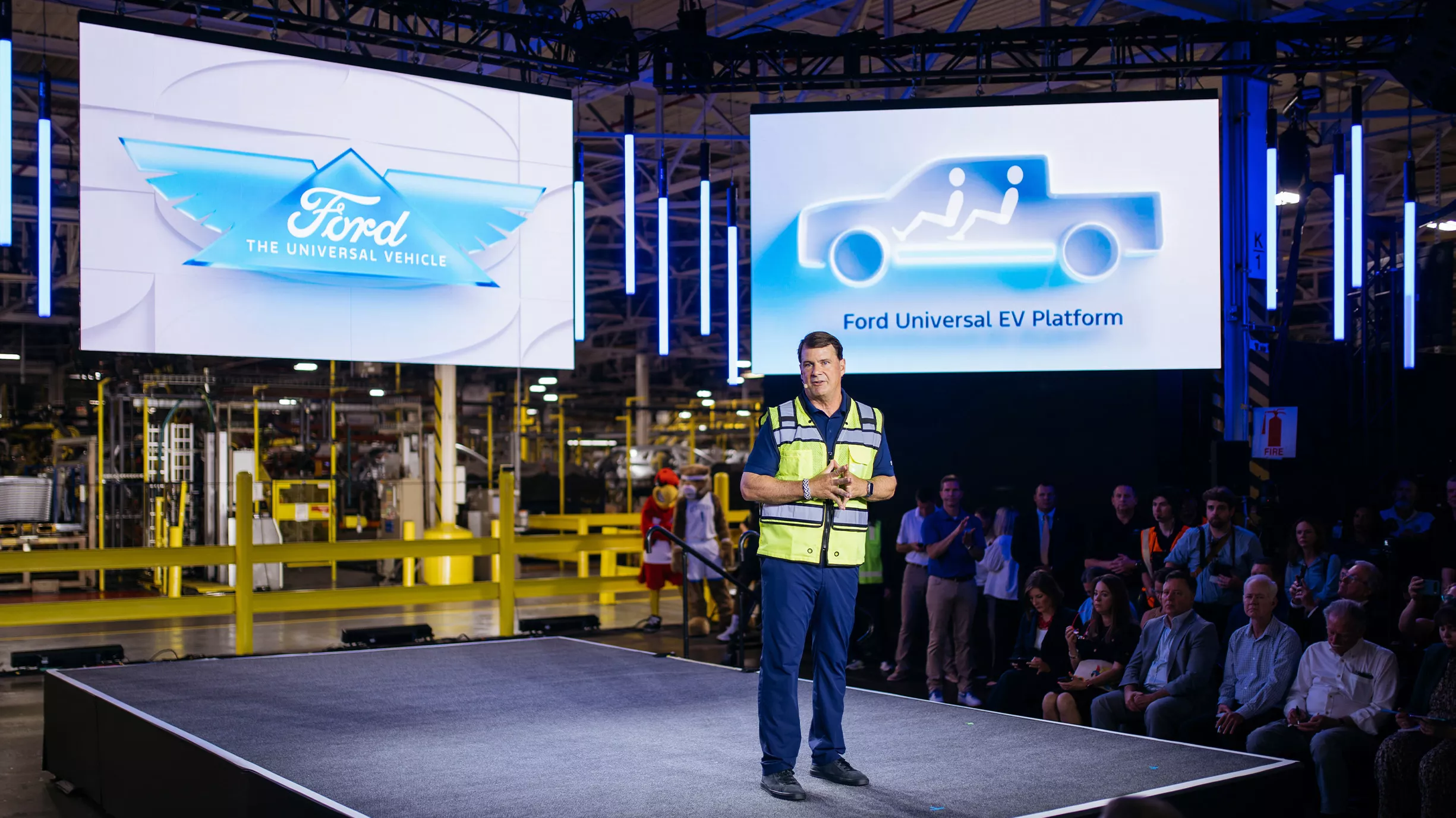
Ford Motor’s secretive “skunkworks” electric vehicle platform project is progressing well, with supply chain work completed and prototype vehicles already operating on Ford-developed software, Chief Executive Jim Farley said in an interview, underscoring the company’s push to reset its electric vehicle strategy.
Speaking to InsideEVs on the sidelines of the Detroit Auto Show, Farley compared the Universal EV (UEV) platform to the United States’ space race-era programs. “This is literally like the Apollo or Gemini mission within Ford,” he said. “A uniquely American, high-risk project… it’s one of the most challenging projects I’ve ever been involved in.”
See also: Ford Motor Targets 2028 Launch for Level 3 Hands- and Eyes-Off Driving System
Announced last year, the UEV platform is designed to underpin a new generation of lower-cost electric vehicles capable of competing with Chinese automakers on both technology and pricing. Ford has said the platform will debut in 2027 with a Kentucky-built electric pickup truck priced at about $30,000, with up to seven additional variants expected to follow.
Farley said major preparatory work has already been completed. “All the parts are quoted and designed, and now we’re deeply into retrofitting the manufacturing facility,” he said, adding that Ford has halted Escape production at one plant, installed megacasting equipment and begun building prototypes using its own zonal electric architecture. “I was very excited to see… the vehicle turning and stopping with Ford software, and the silicon that we designed and specced.”
See also: Ford Says New Low-Cost EV Platform Will Support Multiple Models and Cut Production Complexity
The $5 billion project was established in California, separate from Ford’s main management structure, and is led by veterans from companies including Tesla, Apple and Rivian. The vehicles will use lithium iron phosphate batteries co-developed with CATL and are designed to use about 20% fewer parts than a typical vehicle, a move aimed at lowering production costs and improving profitability.
The initiative has taken on heightened importance after Ford scaled back some earlier EV plans amid mounting losses and slower-than-expected electric vehicle adoption, shifting more focus toward hybrids for larger models. Farley acknowledged the risks involved, noting that many automakers have struggled with quality and software issues on new EV platforms. “There are so many experimental things for Ford that right now, we’re just focused on landing the plane,” he said.
See also: Ford Scales Back EV Plans, Shifts Focus to Hybrids, EREVs and Energy Storage
Farley has repeatedly warned that Chinese automakers pose Ford’s most significant competitive threat due to their cost structures and speed of innovation. He declined to comment on which vehicle bodies, or “top hats,” the UEV platform might ultimately support, including whether it could underpin a future Mustang Mach-E. “I have lots of thoughts on that idea, but I’m not ready to talk about it,” he said.