
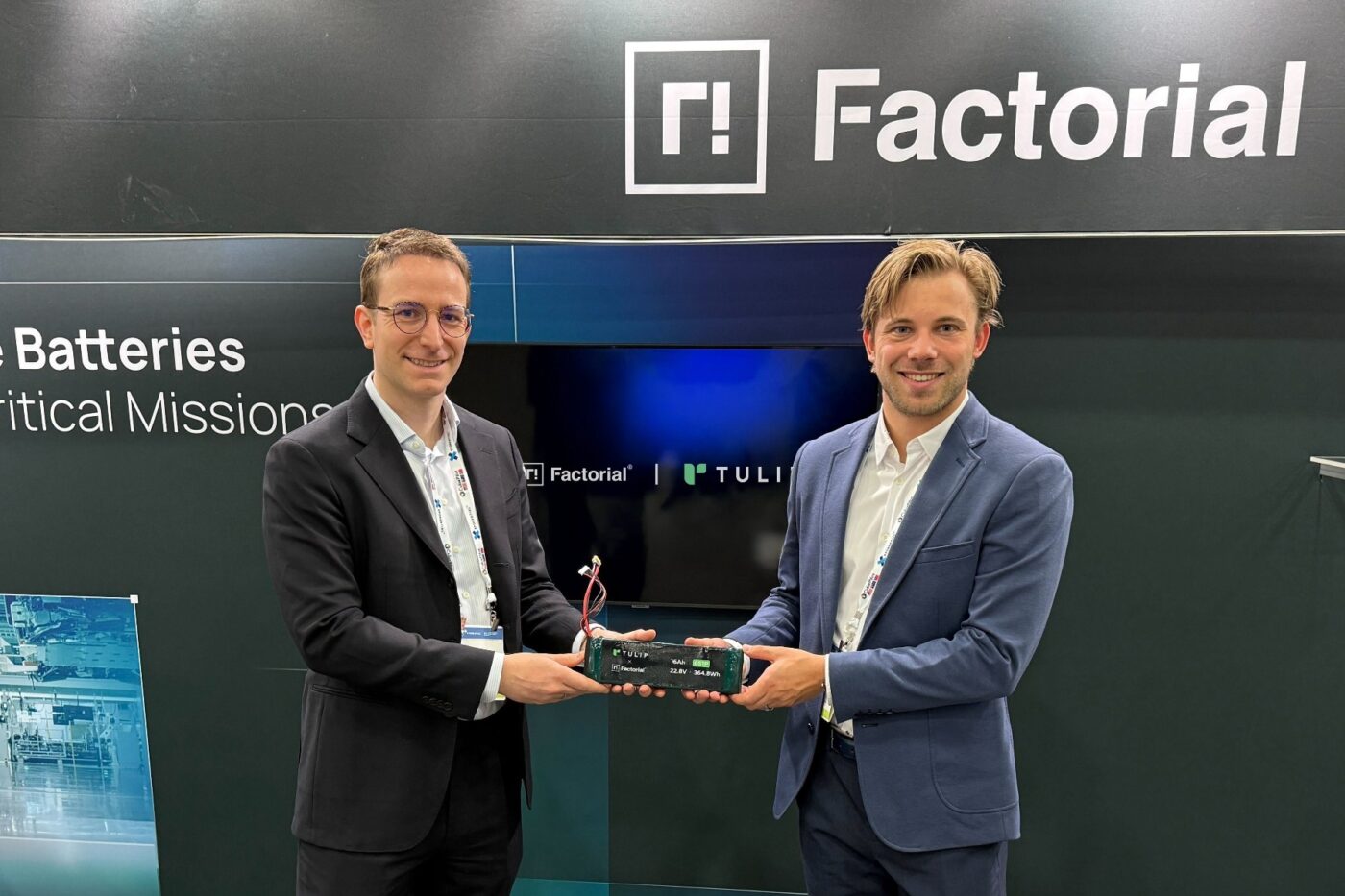
Factorial Energy and Dutch battery specialist Tulip Tech have formed a strategic partnership to commercialise solid-state and lithium-metal battery technology for unmanned aerial vehicles (UAVs).
The companies aim to accelerate the adoption of next-generation batteries for drone applications across commercial, industrial and defence markets.
Partnership Targets Drone Battery Commercialisation
The agreement follows flight tests that, according to the companies, demonstrated more than a 30% increase in flight range compared with conventional lithium-ion battery technology.
The partnership will establish a commercialisation framework covering joint customer engagement, product development and a roadmap toward large-scale production.
For Factorial Energy, the collaboration marks an expansion beyond its traditional automotive focus into aerospace and unmanned aviation applications.
Growing Demand for Longer-Endurance UAVs
The companies said higher energy density remains one of the key requirements for extending drone endurance, increasing payload capacity and improving operational flexibility.
Factorial’s solid-state and lithium-metal battery platforms are designed to deliver higher energy density while reducing battery weight, making them suitable for applications ranging from electric vehicles to aircraft and space systems.
Tulip Tech, headquartered in Den Bosch, Netherlands, develops high-energy battery systems for drones and serves more than 250 customers across the defence, security and commercial sectors.
The company said it manufactures more than 100,000 battery packs each month and specialises in customised battery systems tailored to mission-specific requirements.
Expanding Battery Applications
Factorial said the partnership builds on the development of its advanced battery technologies, which are also being evaluated by automotive manufacturers.
The U.S.-based company is backed by automotive groups including Mercedes-Benz, Stellantis and Hyundai Motor Group, which have announced plans to incorporate Factorial’s solid-state batteries into future electric vehicle programmes.
The companies said the collaboration reflects growing interest in applying advanced battery technologies beyond the automotive sector as demand increases for higher-performance energy storage solutions in aerospace applications.