


Finnish technology company Donut Lab has conducted a fast-charging test of its solid-state battery in a production electric motorcycle, marking its first public demonstration at the full battery pack level.
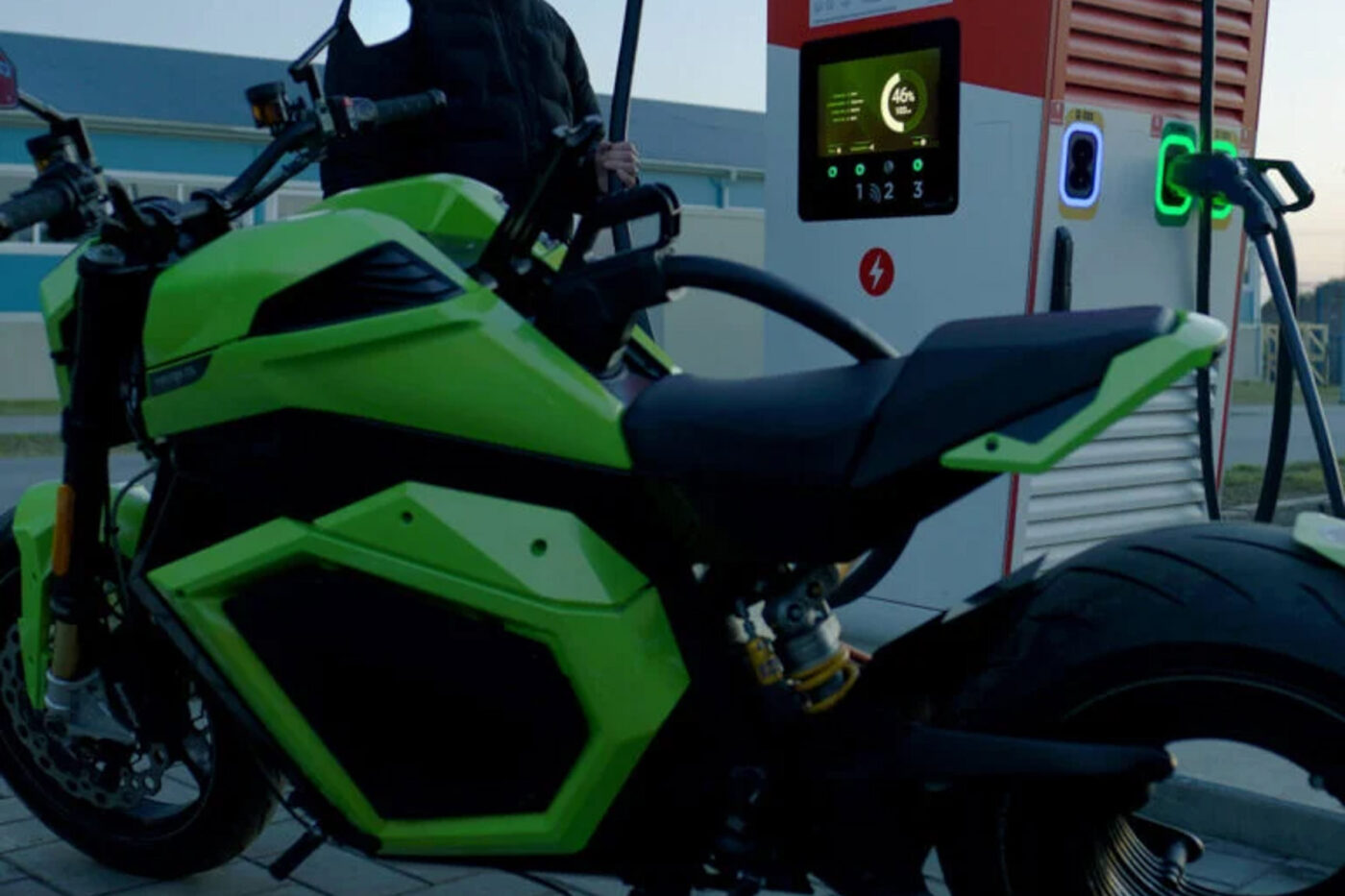
The test, carried out as part of the company’s “I Donut Believe” campaign, used a Verge TS Pro motorcycle equipped with Donut Lab’s latest battery technology. Unlike earlier evaluations conducted in laboratory settings with the Technology Institute VTT, this test aimed to show real-world performance in a vehicle environment.
See also: Donut Lab Test Shows Solid-State Battery Retains 97.7% Charge After 10 Days
“The use of Donut Lab’s solid-state battery technology in a production vehicle will be a historic breakthrough that is shaking up the entire automotive industry,” Donut Lab said in a statement. “Now, for the first time, the company is publicly demonstrating the battery’s functionality in a vehicle at the battery pack level.”

The battery pack tested had a nominal capacity of 18 kWh, corresponding to around 20.2 kWh gross energy. During the trial, the motorcycle was charged at an Alpitronic Hypercharger operated by Circle K, starting from a battery temperature of 20 degrees Celsius.
See also: Donut Lab Publishes High-Temperature Test Results for Contested Solid-State Battery
According to Donut Lab, charging began at more than 100 kW—equivalent to a charging rate of around 5C—and maintained this level for approximately five minutes, increasing the state of charge from 10% to 50%. The battery reached 70% in just over nine minutes and 80% in around twelve minutes.
“Although the results of the fast charging test are already excellent, and the battery pack charges three times faster than Verge’s previous battery, the results will be even better after optimization performed by Verge,” the company said.
The Verge TS Pro model used in the test is air-cooled and represents a previous-generation motorcycle fitted with the updated battery pack. Donut Lab has previously claimed that the system could enable a range of around 350 kilometres, with the ability to recharge enough energy for 300 kilometres in under ten minutes. However, based on the latest test results, achieving such a range increase would require charging beyond the demonstrated 80% level, and the company has not yet provided detailed validation under those conditions.
See also: Donut Lab Publishes First Independent Test Results for Solid-State Battery
Industry observers have noted that Donut Lab’s tests have so far been conducted or commissioned by the company itself, with limited independent verification of the battery chemistry or performance. Earlier laboratory results on thermal behaviour and charge retention had already drawn scrutiny from battery researchers.
Chief Technology Officer Ville Piippo said the latest test represents a step forward in demonstrating the technology’s scalability. “This is the first test we have published to a wider audience that demonstrates the performance and behaviour of multiple battery cells in a real vehicle environment,” he said.
“The high energy density of our battery technology enables flexible battery pack design and superior performance even in more challenging applications, such as motorcycles, where space is limited and system simplicity is key,” Piippo added.
See also:Svolt Chair Calls Donut Lab Solid-State Battery Claims a ‘Scam’ After CES Reveal
Verge Motorcycles Chief Executive Tuomo Lehtimäki said the technology aligns with the company’s focus on user experience. “Our goal is to provide Verge users with the best possible user experience. The advantages of Donut Lab’s battery technology, such as ultra-fast charging, complement our goal seamlessly,” he said.
“The world’s fastest charging electric motorcycle, the Verge TS Pro, is also air-cooled. The battery pack used in this test is our standard model, but an extended range version is also available, with approximately two-thirds more energy capacity,” he added.
While the results suggest progress in fast-charging capabilities, questions remain over real-world scalability, independent validation, and long-term durability, as the technology moves from laboratory claims toward commercial application.


