





Donut Lab has released additional independent test results for its disputed solid-state battery as part of the company’s “I Donut Believe” campaign, focusing on the cell’s performance under high-temperature conditions.
The tests were carried out by VTT Technical Research Centre of Finland, marking the institute’s second publication examining the company’s battery technology. Donut Lab first presented the cell during the CES 2026 but initially disclosed only limited technical data.
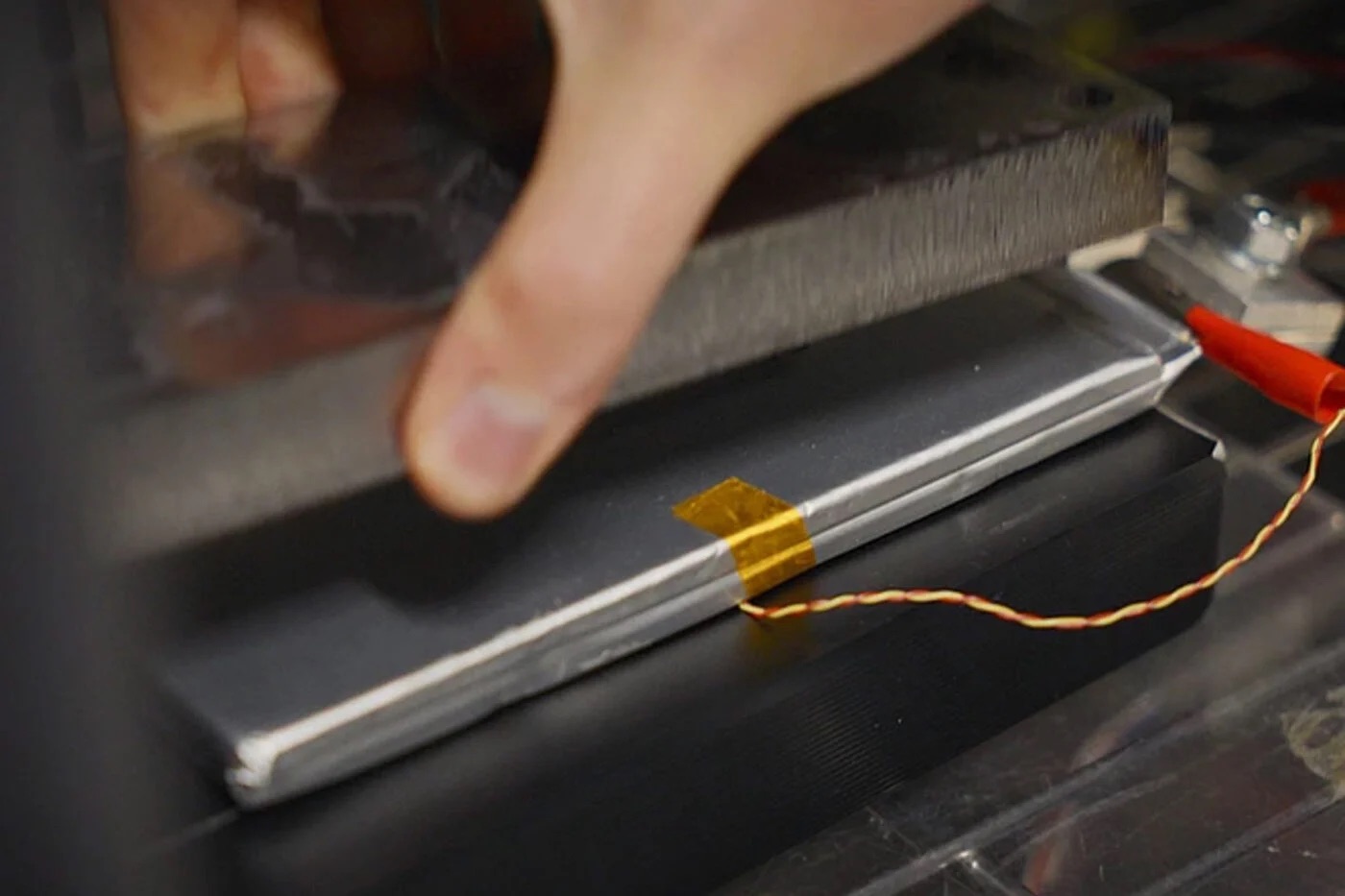
In the latest test series, VTT evaluated a pouch cell with a nominal capacity of 26 Ah and an energy content of 94 Wh. The testing was performed in a climate chamber and included the application of mechanical pressure using a 2.4-kilogram steel weight placed on the cell.
The evaluation involved three charge-discharge cycles. The first cycle was conducted at 20°C to determine baseline capacity. VTT reported that the cell delivered a capacity of 24.9 Ah when discharged at a constant current of 14 amperes down to 2.7 volts.
Subsequent tests examined the cell’s behaviour at elevated temperatures. After charging, the cell was heated to 80°C and discharged at 24 amperes. According to VTT, the discharge capacity corresponded to 110.5% of the initial capacity measured at 20°C under the same current. In a separate test, the cell was heated to 100°C and discharged at 12 amperes.
“Under the specified conditions, the cell was successfully discharged at +80 °C with a current of 24 A, achieving a discharge capacity corresponding to 110.5 % of the initial discharge capacity at +20 °C with the same current,” VTT wrote in its report. “The cell was also discharged at +100 °C with a current of 12 A, achieving 107.1 % of the reference discharge capacity measured at +20 °C with the same current.”
Donut Lab said the results demonstrate the heat tolerance of its technology. “The test measuring battery performance at high temperatures has shown that the Donut battery is extremely heat-resistant and even delivers improved performance at elevated temperatures,” the company stated.
Ville Piippo, Chief Technology Officer of Donut Lab, said the results indicated stable operation even under extreme conditions. “The battery characteristics remained unchanged even at 100 degrees, and after recharging it functioned flawlessly, confirming the convincing performance of the Donut battery even under extremely hot conditions,” he said.
However, VTT noted that the pouch cell used in the experiment lost its vacuum seal after the 100°C test. Donut Lab described the outcome as evidence that the internal materials remained functional despite the casing issue.
The research institute also reiterated a caveat already included in the first report: it did not independently verify the chemical composition of the cell. VTT described the tested device as an “energy storage device provided by the customer […] identified by the customer as a solid-state battery cell.”
The company’s claims have drawn scrutiny from battery researchers. Some experts argue that the available data suggests the cell could still be a lithium-ion design rather than a lithium-free solid-state system. Among the critics, Joachim Sann questioned aspects of the test procedures defined by Donut Lab.
Other analysts have also expressed scepticism. Battery researcher and YouTuber Ryan Inis Hughes said he had revised his earlier assessment of the company’s claims following the publication of the test results.
For now, the debate surrounding Donut Lab’s battery technology is likely to continue. Researchers say that independent investigations of the cell’s chemistry will ultimately be needed to confirm whether the technology represents a genuine solid-state breakthrough.


