





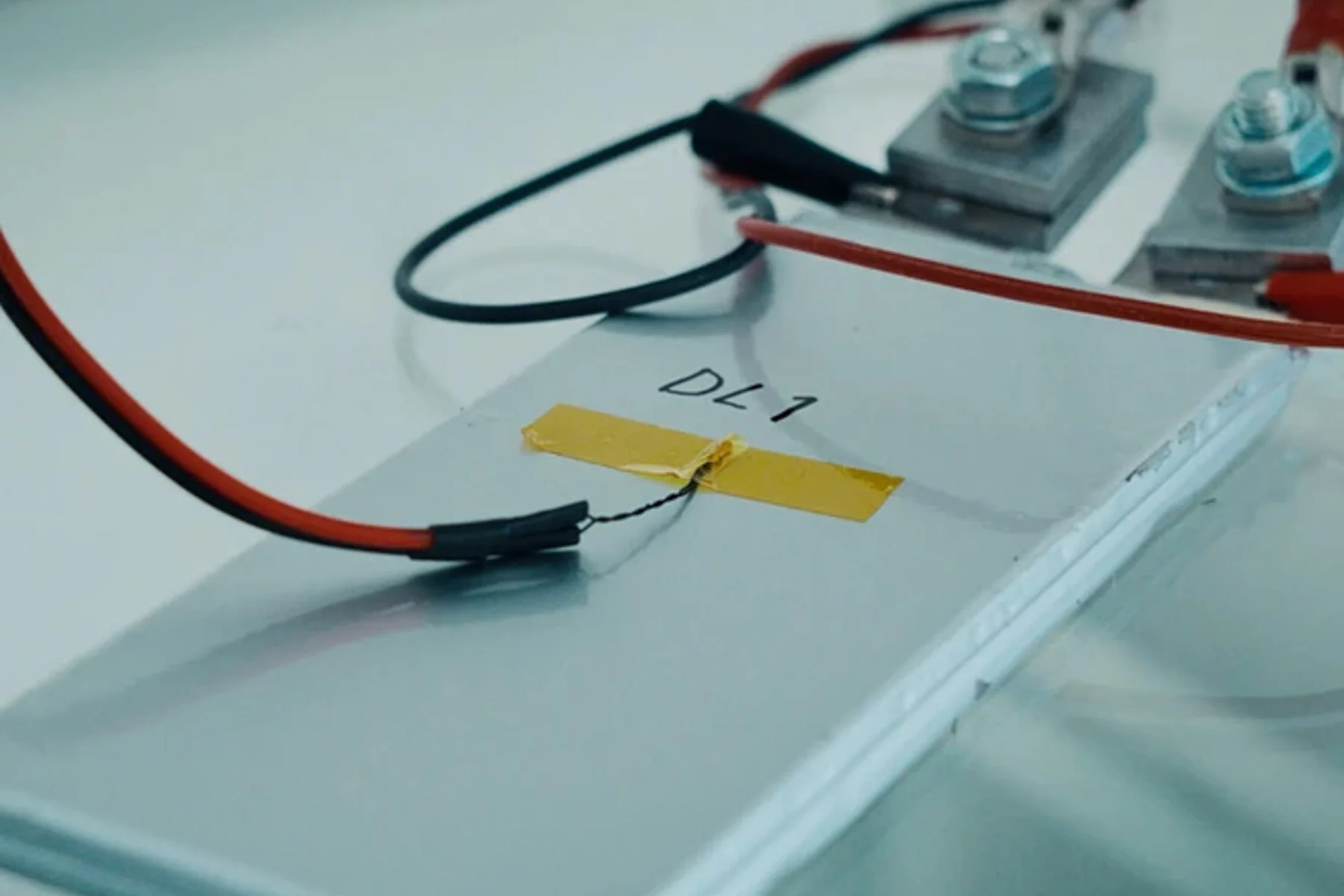
Finnish technology company Donut Lab said new test results indicate its prototype solid-state battery retains most of its charge during periods of inactivity, a result the company says counters speculation that the device might actually be a supercapacitor.
The third round of tests, conducted by the Finnish research institute VTT Technical Research Centre of Finland, examined the ability of the company’s experimental cell to hold charge when not in use.
Donut Lab previously released two other sets of test results earlier this year. The first focused on fast-charging characteristics, while the second evaluated the battery’s performance at temperatures of up to 100°C.
The latest experiment measured self-discharge behaviour, a key parameter distinguishing batteries from supercapacitors. After announcing its solid-state battery in January 2026 with limited technical disclosure, some critics suggested the technology might actually be a high-performance supercapacitor, pointing to the company’s claims of 400 Wh/kg energy density, lithium-free chemistry, and a lifespan of 100,000 cycles.
For the test, the prototype cell—identified as DL-1—was charged to 50% capacity following a standard 1C capacity test and then stored for 10 days at room temperature. During the 240-hour period, the cell remained connected to VTT measurement equipment, which recorded voltage levels every ten seconds. After the storage period, the remaining capacity was measured through a discharge test.
According to the test protocol, the cell initially contained 13.335 Ah of stored capacity. After ten days, 13.029 Ah remained, meaning the battery retained 97.7% of its charge, corresponding to a 2.3% capacity loss over the period.
The voltage decreased from 3,861 mV to 3,733 mV, though the decline slowed significantly after the first few hours. Within the first ten seconds the voltage dropped by about 60 mV, and after ten hours the total drop reached 116 mV. Over the remaining 230 hours, the voltage decreased only slightly further, ending 128 mV below the starting level.
Modern mass-produced battery cells typically lose around 0.5% to 1% of capacity over a similar timeframe. Donut Lab said the higher loss in its test is not unusual for prototype cells, which are often produced manually rather than on automated production lines. Prototype losses of up to 5% are considered typical in early-stage testing.
The voltage retention pattern also differs significantly from supercapacitors, which would typically lose roughly half of their voltage during the same period.
“Since we unveiled the Donut Battery, there has been a lot of speculation and theories about whether it is a supercapacitor. In all its simplicity, this test proves that it is a battery,” said Ville Piippo. “Supercapacitors charge and discharge quickly, but they also lose their charge quickly when not in use. The Donut Battery behaves like a battery and can maintain a charge for significantly longer.”
However, the independent test did not verify the battery’s internal chemistry. VTT noted that its role was limited to measuring performance of the device supplied by the company.
“The aim of the project was to conduct an independent self-discharge performance test on the energy storage device supplied by the customer, which the customer identified as a solid-state battery cell,” VTT said in its report.
The new results also address concerns that different prototype cells may have been optimized for each previous test. Earlier experiments evaluated different samples—labelled DL-1, DL-2 and DL-3—raising questions about whether each cell was tailored for specific characteristics such as fast charging, heat resistance or charge retention.
According to VTT, voltage behaviour observed during the capacity tests suggests the cells are broadly similar, though further testing will be needed to confirm long-term durability, cold-weather performance and energy density under real-world conditions.


