
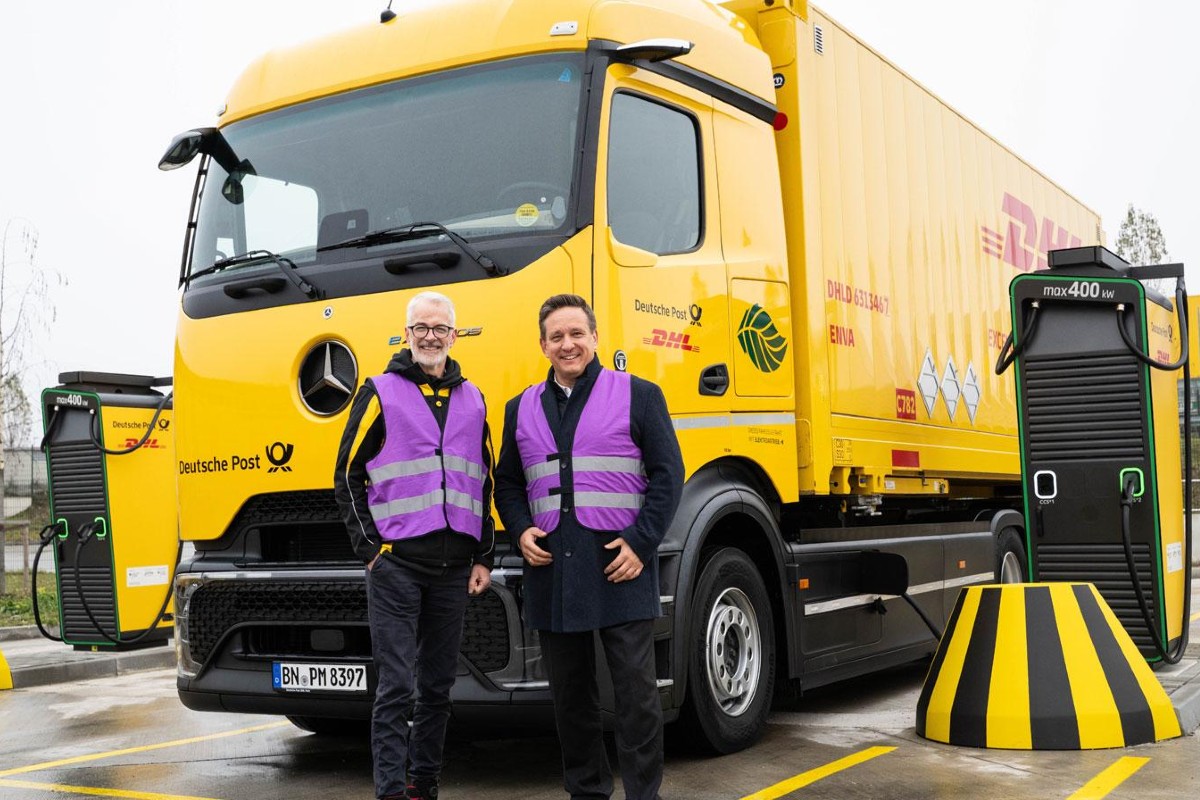
DHL has begun rolling out its first dedicated high-power charging hubs for battery-electric heavy goods vehicles (HGVs) at its German parcel centres, commissioning six fast-charging points at its Aschheim facility near Munich, the logistics group said on Thursday.
The Aschheim site marks the first completed location under an 18-month collaboration between DHL and utility group E.ON to expand fast-charging infrastructure for electric trucks across Germany. The newly installed chargers, supplied by Italian manufacturer Alpitronic, can deliver up to 400 kilowatts each, with power shared when two trucks charge simultaneously on the same unit.
See also: DHL Express Expands U.S. Fleet with 45 Mercedes-Benz eSprinter Electric Vans
By 2027, DHL and E.ON plan to install a total of 170 high-power HGV charging points nationwide, forming the backbone for a broader expansion of DHL’s electric truck fleet. DHL’s Post & Parcel Germany division currently operates 17 battery-electric HGVs and has ordered a further 42 electric trucks through rental provider Hylane. The company said its longer-term goal is to expand its electric HGV fleet into the “triple-digit” range.
“By establishing our own high-performance charging parks, we are laying the foundation for the further expansion of sustainable logistics and the deployment of additional battery-electric HGVs in our transport fleet,” said Thomas Schlickenrieder, head of operations infrastructure for Post & Parcel Germany at DHL Group.
See also: DHL Launches Africa’s First Electric Superlink Truck in South Africa
Under the partnership, E.ON is responsible for the planning, construction and operation of the fast-charging systems, transformer stations and load management. The infrastructure is designed to support charging both at loading docks and outdoor parking areas. DHL said tailored solutions include overhead cable management systems to allow charging in tight spaces.
The scale of the rollout is smaller than originally envisioned. When the partnership was announced in 2023, the companies had targeted up to 250 charging points with capacities between 150 kW and 400 kW, alongside plans for about 150 electric HGVs to be in service by 2025. DHL did not directly address the slower pace of the broader electric truck ecosystem.
See also: DHL to Expand German EV Fleet with 2,400 More Ford Electric Vans by Year-End
E.ON Drive Managing Director Christoph Ebert said the project supports DHL’s climate strategy. DHL is “a pioneer in sustainable freight transport – and we are pleased to support the ongoing decarbonisation of its post and parcel division as a partner,” he said.
Globally, DHL operates about 35,000 electric vehicles in its collection and delivery operations, a figure that includes electric trikes as well as vans and trucks. The group aims for 66% of its own last-mile fleet to be electric by 2030. In Germany, DHL currently also operates around 450 compressed natural gas (CNG) HGVs alongside its battery-electric trucks.
See also: DHL, Daimler Truck and Hylane Partner to Deploy 30 Electric Trucks in Germany
DHL said it operates roughly 40,000 charging points worldwide, though these differ sharply from the newly installed HGV chargers. The high-power units for electric trucks require “a hundred times the power” of standard charging infrastructure, the company said.