
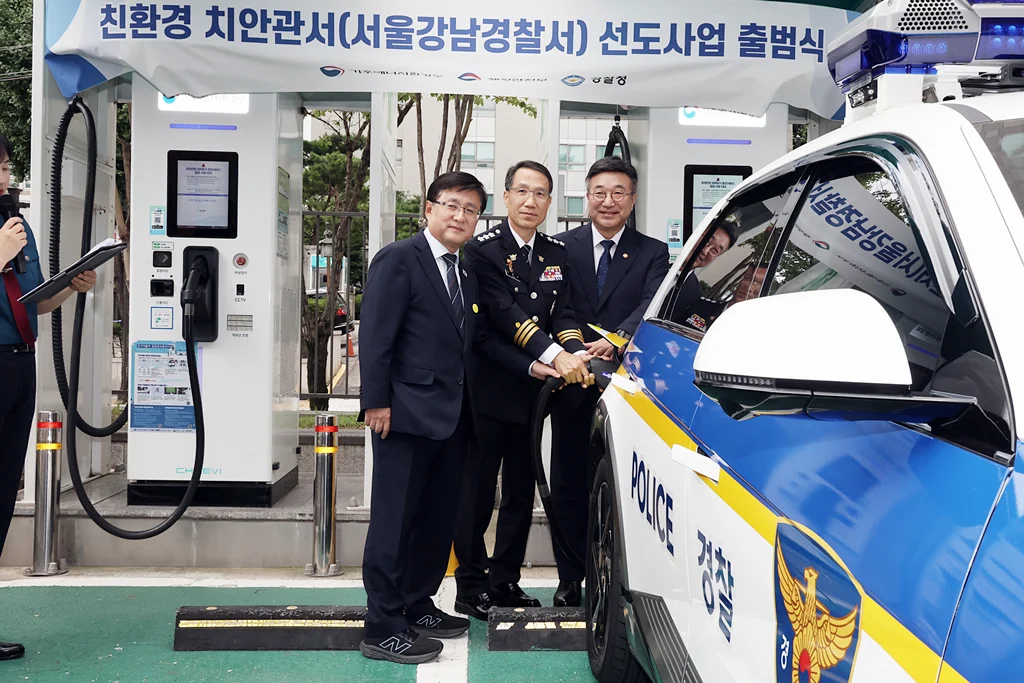
South Korea plans to transition newly purchased or leased police vehicles to electric and hydrogen models by 2035, as the government moves to accelerate the adoption of zero-emission vehicles across the public sector.
The Ministry of the Interior and Safety (MOIS), Korean National Police Agency (KNPA) and Ministry of Climate, Energy and Environment (MCEE) signed a memorandum of understanding on July 30 to advance the initiative. The agreement was announced at Gangnam Police Station in Seoul, where the agencies also launched a pilot programme for an eco-friendly police station.
Police Fleet Begins Shift To Zero-Emission Vehicles
South Korea’s police fleet consists of about 17,600 vehicles. At the end of June 2026, electric and hydrogen vehicles represented 2,185 units, or about 12.4% of the total fleet.
The KNPA purchases or leases approximately 1,908 new vehicles annually, based on procurement figures from 2023 to 2025. Under the new initiative, the government intends for virtually all new police vehicles, excluding certain special-purpose models, to use electric or hydrogen power by 2035.
Authorities said the transition could improve police operations through the performance and quieter operation of zero-emission vehicles. The government also expects software-defined vehicle technology to contribute to improvements in the quality and delivery of public safety services.
Gangnam Police Station Launches EV Pilot
The first pilot programme will replace 22 internal-combustion-engine vehicles operated by police substations under Gangnam Police Station with electric vehicles.
The project will also introduce nine 200-kilowatt fast chargers across six substations. Yeoksam, Nonhyeon and Cheongdam will each receive two chargers, while Samseong A, Samseong B and Sinsa will each receive one.
The government intends to use the Gangnam programme to assess the operational suitability of electric vehicles and charging infrastructure before expanding the initiative to additional police facilities.
The pilot is also designed to encourage greater acceptance of electric vehicles among police officers by allowing them to gain direct experience with the technology in daily operations.
Police To Identify Additional Pilot Locations
The authorities expect the Gangnam project to serve as a test bed for a broader transition of the national police fleet.
Yoo Jae-sung, acting commissioner general of the KNPA, said the agency intends to move quickly on expanding the programme.
“We will accelerate efforts to identify the second and third locations for this pilot.”
The next stages will provide the police with additional opportunities to evaluate EV performance, charging requirements and operational practicality as South Korea works toward its 2035 target for new police vehicles.