
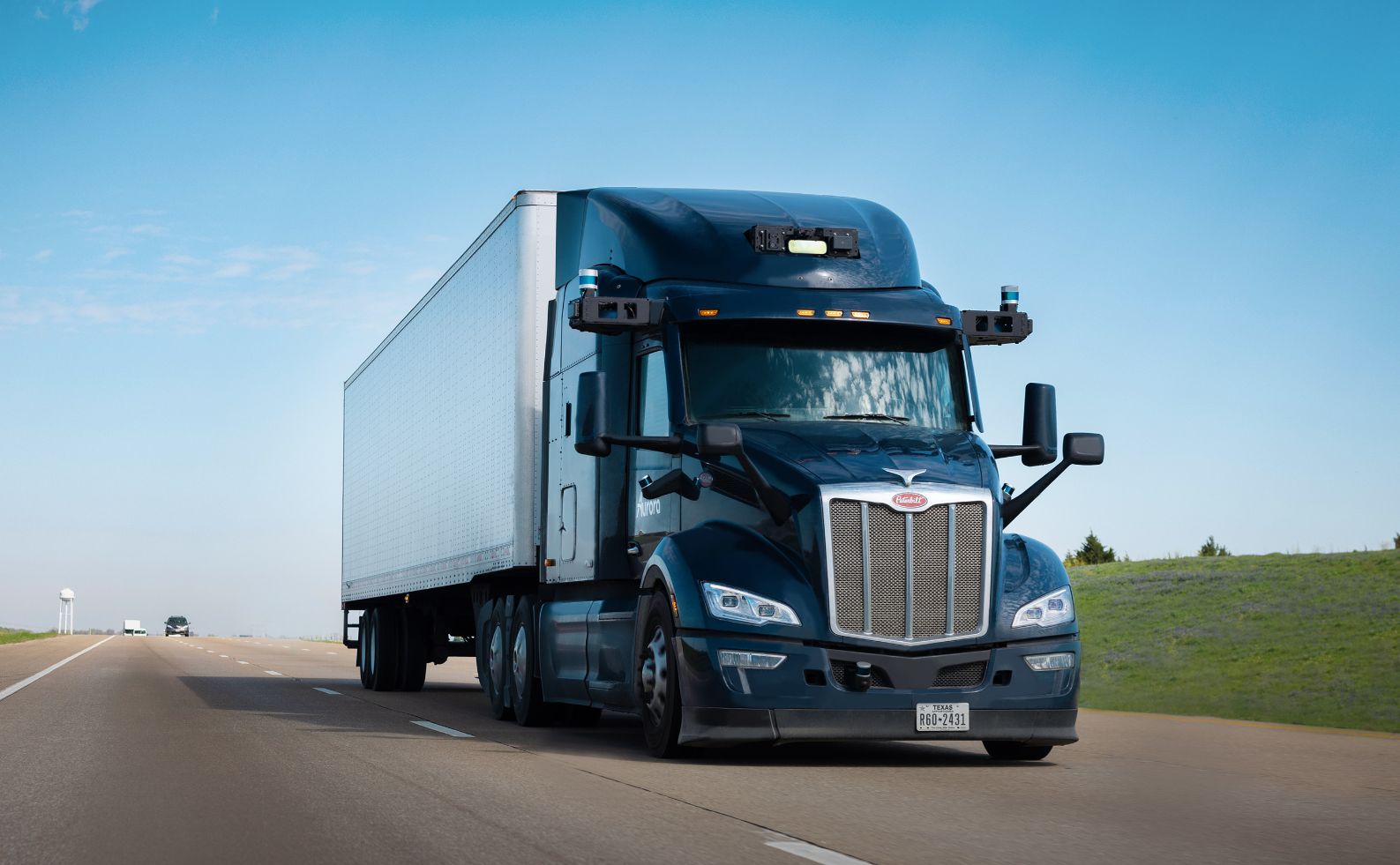
Aurora Innovation has expanded its autonomous freight operations with a new 600-mile driverless route between Fort Worth and El Paso, marking the company’s second commercial lane for its self-driving trucks, it said on Tuesday alongside its third-quarter earnings report.
The company said it has now logged more than 100,000 driverless miles on public roads using five trucks since launching commercial operations in May. Aurora’s first commercial route, connecting Dallas and Houston, was introduced earlier this year with launch partners Hirschbach Motor Lines and Uber Freight. The company said it plans to extend its operations to Phoenix by the end of 2025.
See also: Aurora Innovation Targets Sunbelt Expansion with Driverless Trucks, Logs 20,000 Miles
Aurora said the Fort Worth–El Paso route offers a more compelling distance for freight carriers facing staffing challenges and the constraints of completing 10-hour hauls in a single day. Customers on the new route include Hirschbach Motor Lines and Russell Transport.
The company also unveiled details of its next-generation hardware platform, produced by Fabrinet and integrated with Volvo’s VNL Autonomous trucks. Aurora said the new hardware is more durable, performs better, and costs roughly half as much as its current generation. The upgraded lidar system can detect objects up to 1,000 meters away—double the range of its predecessor—and features improved cleaning systems designed to enhance performance in challenging weather conditions.
See also: Aurora Innovation Targets Night Driving, Route Expansion for Autonomous Freight in 2025
“The integration of Aurora’s next-generation hardware with the Volvo VNL Autonomous on the pilot line at our New River Valley facility marks an industry-first partnership and highlights the meaningful progress we are making together,” said Nils Jaeger, president of Volvo Autonomous Solutions. “By manufacturing trucks purpose-built for autonomy, we’re moving beyond prototypes and creating scalable solutions that are ready to meet the demands of a modern supply chain.”
Aurora said it plans to produce hundreds of trucks equipped with its next-generation hardware by 2026. A higher-volume suite of hardware, developed jointly with Aumovio—formerly Continental—is expected to enter production in 2027, enabling the company to scale manufacturing to “tens of thousands of self-driving trucks.”