
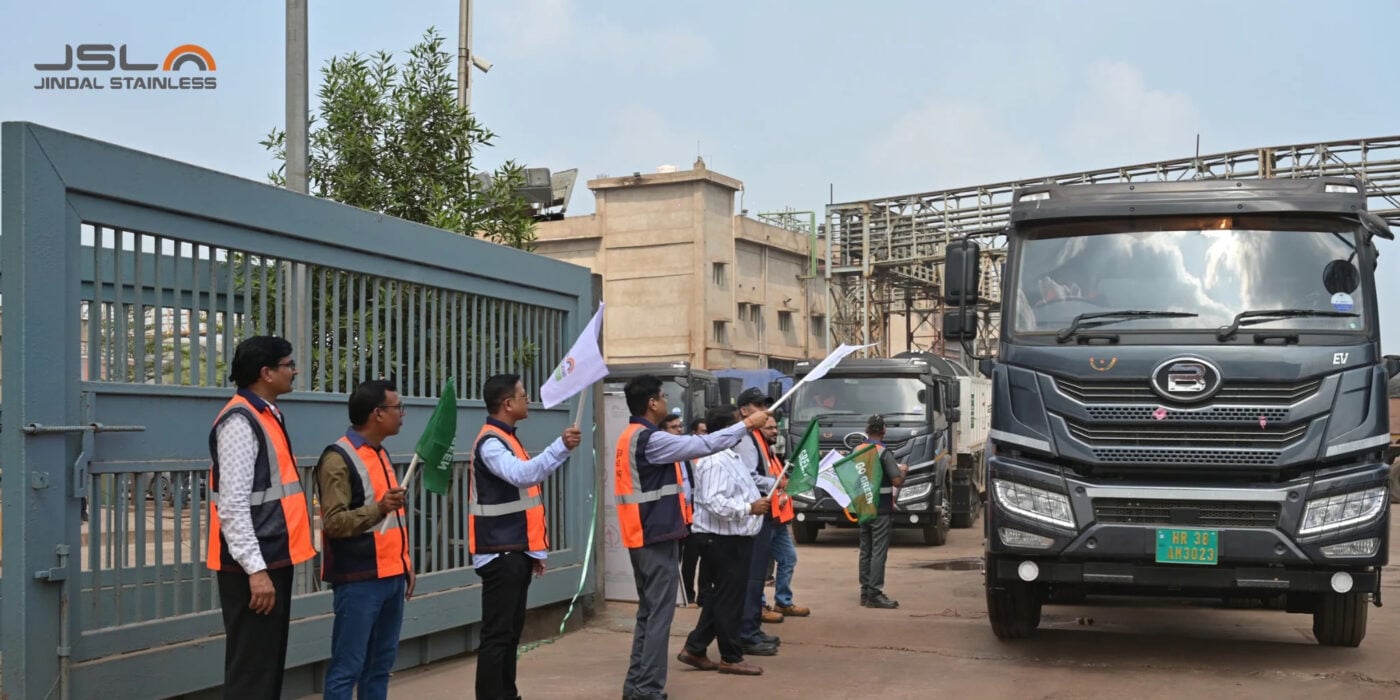
Indian steel manufacturer Jindal Stainless has deployed 10 heavy-duty electric trucks to transport finished goods, marking the company’s first use of electric trucks for this purpose. The move expands its efforts to reduce logistics emissions, following the introduction of vehicles powered by liquefied natural gas (LNG) and compressed natural gas (CNG).
The electric trucks operate on routes linking Jindal Stainless’ plant in Jajpur, Odisha, with Kharagpur and Kolkata in West Bengal. The journey from Jajpur to Kharagpur covers approximately 227 kilometres, followed by another 131 kilometres to Kolkata. Depending on the destination, the trucks may cover more than 350 kilometres one way.
Jindal Stainless Targets Lower Logistics Emissions
Jindal Stainless estimates that its combined fleet of LNG-, CNG- and battery-electric vehicles could reduce CO₂ emissions by approximately 26%, equivalent to around 71 tonnes per month.
The estimate is based on a monthly dispatch volume of 8,000–9,000 tonnes and a combined truck travel distance of approximately 240,000 kilometres. The company has not provided a separate emissions-reduction figure for the 10 electric trucks.
The new vehicles represent a relatively small part of its broader lower-emission fleet, which also includes 80 LNG trucks, 60 CNG buses and an undisclosed number of CNG trucks.
Commenting on the deployment, Jindal Stainless Managing Director Abhyuday Jindal said:
“The deployment of electric trucks marks an important milestone in our efforts to decarbonise logistics and integrate lower-emission transportation solutions into our operations. Our approach is focused on adopting practical, scalable solutions that reduce our environmental footprint while maintaining operational efficiency.”
Blue Energy Motors Supplies the 5548e Electric Truck
All 10 vehicles were sourced from Blue Energy Motors and belong to the company’s 55-tonne 5548e model range. Jindal Stainless has not disclosed the specifications of its particular trucks.
Blue Energy Motors offers multiple battery configurations for the 5548e, with capacities ranging from 282 kWh to 423 kWh. Specifications for the base configuration include a 282 kWh lithium iron phosphate (LFP) battery designed for module-to-bracket swapping, a 480 hp permanent magnet synchronous motor and a four-speed automated manual transmission.
The base model’s battery can be swapped in approximately five minutes. Alternatively, fast charging from 20% to 80% state of charge takes around 45 minutes.
The 5548e can climb gradients of up to 24% and has a claimed range of up to 200 kilometres on a single charge. Actual range and operating performance depend on the vehicle configuration and operating conditions.
Electric Trucks Expand India’s Industrial Transport Options
The deployment adds battery-electric heavy-duty vehicles to the transport operations of a major Indian steel producer. For routes connecting manufacturing facilities with distribution destinations, factors such as driving distance, payload, charging access and vehicle turnaround time will influence the operational suitability of electric trucks.
Jindal Stainless’ combination of electric, LNG and CNG vehicles reflects a multi-technology approach to reducing emissions from goods movement. The company’s stated emissions target covers the combined fleet rather than the electric trucks alone, leaving the individual contribution of each vehicle type unspecified.