
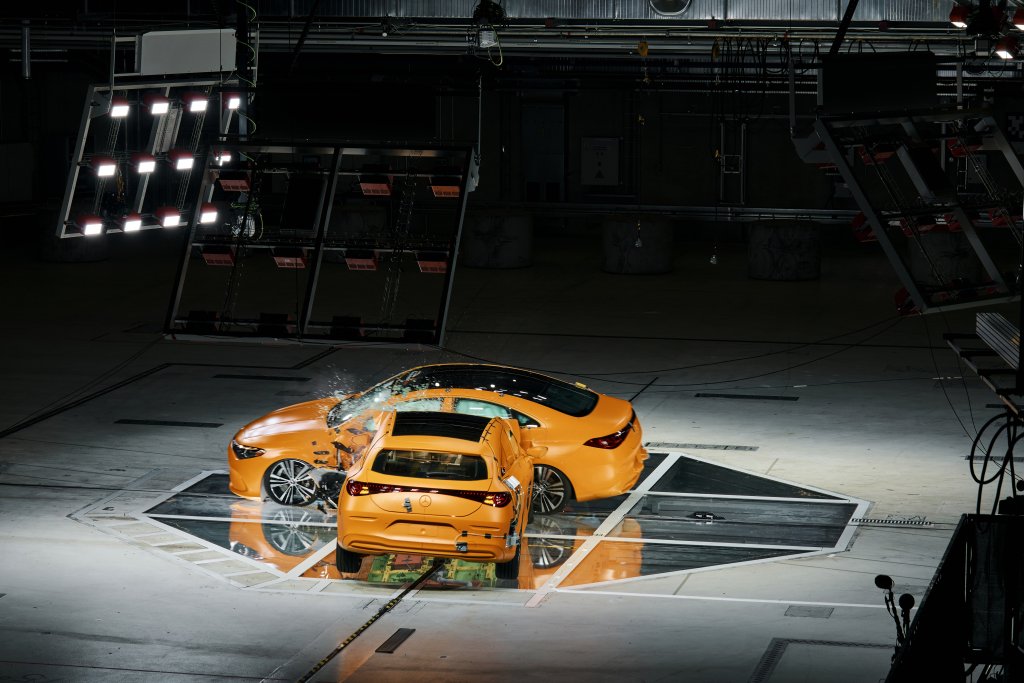
Mercedes-Benz has conducted a high-speed side-impact crash test involving a hybrid CLA Shooting Brake and an all-electric CLA Sedan, bringing the two vehicles together in a 90-degree collision at 35 mph (56 km/h) to demonstrate their occupant protection and post-crash safety systems.
The Stuttgart-based automaker said both vehicles maintained their passenger-compartment integrity during the test. The electric CLA’s high-voltage battery remained intact, while the hybrid model automatically shut off its fuel system following the impact.
Mercedes reported that all eight crash-test dummies remained below the applicable injury assessment thresholds. The test involved four adult and four child dummies, each equipped with instrumentation capable of recording up to 150 measurement points.
Side-Impact Test Challenges Both Safety Cells
Side-impact collisions present a different engineering challenge from frontal crashes because vehicles have less structural space between the point of impact and the occupants.
In this test, the hybrid CLA Shooting Brake struck the driver’s side of the electric CLA Sedan at 35 mph. Both vehicles weighed more than 2,000 kilograms in their test configurations.
The impact also tested the electric model’s ability to protect the high-voltage battery integrated into its underfloor structure. Mercedes said both vehicles’ safety cells preserved the space intended for occupants.
The company deliberately conducted the assessment without automatic emergency braking (AEB), allowing engineers to focus on structural crashworthiness and the performance of occupant-restraint systems under the specified impact conditions.
Crash footage published by Mercedes shows the vehicles’ crumple zones absorbing impact energy while seatbelts, pretensioners and airbags help manage occupant movement.
Battery and Fuel Systems Respond Automatically
The electric CLA Sedan automatically disconnected its high-voltage battery from the drivetrain following the collision. Mercedes reported that the traction battery remained intact during the test.
The hybrid CLA Shooting Brake activated a different protective measure by shutting off its fuel system, reducing the risk associated with fuel leakage after a serious crash.
Both vehicles also unlocked their doors, partially lowered their side windows and initiated an automatic emergency call through the eCall system.
These functions are intended to support occupants and emergency responders in the immediate aftermath of a collision, alongside the primary protection provided by the vehicles’ structures and restraint systems.
How the Test Compares With Standardised Assessments
Mercedes describes the demonstration as a world first for a publicly presented high-speed side-impact test involving two moving vehicles. The company’s assessment differs from established crash-test procedures used by independent safety organisations.
The Insurance Institute for Highway Safety (IIHS), for example, conducts its side-impact assessment by launching a deformable barrier into the driver’s side of a stationary vehicle. Euro NCAP also uses dedicated side-impact procedures, including a mobile barrier test and a side-pole test, with different impact speeds and configurations.
In Mercedes’ demonstration, both vehicles were moving and met at right angles. The test therefore examined a different collision scenario from the stationary-vehicle assessments used in standardised rating programmes.
Manufacturer Results Are Not an Independent Safety Rating
Mercedes said the test results indicate a low risk of serious injury under the specific conditions assessed. However, the findings are based on a manufacturer-conducted test and should not be treated as equivalent to an independent IIHS or Euro NCAP rating.
The outcome provides information about the two CLA models’ structural performance, restraint systems and post-crash safety responses in this particular collision. Broader conclusions about vehicle safety require consideration of additional crash scenarios and independently conducted assessments.