
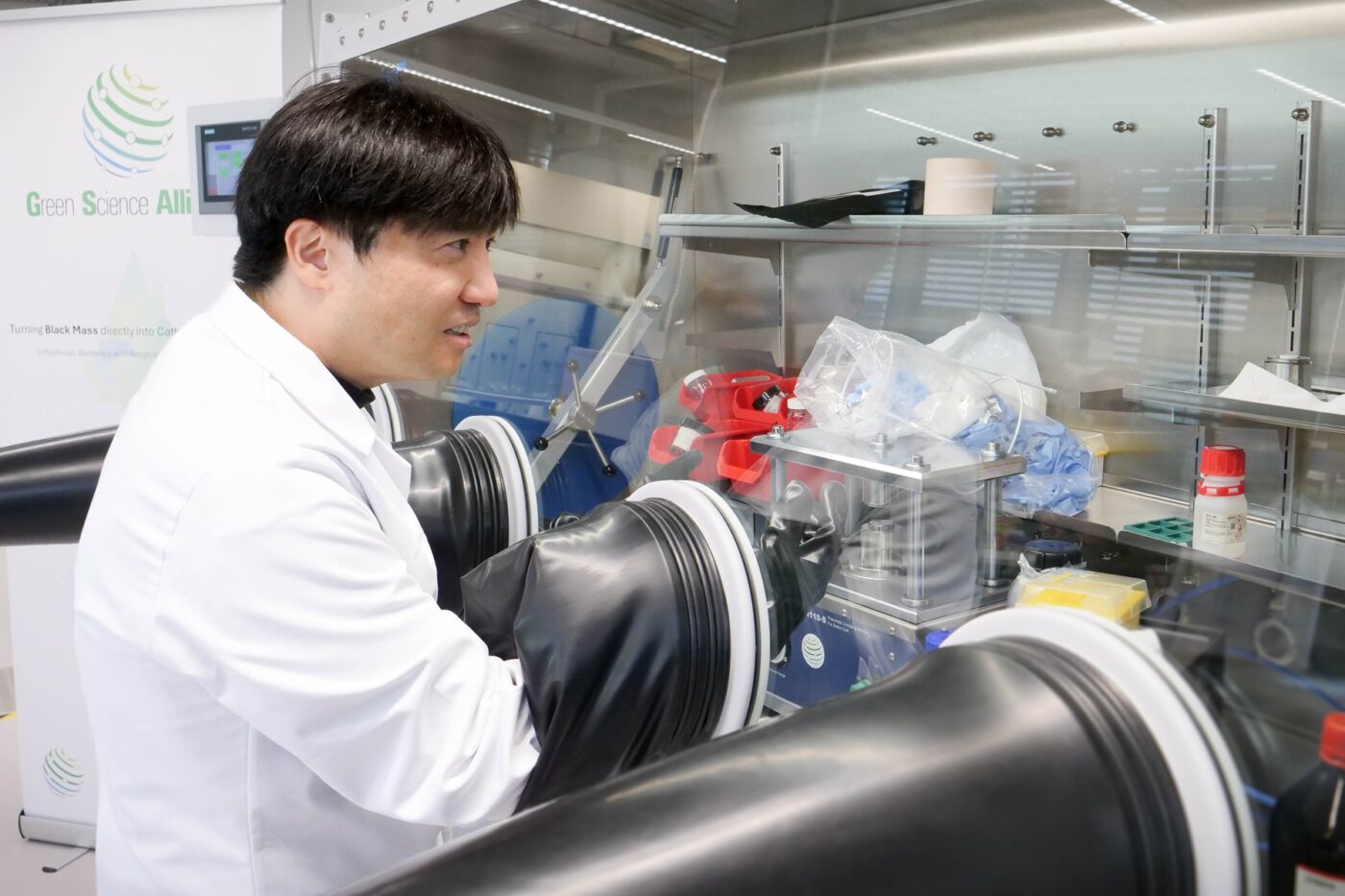
Japanese chemical and greentech company GSA has opened a battery recycling laboratory at Switzerland Innovation Park Biel/Bienne (SIPBB) in the Swiss canton of Bern, partnering with the Swiss Battery Technology Center (SBTC) to develop a process that directly recovers and reuses cathode materials from spent lithium-ion batteries.
Inaugurated on Monday, the facility is intended to help GSA establish a foothold in the European market. The opening ceremony was attended by GSA CEO Ryohei Mori and SBTC Director Christian Ochsenbein.
Headquartered in Kawanishi, Japan, GSA works on technologies including quantum dots, metal-organic frameworks (MOFs) and deep eutectic solvents. Its Swiss partner, SBTC, provides capabilities spanning material analysis, electrode production, battery cell development, testing and recycling.
Direct Recovery of Cathode Materials
The research focuses on black mass, the dark powder produced when used batteries are shredded and mechanically processed. It contains the active materials responsible for storing and releasing energy in battery cells.
Conventional recycling typically separates black mass into individual metals, including lithium, nickel and cobalt, using chemical treatments. Recovering cathode material from those metals then requires additional processing.
GSA aims to bypass these intermediate steps by reprocessing material from black mass for direct reuse in new battery cathodes. Known as direct recycling, the approach could reduce processing requirements and resource consumption while lowering demand for newly mined raw materials.
However, the partners have not disclosed the precise details of GSA’s recycling process.
The quality and composition of black mass can vary according to battery chemistry, age and processing methods. These differences are also being investigated through the SHERLOCK research project, which seeks to establish quality standards for black mass.
Early Tests Show More Than 90% Capacity
Initial laboratory results indicate that batteries made with GSA-regenerated cathode material achieved more than 90% of the initial capacity of comparable batteries using commercial-grade material.
The result remains an early-stage laboratory finding. The partners have not provided details on the number of charge cycles tested, cell formats or independent verification of the measurements.
The technology is being developed for both nickel-manganese-cobalt (NMC) and lithium iron phosphate (LFP) batteries.
Developing an economical recycling route for LFP chemistry is particularly important because these batteries contain neither nickel nor cobalt. This makes the recovery of individual metals less attractive economically and increases the potential value of processes that preserve and reuse cathode materials directly.
Swiss Research Partnership Targets Industrial Scale-Up
The partners have divided responsibilities according to their respective capabilities. GSA contributes its recycling technology, while SBTC supplies research expertise, laboratory infrastructure and facilities.
The collaboration will examine the processed materials, manufacture electrodes and battery cells, and test their performance. The work is intended to determine whether the process can eventually be scaled for industrial application.
The initial research phase is being supported by an Innovation Cheque from Innosuisse, Switzerland’s innovation funding agency. The scheme covers eligible costs for a Swiss research partner up to CHF 15,000, or approximately €16,200, and supports feasibility studies that must be completed within six months.
The partners describe the project as an initial step towards broader joint research rather than a demonstration of commercial-scale readiness.
EU Battery Rules Strengthen Demand for Recycling
The research comes as European battery regulations increase the importance of recovering valuable materials and incorporating recycled content into new batteries.
The EU Battery Regulation establishes recovery requirements for materials including lithium, nickel and cobalt, alongside minimum recycled-content requirements for new electric vehicle batteries scheduled to apply from August 2031.
Despite these policy drivers, battery recycling remains economically challenging. The EU’s Safeloop study puts current losses at around €1.90 per kilogram of battery pack, highlighting the need for more cost-efficient processes.
GSA and SBTC believe reducing the number of processing stages could help improve recycling economics. At industrial scale, the approach could also reduce reliance on newly mined resources and strengthen the resilience of European battery supply chains.
Cross-border research partnerships are developing in parallel. In early October, Germany’s Fraunhofer FFB in Münster signed letters of intent with South Korean partners covering areas including battery recycling and implementation of the EU Battery Regulation.
GSA plans to use SIPBB’s research network to advance its technology from laboratory development towards industrial application. Whether the reported capacity performance can be maintained with larger material volumes and at commercially viable costs remains to be demonstrated.