
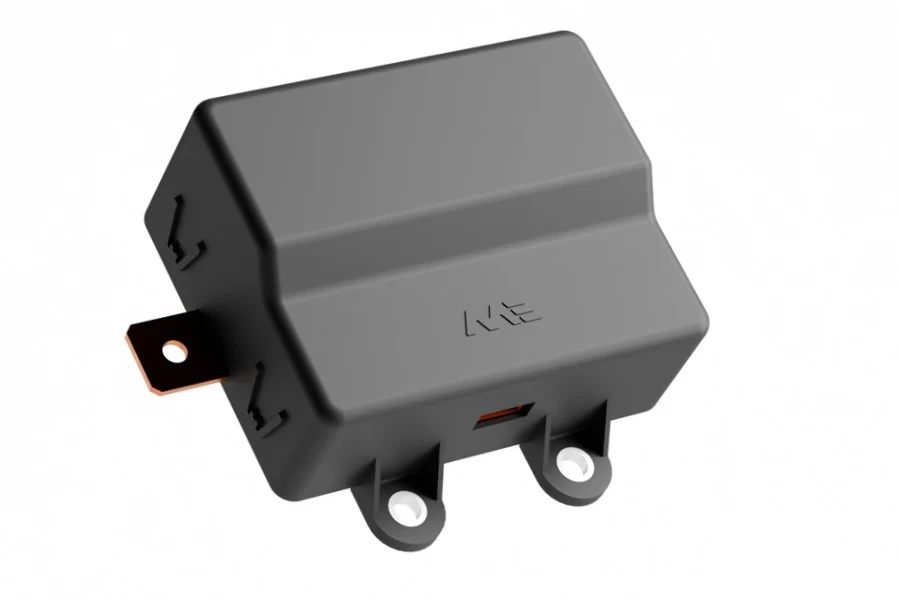
Munich Electrification will present a semiconductor-based battery disconnect device for electric commercial vehicles at IAA Transportation 2026 in Hanover, Germany. The company’s ME Solid-State Relay (ME SSR) is designed to replace conventional mechanical contactors and pyrotechnic fuses used to isolate high-voltage battery systems from the powertrain.
The ME SSR will be showcased from 15 to 20 September 2026. Munich Electrification says the technology is designed specifically for the switching cycles, vibration levels and continuous loads associated with commercial vehicle applications.
Semiconductor-Based Battery Disconnection
The ME SSR connects the high-voltage battery to the vehicle’s powertrain during normal operation and can rapidly isolate the systems when required. Applications include vehicle parking, maintenance and fault situations.
Eaton, Munich Electrification Partner on EV Power Protection and Megawatt Charging Systems
Unlike mechanical contactors, the semiconductor-based system has no moving parts. It also differs from pyrotechnic fuses, which are single-use components that require replacement after activation.
According to Munich Electrification, the ME SSR can disconnect high-voltage circuits in less than five microseconds without mechanical wear or electrical arcing.
“In commercial vehicles, uptime dictates the profitability of the entire vehicle. Mechanical contactors wear out, and pyrotechnic fuses only trigger once – every failure means repairs and downtime,” said Timo Völkl, CTO of Munich Electrification.
“The ME SSR switches purely electronically: wear-free, in under five microseconds, and resettable after every fault. This keeps the vehicle in operation instead of in the workshop,” he added.
Software-Defined Protection
Munich Electrification says the semiconductor architecture enables software-defined safety functions in addition to high-speed switching.
Eaton Partners with Munich Electrification to Develop Advanced Battery Switch for EVs
The ME SSR is designed to perform self-tests, identify latent faults and provide operational data that can help predict potential failures. Its short-circuit protection is also resettable, allowing the device to return to operation after a fault rather than requiring replacement of a blown fuse.
The approach is intended to reduce maintenance requirements and limit vehicle downtime, which can be particularly significant for commercial fleets where vehicle availability directly affects operating economics.
Two Integration Options
Munich Electrification will offer the ME SSR in two configurations.
The first is a standalone drop-in unit that can be integrated into existing Battery Disconnect Units (BDUs). This configuration is aimed at manufacturers seeking improved switching performance without redesigning the complete BDU.
The second is an integrated module combining switching and sensor functions in a single unit. Munich Electrification says this version is intended for new vehicle platforms and BDU consolidation projects where manufacturers want to simplify system architecture.
Expanding Beyond Battery Management
The ME SSR represents an expansion of Munich Electrification’s portfolio into high-voltage switching and disconnection technology.
Munich Electrification Partners with Daimler Truck AG for Advanced Battery Management System
The company has traditionally focused on battery management and sensor systems, including cell monitoring, current and voltage measurement, and functional safety technologies.
The new device builds on its existing Battery Management System platform, which is used in several OEM programs, including heavy-duty truck applications.
Munich Electrification says the expanded portfolio could allow vehicle manufacturers and suppliers to source battery management, sensing, high-voltage switching and safety software from a single provider.
Among the customers publicly identified by the company is Daimler Truck.