
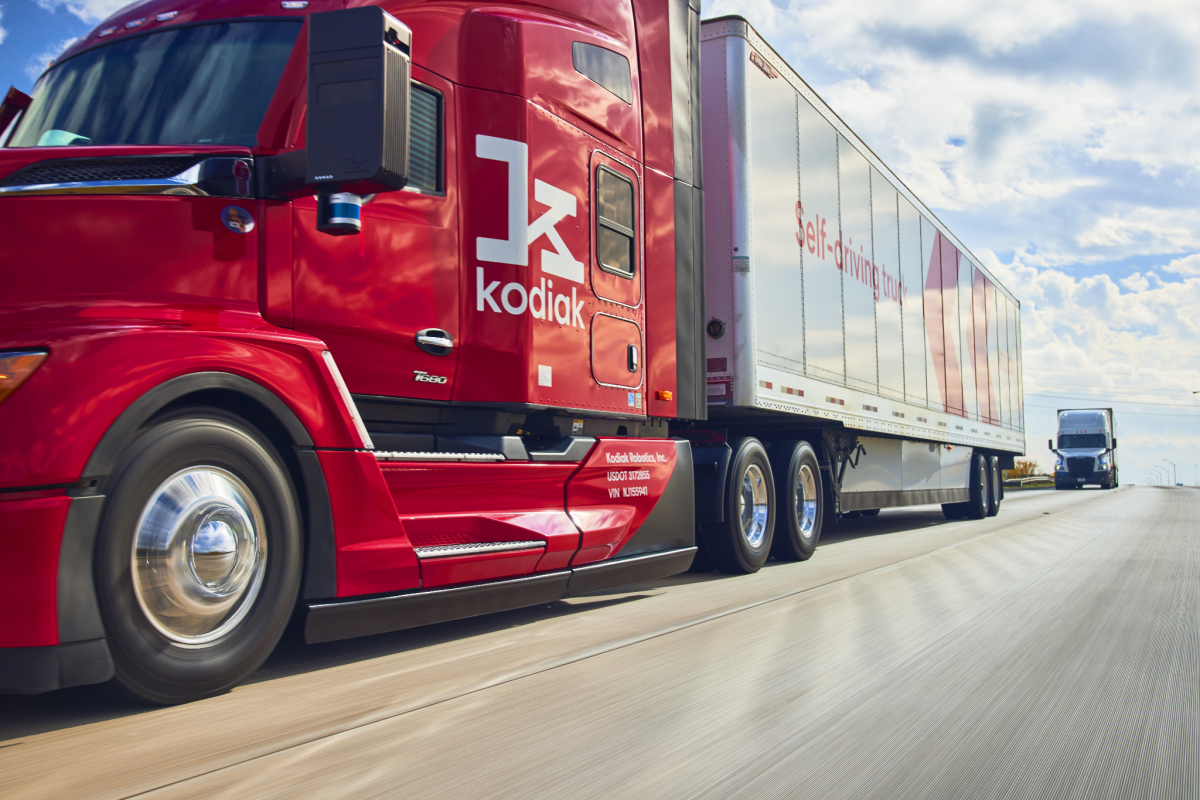
Kodiak AI has introduced two advanced safety-engineering tools designed to identify and evaluate rare collision risks in its autonomous trucking system, drawing on methodologies commonly used in the aerospace and nuclear energy industries.
The company said the tools have already demonstrated their value by uncovering a low-probability collision scenario within minutes that would likely have required tens of thousands of miles of real-world driving to encounter even once. The technologies — a Probabilistic Risk Assessment (PRA) framework and an AI-powered analysis tool called BreakPoint — form a central part of Kodiak’s safety strategy as it expands driverless operations.
Probabilistic Model Estimates Rare Collision Risks
Kodiak’s PRA framework is designed to assess safety in situations that are too rare to be reliably measured through road testing alone. The system combines Bayesian probability methods, reliability analysis, systems engineering, and statistical modeling to estimate expected collision rates across a wide range of operating conditions.
The model evaluates risk by analyzing three key factors:
- Scenario exposure — how frequently a particular driving situation occurs.
- Collision likelihood — the probability that a collision will happen within that scenario.
- Collision severity — the expected seriousness of the resulting crash.
According to Kodiak, the framework continuously updates as new operational data becomes available. Areas where evidence remains limited are treated as uncertainties rather than assumptions, helping engineers focus on scenarios that require further investigation.
The company benchmarks its safety estimates against collision-rate data from human drivers obtained through partnerships with transportation research organizations, with the goal of demonstrating performance that exceeds human driving safety levels.
Addressing Unknown Safety Hazards
Kodiak said the PRA framework supports compliance with the principles outlined in ISO 21448, known as Safety of the Intended Functionality (SOTIF), which focuses on hazards that may emerge even when vehicle components are operating as designed.
While traditional functional safety approaches concentrate on hardware or software failures, SOTIF addresses situations where systems behave unexpectedly despite functioning correctly.
Kodiak explains that the remaining challenge for autonomous vehicle developers lies in identifying and eliminating previously unknown hazardous scenarios. The company’s safety process seeks to systematically reduce those risks by converting unknown hazards into known, measurable events that can be analyzed and mitigated.
BreakPoint Uses AI to Search for Hidden Failures
Complementing the PRA model is BreakPoint, an internally developed AI-based testing tool that performs adversarial simulations on Kodiak’s autonomous driving software.
The system injects realistic, time-varying faults into vehicle data streams and deliberately searches for conditions that could trigger a simulated collision. When a vulnerability is identified, BreakPoint estimates its likelihood and passes the findings back into the PRA framework for further analysis.
According to Kodiak, the approach enables engineers to explore an enormous range of possible driving scenarios without relying solely on physical testing.
In one example, BreakPoint identified a rare perception-related issue involving stalled vehicles within Kodiak’s Industrial Operational Design Domain (ODD). The company estimates that discovering the same scenario through conventional road testing would have required tens of thousands of miles of vehicle operation.
Continuous Safety Validation
Kodiak describes the interaction between BreakPoint and the PRA framework as a continuous safety loop.
BreakPoint searches for previously unknown failure modes and estimates their probability, while the PRA model incorporates those findings to evaluate overall risk levels and highlight areas where confidence remains limited. Engineers can then prioritize mitigation efforts before reassessing the system.
The company says this process creates a cycle of discovering, quantifying, prioritizing, correcting, and re-evaluating safety risks, helping narrow the pool of unknown hazards and strengthen confidence in autonomous vehicle performance.
As autonomous trucking companies move toward broader commercial deployment, Kodiak believes that combining probabilistic risk assessment with AI-driven adversarial testing offers a more comprehensive approach to validating safety than traditional road-testing methods alone.