
Uber has begun allowing customers in the United Kingdom to join an interest list for autonomous vehicle rides powered by Wayve, signaling that the companies are moving closer to launching a robotaxi service in London.
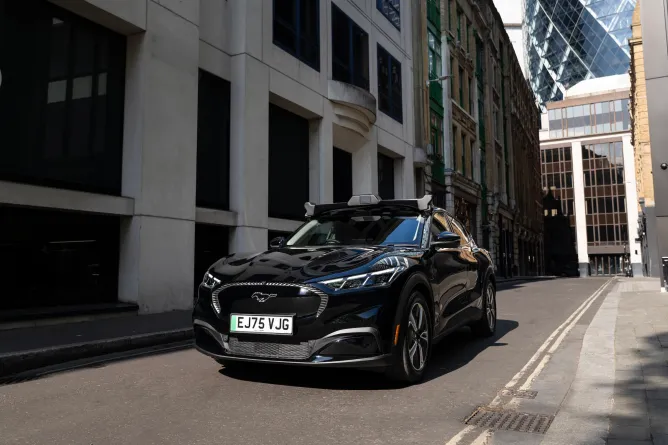
The announcement was made in London alongside the unveiling of a black Ford Mustang Mach-E equipped with Wayve’s autonomous driving technology. While Wayve provides the self-driving system, Uber has developed the in-cabin experience, including interactive touchscreens that support 64 languages and are designed to help passengers interact with the vehicle during their journeys.
Uber said the robotaxi service is expected to launch in the coming months, subject to regulatory approval. Once operational, customers requesting rides through the Uber app may be matched with a Wayve autonomous vehicle at no additional cost compared with a conventional ride driven by a human driver.
Customers Can Opt Into Autonomous Rides
To increase their chances of receiving an autonomous vehicle, Uber users can update their rider preferences within the app and select autonomous vehicles as a preferred option.
If matched with a robotaxi, riders will still have the ability to decline the autonomous vehicle and request a conventional ride instead.
Initially, the Wayve vehicles will operate with human safety operators behind the wheel as the companies gather operational data and complete regulatory requirements. Fully driverless operations are planned for a later stage.
Competition With Waymo Looms
The planned launch sets the stage for competition with Waymo, the autonomous driving company owned by Alphabet, which is widely regarded as the leader in commercial robotaxi services in the United States.
Waymo has already established a presence in London. In April, the company began testing approximately 100 autonomous Jaguar I-Pace vehicles equipped with safety operators across a 100-square-mile area of the city.
The potential rivalry is notable because Uber and Waymo currently maintain a partnership in the United States.
The companies first agreed to collaborate in 2023 when Waymo vehicles became available through the Uber platform in Phoenix. The partnership later expanded to Austin and Atlanta, where customers can access Waymo robotaxis exclusively through the Uber app.
However, the relationship has become increasingly complex as Uber broadens its network of autonomous vehicle partnerships and investments.
Uber Expands Autonomous Vehicle Strategy
Over the past two years, Uber has invested in and partnered with numerous autonomous driving companies, including Wayve.
The UK-based autonomous driving startup raised $1.2 billion in February from investors that included Uber. The total funding package could increase to $1.5 billion through an additional $300 million commitment from Uber tied to the deployment of robotaxi services, beginning in London.
Uber has also launched new divisions focused on autonomous transportation, including AV Labs and Uber Autonomous Solutions, highlighting its ambition to become a major platform provider for self-driving mobility services.
The company’s strategy allows it to work with multiple autonomous vehicle developers rather than relying on a single technology provider.
Regulatory Process Still Underway
Despite the growing momentum, regulatory approval remains a key hurdle before widespread commercial deployment can begin.
The UK government is currently developing a framework for autonomous vehicle operations and launched applications for its autonomous vehicle pilot program in May.
Authorities have indicated that insights gained from the pilot program will help shape future regulations governing self-driving vehicles across the country.
Until those rules are finalized, both Uber and Wayve will continue preparing their operations while participating in testing and pilot activities designed to demonstrate the safety and readiness of autonomous mobility services.
The upcoming launch in London could become one of Europe’s most closely watched robotaxi deployments, offering an early indication of how autonomous ride-hailing services may evolve in major urban markets outside North America.