
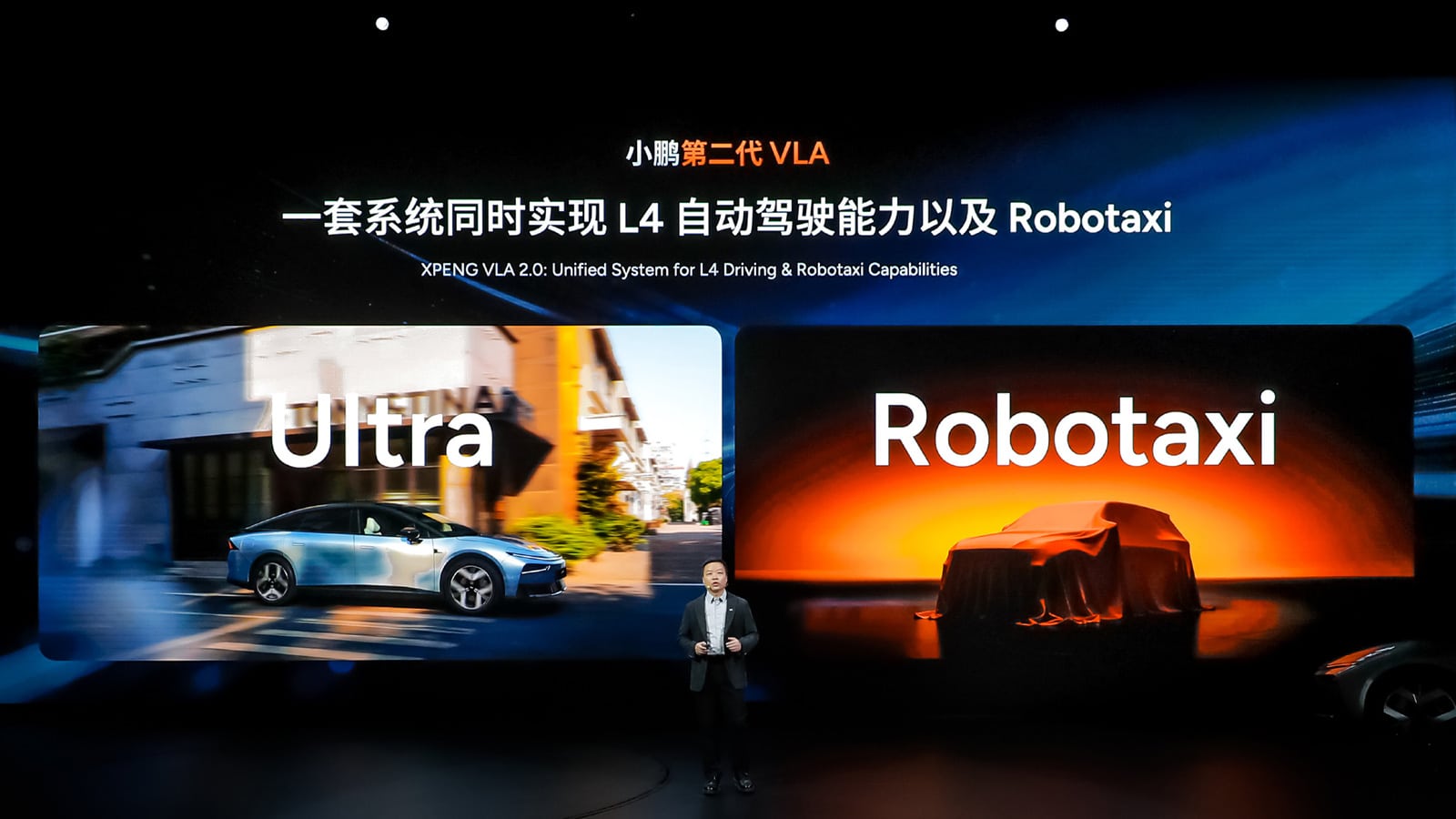
Xpeng said it will begin public road testing of robotaxis equipped with its VLA 2.0 software, marking a further step in the Chinese electric vehicle maker’s push toward higher levels of autonomous driving.
The company’s chairman and chief executive, He Xiaopeng, said on Thursday that the robotaxis have already completed closed-venue testing conducted by third-party agencies. He made the announcement at a product launch event in Guangzhou, where Xpeng outlined its latest autonomous driving roadmap.
See also: Xpeng CEO Compares Tesla FSD With VLA System, Eyes 2026 Catch-Up
VLA, short for Vision-Language-Action, is Xpeng’s large-scale physical model designed to enable entry-level Level 4 autonomous driving. The company said VLA 2.0 is capable of interpreting real-world driving environments in a human-like manner and is intended to support full-scenario autonomous operation. According to Xpeng, the system can be deployed without regional restrictions and is designed to operate in complex environments such as narrow roads and campuses, while supporting front-loaded mass production.
Xpeng has previously said it plans to launch three robotaxi models in 2026. The vehicles are expected to feature four in-house developed Turing AI chips, delivering computing power of up to 3,000 trillion operations per second (TOPS). The automaker has said the models will integrate the VLA 2.0 system, enabling them to adapt to different global traffic patterns without relying on high-definition maps or requiring vehicle modifications.
See also: Xpeng Research on Autonomous Driving Model Accepted at AAAI 2026
The company also said its conventional production vehicles will begin receiving VLA 2.0 software updates starting in March, bringing near-Level 4 smart driving capabilities to consumer models.
Xpeng has positioned autonomous driving as a core pillar of its long-term strategy and said 2026 would mark a turning point for the rollout of fully autonomous technologies in major markets, including China and the United States.