
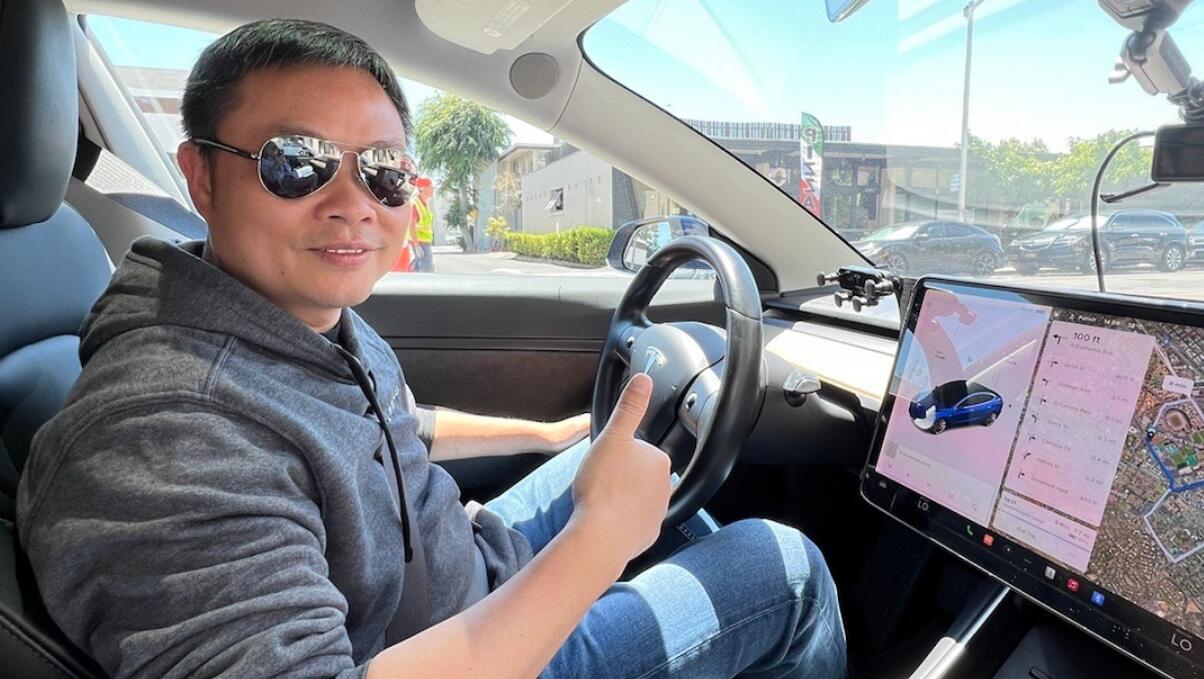
Xpeng Motors Chief Executive He Xiaopeng has tested Tesla’s latest Full Self-Driving (FSD) software and Robotaxi service in Silicon Valley, renewing a comparison he last carried out in mid-2024 and sharpening the Chinese automaker’s ambitions in autonomous driving.
He said the latest five-hour test of Tesla’s FSD version 14.2 showed clear progress from his previous experience, describing a shift from what he once saw as a refined but limited system to one approaching higher autonomy. Tesla’s standard vehicles and Robotaxi units operated on the same underlying model and displayed broadly consistent driving behaviour, he said in posts shared on Chinese social media platform Weibo.
See also: Xpeng CEO He Xiaopeng Raises Stake With Latest Share Purchase
“FSD has evolved from a ‘smooth but still L2-like’ experience to a level now close to quasi-L4 stability,” He wrote, adding that while some details still need improvement, the overall performance represents “a substantial leap” compared with last year.
The assessment reinforced He’s view that consumer vehicles and Robotaxi fleets will ultimately converge on the same autonomous-driving software and hardware stack. He also said he expects users to skip intermediate autonomy stages, moving directly from advanced driver assistance to L4-capable functions in mass-produced vehicles.
See also: Xpeng CEO He Xiaopeng Impressed by Tesla’s Full Self-Driving Software
He acknowledged that Xpeng’s first release of its second-generation Vision-Language-Action (VLA) system does not yet match the full capabilities of Tesla’s FSD 14.2, citing development time constraints. Still, he set a clear internal benchmark, saying Xpeng aims to deliver a comparable domestic driving experience by August 2026. “By the end of August 2026, Xpeng’s VLA must achieve an overall road experience in China equivalent to FSD V14.2 in Silicon Valley,” He said.
Xpeng formally launched its VLA 2.0 system at its 2025 AI Day in November. The company plans an initial co-creation experience for early users in late December, followed by a broader rollout to its Ultra vehicle series in the first quarter of 2026. In parallel, Xpeng said it is advancing Robotaxi commercialisation, with three dedicated models planned and trial operations expected to begin in 2026.