


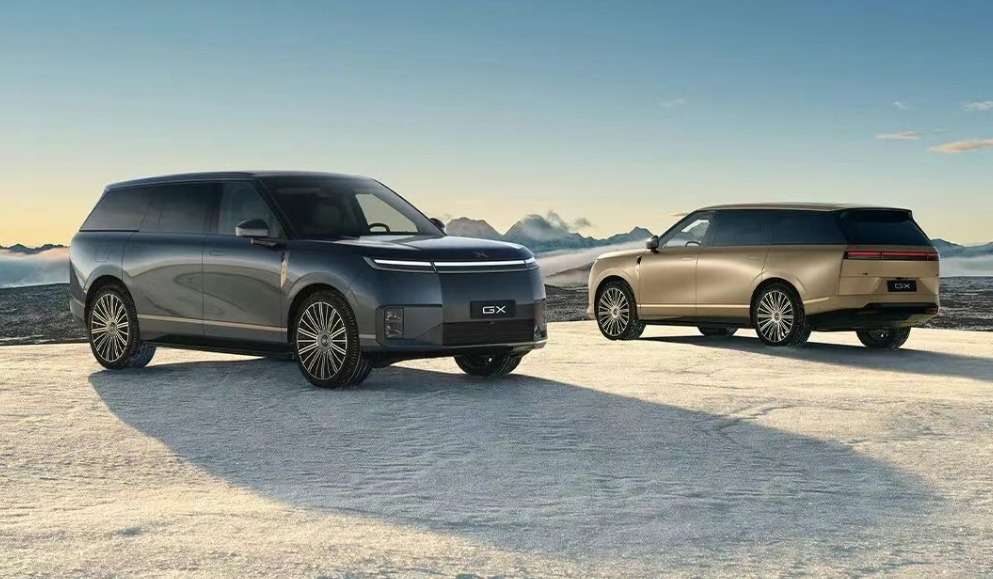
Xpeng has launched the GX, a new full-size flagship sport utility vehicle positioned as a technology-focused premium model for China’s increasingly competitive new energy vehicle market.
The GX is available in both battery-electric and extended-range variants, with all versions equipped as standard with rear-wheel steering and Xpeng’s second-generation VLA 6.2.0 driver-assistance platform.
The battery-electric GX starts at 279,800 yuan ($38,900) for the Max trim and rises to 359,800 yuan for the Ultra Flagship edition. The extended-range lineup begins at 289,800 yuan, while the top-spec model is priced at 359,800 yuan.
The SUV measures 5,265 mm in length, 1,999 mm in width and 1,800 mm in height, riding on a 3,115 mm wheelbase. Xpeng said the vehicle achieves a drag coefficient of 0.255 despite its large dimensions.
Inside, the GX uses a six-seat 2+2+2 configuration with a power-folding third row and cargo space expandable to 1,748 liters. Exterior color options include Dawn White, Forest Mist Purple and Platinum Brown.
The cabin includes a 17.3-inch 120Hz infotainment display and a roof-mounted 21.4-inch 3K entertainment screen. Other features include a 33-speaker audio system, an in-car refrigerator and AI-controlled privacy glass capable of changing opacity within 0.16 seconds.
Xpeng said the GX is the company’s first mass-produced vehicle engineered around a Robotaxi-ready architecture designed to meet Level 4 autonomous driving standards.
The SUV uses a vision-only perception system without LiDAR sensors, differing from many competing Chinese smart EVs. The platform combines Xpeng’s VLA and VLM large-model AI technologies and supports functions including automatic emergency braking at speeds up to 150 km/h and emergency obstacle avoidance on snow- and ice-covered roads.
The chassis incorporates steer-by-wire technology and active rear-wheel steering, enabling a turning radius of 5.4 meters.
On safety, Xpeng said the GX uses a 16,000-tonne integrated die-casting structure and includes 11 airbags along with six-layer redundancy systems covering steering, braking, propulsion, communication, power supply and door unlocking functions.
During the launch event, the company demonstrated what it described as the industry’s first “720-degree five-stage chain collision test,” involving multiple impact scenarios including bottom scraping, frontal, side and rear collisions, as well as a roof impact test.
The extended-range version offers up to 430 kilometers of pure electric driving range and a combined range of 1,585 kilometers. The battery-electric version delivers a CLTC-rated range of 750 kilometers and supports 5C ultra-fast charging.
All variants come standard with dual-chamber air suspension and CDC adaptive damping systems.
Xpeng also emphasized lifestyle-focused features including 62 storage compartments, 15 charging ports, eight accessory expansion interfaces and 6 kW vehicle-to-load external power functionality.
Additional comfort features include dual zero-gravity seats, a dual-zone onboard refrigerator and a climate-control system designed to reduce direct airflow discomfort for passengers.


