



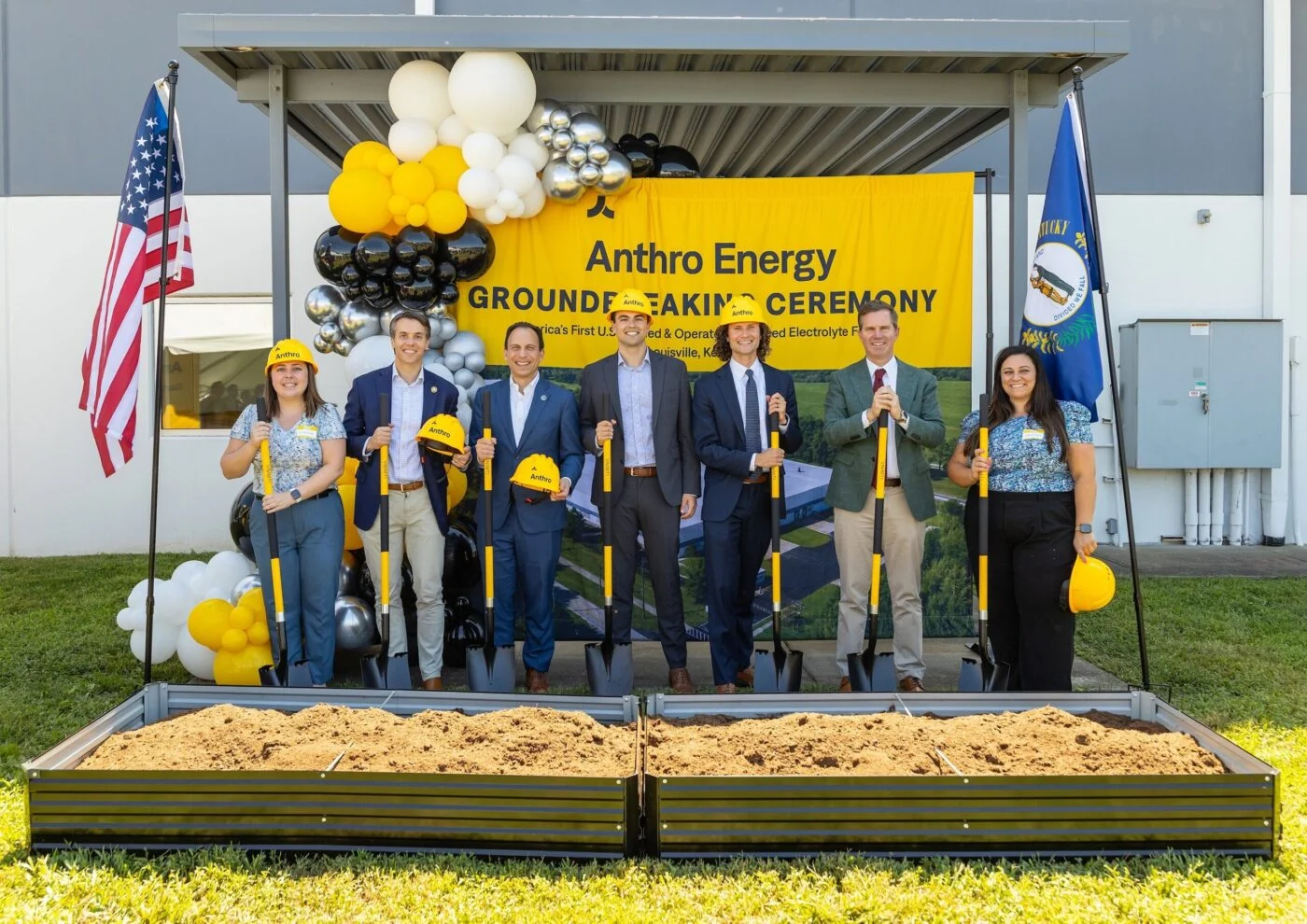
Anthro Energy has begun construction of its first commercial electrolyte manufacturing facility in Louisville, Kentucky, as the company moves to establish a domestic supply of advanced battery materials in the United States.
The facility is expected to begin commercial production in late 2027 and will have an annual capacity of approximately 12,000 tonnes of electrolyte, enough to support battery cell production with total capacity of up to 25 GWh. The project is expected to create around 110 permanent jobs.
Kentucky Facility Targets US Battery Supply Chain
The groundbreaking marks the construction phase of a project Anthro Energy first announced in 2024. The company describes the Louisville plant as the first US-owned and operated advanced electrolyte factory of its kind in the country.
Production will be introduced in phases following construction. Anthro initially plans to manufacture several electrolyte formulations, with the proportion of its proprietary Proteus polymer electrolyte expected to increase as customer validation progresses.
The company intends to use materials that are not subject to US restrictions concerning Foreign Entities of Concern (FEOC), supporting its goal of developing a domestic supply source for a key battery-cell component.
Proteus Technology Targets Next-Generation Batteries
Anthro Energy’s Proteus platform uses a polymer electrolyte that is initially processed as a liquid during battery cell manufacturing before solidifying inside the cell.
According to the company, the liquid processing approach allows the electrolyte to penetrate the anode and cathode similarly to conventional liquid electrolytes. Once solidified, the material is designed to provide greater mechanical stability and safety.
Anthro says Proteus can also be incorporated into existing lithium-ion cell manufacturing processes with relatively limited modifications. This could allow battery manufacturers to adopt the technology without completely replacing established production equipment and processes.
Potential Path To Semi-Solid And Solid-State Cells
Beyond conventional lithium-ion batteries, Anthro sees its polymer electrolyte technology as a potential pathway toward semi-solid and solid-state battery applications.
The company argues that processing the electrolyte as a liquid before it solidifies could help address some manufacturing challenges associated with producing solid-state cells at scale.
Anthro Energy Secures $24.9M US Department of Energy Grant to Boost Domestic Battery Production
However, the commercial viability of the technology for large-scale next-generation battery production remains subject to further development and customer validation.
Federal Support For Battery Manufacturing
The Louisville project was selected by the US Department of Energy in 2024 for a $24.9 million grant under the Infrastructure Investment and Jobs Act. The department has since approved the project for implementation.
Anthro has also received $18.4 million in tax credits through the 48C Advanced Energy Project Tax Credit Programme.
The facility is located in the US Battery Belt, providing access to a growing concentration of battery and vehicle manufacturing operations.
According to Anthro Energy CEO and co-founder David Mackanic, approximately 70 per cent of current US battery production is within a 12-hour drive of the Louisville facility.
This location could allow Anthro to supply domestically produced electrolytes to lithium-ion battery manufacturers while also positioning the company to serve producers developing semi-solid and solid-state battery technologies.
The plant is expected to begin commercial operations in late 2027, adding domestic electrolyte production capacity as the US battery industry continues to expand its local supply chain.