





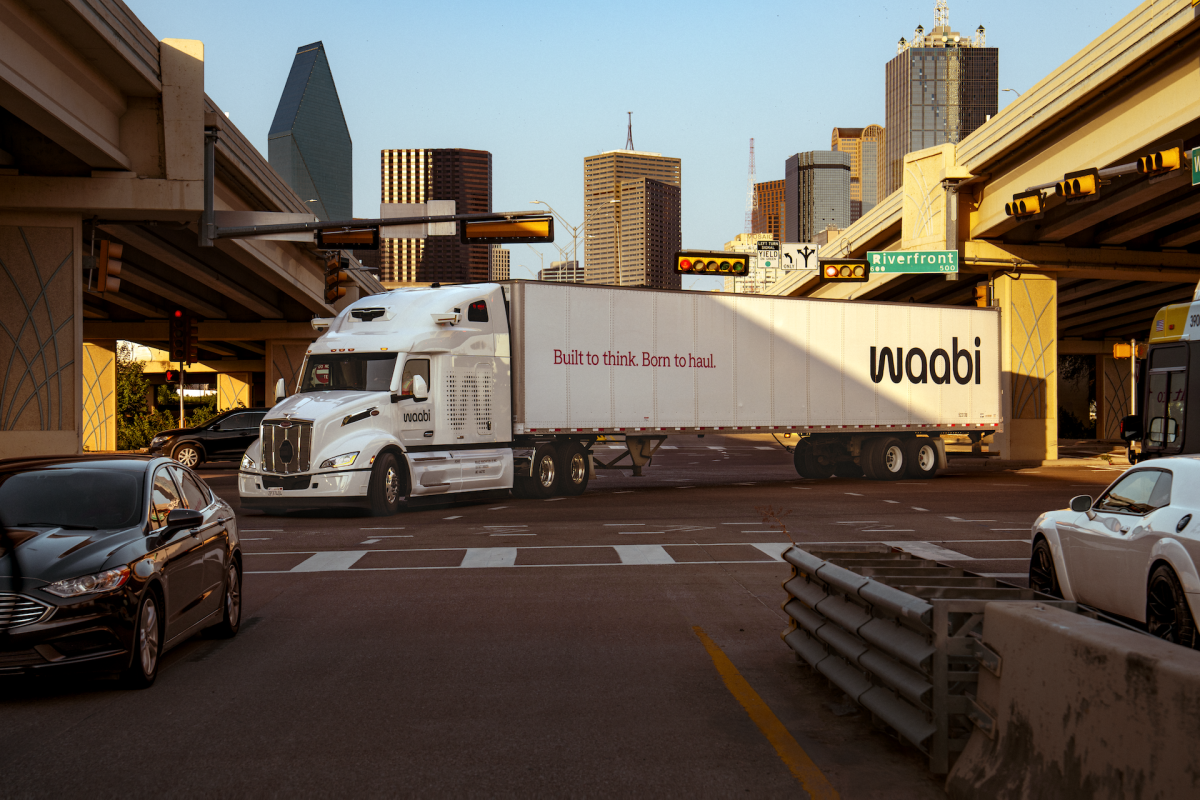
Autonomous vehicle startup Waabi has raised $1 billion in new funding and struck a partnership with Uber to deploy self-driving cars on Uber’s platform, marking Waabi’s first move beyond autonomous trucking.
The financing includes an oversubscribed $750 million Series C round co-led by Khosla Ventures and G2 Venture Partners, along with roughly $250 million in milestone-based capital from Uber. The Uber-backed funding is intended to support the deployment of 25,000 or more robotaxis powered by Waabi’s “Waabi Driver” technology exclusively on Uber’s platform. The companies did not disclose a timeline for reaching that scale.
See also: Waabi and Volvo Unveil Autonomous Truck Aimed at Human-Free Commercial Operations
The partnership represents a significant strategic shift for Waabi, which was founded in 2021 with a focus on autonomous trucking. Founder and Chief Executive Raquel Urtasun said the company’s artificial intelligence platform was designed from the outset to support multiple vehicle types using a single, general-purpose technology stack.
“Our incredible core technology really enables, for the first time, a single solution that can do multiple verticals, and they can do them at scale,” said Urtasun. “It’s not about two programs, two stacks.”
The move contrasts with earlier industry efforts. Waymo, for example, previously pursued both robotaxis and freight before shutting down its autonomous trucking program. Waabi argues that its capital-efficient development model and simulation-heavy approach reduce the need for massive fleets and large-scale data collection.
See also: Waabi Unveils Mixed Reality Testing to Advance Autonomous Vehicle Safety
The Uber partnership brings Urtasun’s work full circle. She previously served as chief scientist at Uber’s former autonomous vehicle unit, Uber ATG, which the company sold to Aurora Innovation in 2020. Waabi already works with Uber through a partnership with Uber Freight.
Uber has been assembling a broad ecosystem of autonomous vehicle partners rather than developing its own vehicles. In addition to Waabi, the company has announced collaborations with firms including Waymo, Nuro, Avride, Wayve, WeRide and Momenta.
The deal comes as Uber launches a new internal unit, Uber AV Labs, aimed at using data from its ride-hailing network to support autonomous vehicle partners. Waabi, however, says it relies less on large-scale real-world data than many competitors.
See also: Waabi Unveils Autonomous Trucking Terminal in Texas, Aiming for Driverless Operations
Waabi’s system is trained and validated using a closed-loop simulator called Waabi World, which creates digital twins of real environments, generates synthetic driving scenarios and allows the AI system to learn from mistakes without human intervention. According to Urtasun, this approach enables the Waabi Driver to generalize across vehicle types and driving conditions with fewer training examples.
Waabi has spent the past four and a half years deploying its technology in autonomous trucking pilots in Texas, operating with a human safety driver. The company had planned to launch fully driverless trucks by the end of last year, but the rollout has been pushed back to the coming quarters, Urtasun said.
See also: Gatik Rolls Out Fully Driverless Truck Operations With $600 Million in Contracted Revenue
Waabi’s latest funding round brings its total capital raised to about $1.28 billion, following a $200 million Series B in June 2024. By comparison, Aurora Innovation and Kodiak Robotics have raised about $3.46 billion and $448 million respectively through a mix of private and public funding.
Urtasun said demand for Waabi’s trucking offering remains strong and that the Uber partnership will help accelerate adoption in passenger transport. “We’re still in the first innings of deployment of robotaxis,” she said. “There’s a lot more scale to come.”
Waabi has not disclosed which automakers it plans to work with for the robotaxi program, but Urtasun said the company intends to integrate its sensors and autonomy stack directly at the factory level. “That is how you really build safe and truly scalable technology,” she said.


