


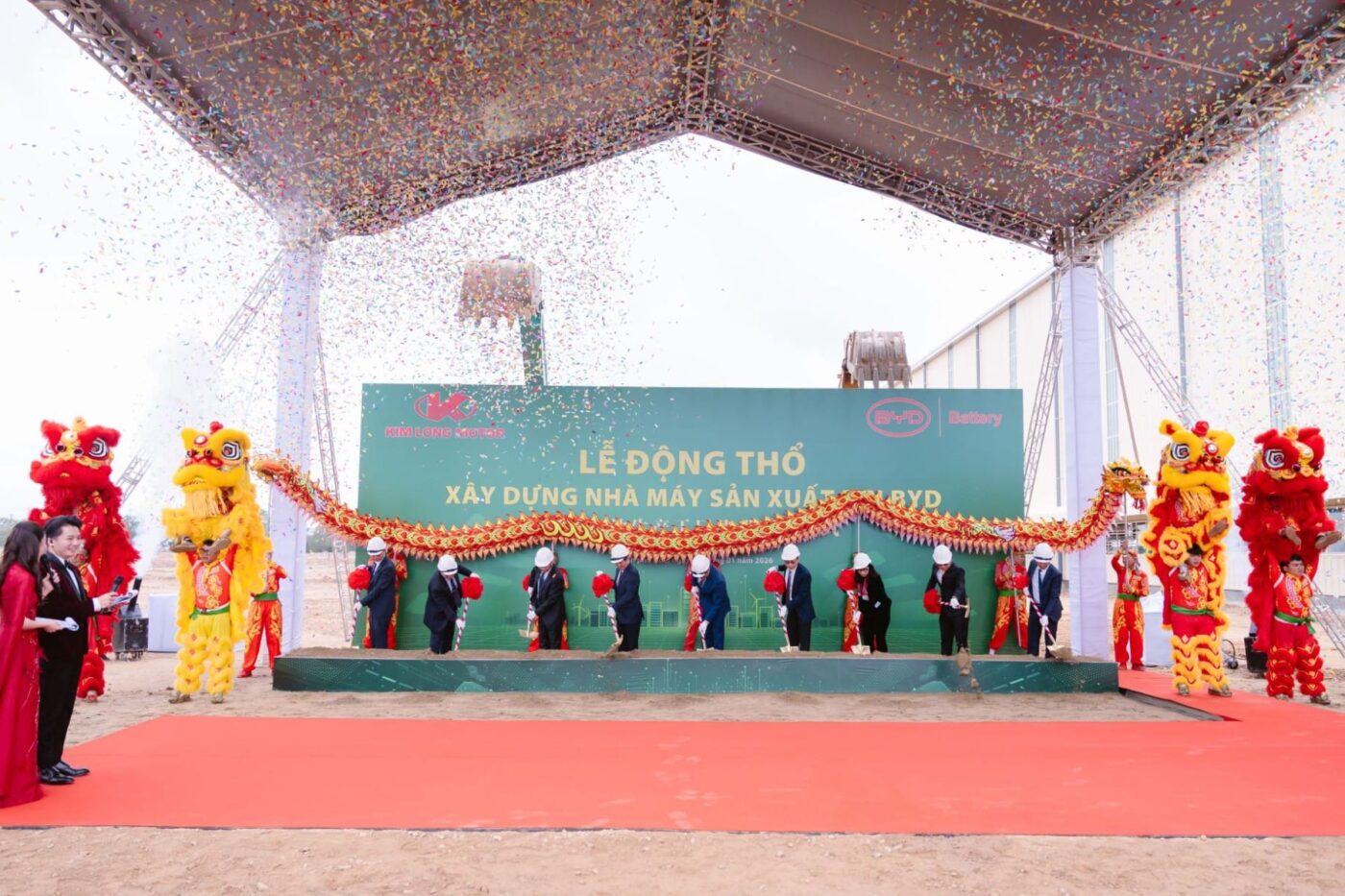
Vietnamese vehicle manufacturer Kim Long Motor and Chinese automaker and battery producer BYD have agreed to build a new electric vehicle battery factory in Vietnam, investing about $130 million as the partners seek to strengthen local supply chains and tap into fast-growing regional demand.
Kim Long Motor will finance construction of the plant at its automotive production and assembly industrial park in Huế, while BYD will provide battery technology and oversee technical implementation. The project is designed to help Kim Long Motor gradually master battery production know-how and improve the performance, safety and competitiveness of its electric vehicles.
See also: Line Man to Deploy BYD e6 Electric MPVs for Ride-Hailing Service in Thailand
In the first phase, the factory will focus on batteries for commercial electric vehicles. The site will cover more than 4.4 hectares and is planned to have an annual production capacity of around 3 gigawatt-hours, sufficient to supply electric trucks, buses, minivans and minibuses. The companies have not yet specified whether the facility will manufacture battery cells, modules, packs or complete systems.
Kim Long Motor said the batteries will support new models, including an electric long-distance nightliner coach with 34 sleeping berths. The company has previously marketed similar vehicles with diesel engines under its Kim Long 99 brand.
See also: BYD Targets 1.3 Million Overseas Vehicle Sales In 2026, Executive Says
A second expansion phase will add production of traction batteries for electric passenger cars, increasing the factory’s footprint to about 10 hectares and lifting total annual capacity to around 6 GWh. The highly automated facility is expected to meet domestic demand and support exports to Southeast Asia and other markets.
“Kim Long Motor recognises that the development of electric vehicles is not only an inevitable trend but also a long-term strategy closely linked to the independence of the national industry,” said Dao Viet Anh, general director of Kim Long Motor. “Our strategic partnership with BYD Group and the investment in the BYD battery factory demonstrate our strong commitment to mastering core technologies, rather than limiting ourselves to assembly or processing.”
See also: Ford in Talks With BYD Over Hybrid Battery Supply, WSJ Reports
Once operational, the plant is expected to help Kim Long Motor achieve a localisation rate of more than 80% by the second quarter of 2026 and position the company as part of a regional hub for battery and electric vehicle production.
The project comes as global demand for electric vehicle batteries continues to rise sharply. Worldwide EV battery usage reached 1,046 gigawatt-hours in the first 11 months of the year, up 32.6% from a year earlier, according to data from SNE Research. CATL led the market with a 38.2% share, while BYD ranked second, with battery installations of 175.2 GWh, up 31.3% year on year.
See also: BYD’s NEV Sales Fall 18.3% in December to 420,398 Units as Overseas Deliveries Hit Record 133,172
BYD’s expanding battery footprint mirrors its growing strength in electric vehicle sales. In 2025, the company overtook Tesla as the world’s largest seller of battery-electric vehicles, according to industry data. BYD delivered a record 650,811 passenger BEVs in the fourth quarter, while Tesla’s deliveries declined, allowing the Chinese automaker to take the top spot for the full year with 2.26 million BEVs sold, compared with Tesla’s 1.64 million.
Kim Long Motor is also diversifying its battery partnerships. In August 2025, the company signed an agreement with LG Energy Solution to assemble cylindrical NMC battery cells into packs at its Huế facility for use in electric buses.


