
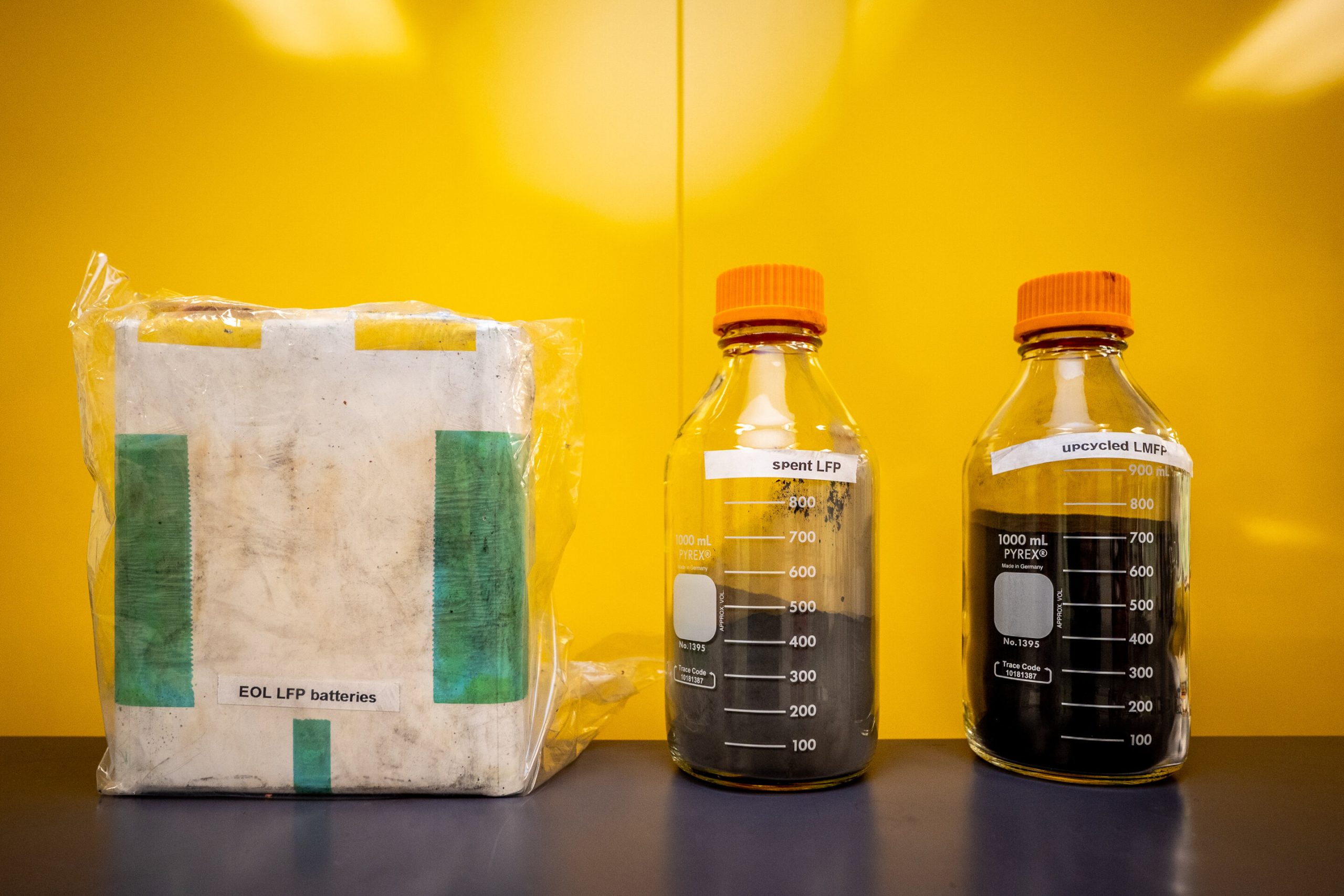
Engineers at the University of California San Diego have developed a battery recycling technique that upgrades used lithium iron phosphate (LFP) battery cathodes into a higher-performance material, potentially giving end-of-life electric vehicle batteries a second life with greater energy storage capacity.
The process converts spent LFP cathodes into lithium manganese iron phosphate (LMFP), a next-generation battery material capable of storing more energy while maintaining the safety and durability that have made LFP batteries widely used in electric vehicles and grid-scale energy storage.
The research was published in the journal Joule.
Upcycling Instead of Conventional Recycling
Unlike conventional battery recycling methods that recover raw materials through energy-intensive chemical or thermal processes, the new approach preserves the existing cathode structure and transforms it into a more valuable battery material.
Researchers said the method could reduce waste, lower energy consumption and decrease emissions associated with battery recycling.
LFP batteries now account for nearly half of the global lithium-ion battery market because they avoid the use of costly metals such as cobalt and nickel. As growing numbers of these batteries reach the end of their service lives, developing efficient recycling technologies has become increasingly important.
Study first author Wei Li said existing recycling methods often require harsh chemicals and high temperatures.
“These processes are not environmentally friendly.”
Converting LFP Into LMFP
The recycling process begins by dismantling used battery packs and separating the cathode coating from its aluminum current collector using water and gentle mechanical agitation.
The recovered cathode material is then dried and processed into powder before lithium, manganese and phosphate compounds are introduced.
To overcome differences in crystal structures between the recycled material and the added compounds, the research team first creates an intermediate material known as lithium manganese phosphate (LMP), which shares a crystal structure similar to LFP.
After mechanical mixing and heat treatment, manganese atoms gradually replace part of the iron within the cathode, forming a uniform LMFP structure. During the heating process, a thin carbon coating also develops around each particle, improving electrical conductivity and enhancing long-term cycling performance.
Senior author Zheng Chen said the approach creates a higher-value product from retired batteries.
“This could offer a more valuable end use for spent batteries.”
Demonstrating Commercial Potential
The researchers successfully tested the recycling method using spent LFP batteries from multiple manufacturers.
They also demonstrated that the process can be scaled to kilogram quantities while producing cathode materials that perform reliably in both laboratory coin cells and larger pouch cells similar to those used in commercial electric vehicles and stationary energy storage systems.
According to the research team, the resulting LMFP cathodes deliver higher energy density than conventional LFP materials while retaining the chemistry’s well-known advantages in safety and durability.
Future work will focus on improving manufacturing efficiency, increasing production yields and refining the material’s composition and particle structure to further enhance battery performance for commercial applications.