

Across South Asia, the cost of staying on the road is becoming harder to predict – and harder to afford. For drivers, delivery operators, and small transport businesses, even the smallest shifts in costs can determine whether a family’s income holds steady, whether work remains viable, and whether new opportunities stay within reach. These pressures are not driven by local demand alone, but by a deeper structural reliance on imported energy that can leave economies exposed to shocks far beyond their control.
Like many emerging economies, Bangladesh depends heavily on imported fuel, and the past months of geopolitical instability have made that dependence acutely visible. Prices have swung unpredictably, supply has tightened, and the millions of commercial drivers who form the backbone of the country’s transport economy have faced mounting pressure on their livelihoods. Amid this uncertainty, the question of how to build a more resilient foundation for growth and development has moved from theoretical to urgent.
Electric vehicles are key to answering this question, as they provide a unique opportunity for economic empowerment through cost stabilisation and driver independence. However, for all its promise, the fast-growing EV industry has too often underserved those with the most to gain from sustainable transport. The revolution has been shaped predominantly by and for affluent consumers in developed markets, with a clear focus on home charging infrastructure, long distance driving, and premium price points.
While such a model speaks to the tastes of select buyers, it has far less to offer the three-wheeler CNG-powered auto-rickshaw driver in Dhaka working twelve-hour shifts, or the driver whose entire business model depends on careful cost control.
These are the people who keep Bangladesh’s economy circulating, and they deserve technology built around their needs. It is this belief that has driven Palki’s growth and earned international recognition for our work.
That is why I founded Palki Motors. From the outset, we have focused on making sustainable transport accessible and affordable for commercial operators. Our vehicles are engineered for durability under demanding daily use, but priced to make economic sense for drivers on modest incomes.
This means strong chassis that can withstand unpaved roads and drivetrain systems that maximise every unit of energy. The result is a machine that pays for itself through lower operating costs, greater earnings predictability, and insulation from forces beyond any driver’s control.
Today, as geopolitical tensions rise and global supply chains are disrupted, we are seeing just how important these solutions are – not just to the country’s economic development, but to the resilience of the economy itself. When fuel shortages hit Bangladesh, Palki drivers stayed on the road.
They continued earning while others queued at filling stations or parked vehicles they could no longer afford to run. Goods kept moving. Passengers reached their destinations. Economic activity that would otherwise have stalled continued to flow.
In the past few months, we have received 23 new orders from commercial operators who watched our fleet operate through the crisis and wanted that same stability for themselves. Our vehicles now carry over 374,000 passengers annually, saves 90% on fuel and 50% on maintenance for drivers, and avoid an estimated 150 tonnes of CO₂ each year. Each unit on the road represents a livelihood protected and an economy made more robust against external shocks.
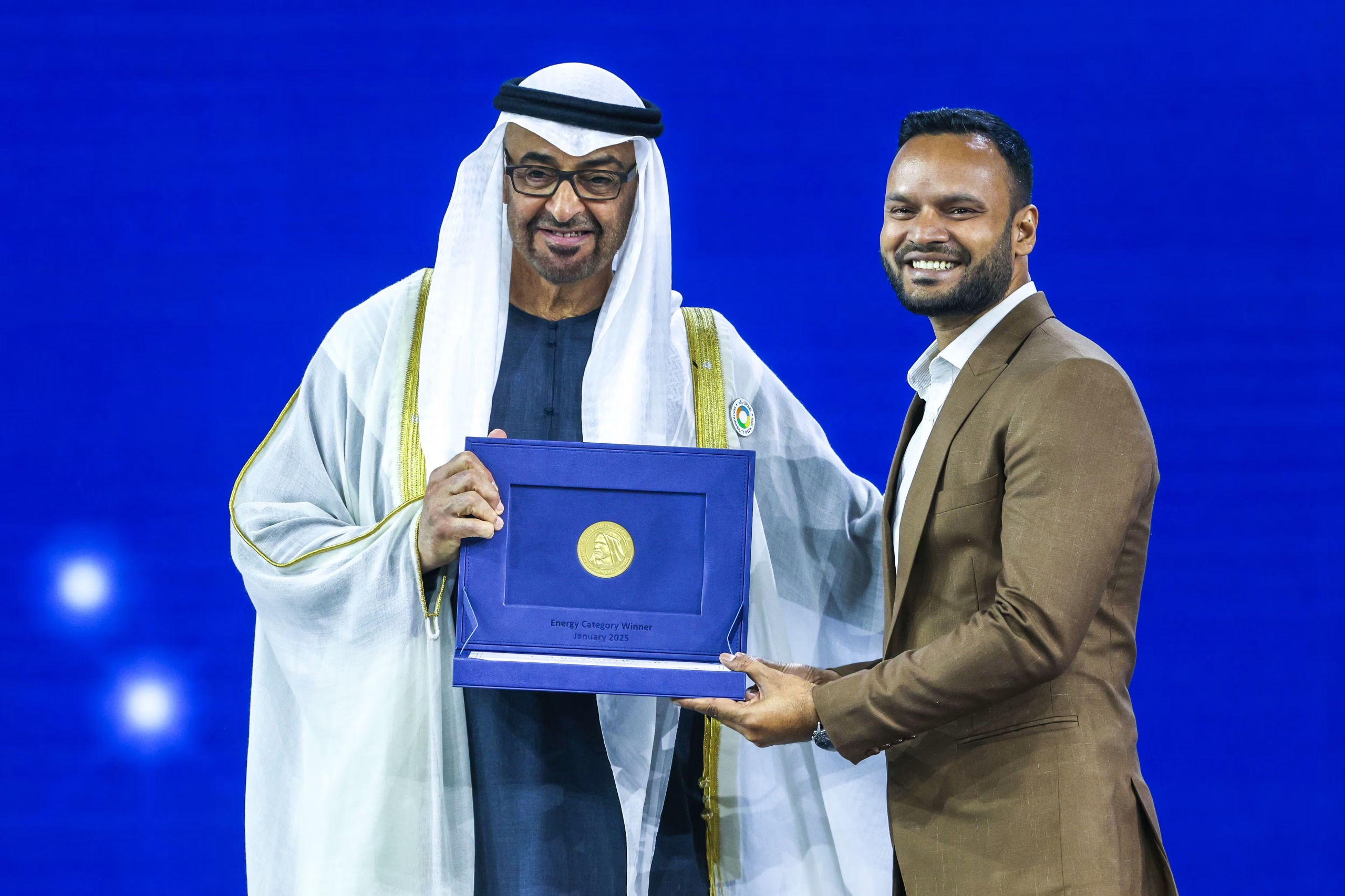
As we work to meet this rising demand and deliver the reliability and affordability that drivers count on, we have learned that international support is critical to meeting the intensifying needs of commercial drivers and small businesses. In 2025, Palki Motors was honoured to receive the Zayed Sustainability Prize, one of the world’s leading awards for transformative innovation across health, energy, food, water, climate action. The recognition validated years of effort, but its significance extended well beyond the Awards Ceremony. The Prize brought credibility that unlocked new opportunities for growth, provided capital at a pivotal moment in our development and helped accelerate the next phase of our expansion.
Since receiving the Prize, we have directed those resources into R&D for two new vehicle lines: the Cityboy V3, our next-generation passenger EV, optimised for urban passenger transport, and the ReVolt V2 designed for light commercial pickup. Both feature improved chassis engineering and range optimisation tailored to the realities our drivers navigate daily. The Prize also helped catalyse an additional USD 400,000 in investment from partners across the MENA region, accelerating development timelines and enabling us to scale more quickly than would otherwise have been possible. Alongside product development, we strengthened our manufacturing processes and built infrastructure to support regional expansion, demonstrating how the Prize has helped transform recognition into tangible growth.
What this journey reinforces is a conviction I have held since founding the company: that resilient economies are built from the ground up. They emerge when local entrepreneurs develop solutions calibrated to local conditions, when innovation addresses the needs of communities rather than simply the preferences of global markets. Of course, realising that potential requires support at critical junctures, as founders building for underserved markets need partners that recognise truly impactful innovation and understand the value of locally-led solutions. For us, that meant funding that brought the Cityboy V3 launch forward into 2026 and seeded our CKD assembly line in Dhaka.
The road ahead for Bangladesh’s commercial drivers remains demanding. Fuel markets and supply chains are likely to remain under pressure and global challenges will continue to evolve. Recent growth, supported by recognition and investment unlocked through the Zayed Sustainability Prize, has strengthened our ability to respond to those challenges at scale. Palki Motors is building so that drivers can meet those challenges with technology designed for their economics, their conditions, and their aspirations. When disruption comes, and it will, they will have options that once seemed out of reach. Because resilient growth means the capacity to absorb shocks and continue forward.