
As electric vehicle adoption accelerates worldwide, the question of how to handle batteries once they reach the end of their automotive use has gained new urgency. A study conducted by researchers from the University of Münster, the Fraunhofer Research Facility for Battery Cell Production (FFB), and Lawrence Berkeley National Laboratory has found that repurposing EV batteries for stationary storage can offer greater environmental benefits than immediate recycling.
The analysis compares two primary options for used EV batteries: recycling them to recover valuable materials like lithium, cobalt, and nickel, or giving them a second life as stationary power storage for applications such as solar energy systems and grid support. Both strategies play important roles in reducing raw material dependency and minimizing environmental harm associated with resource extraction.
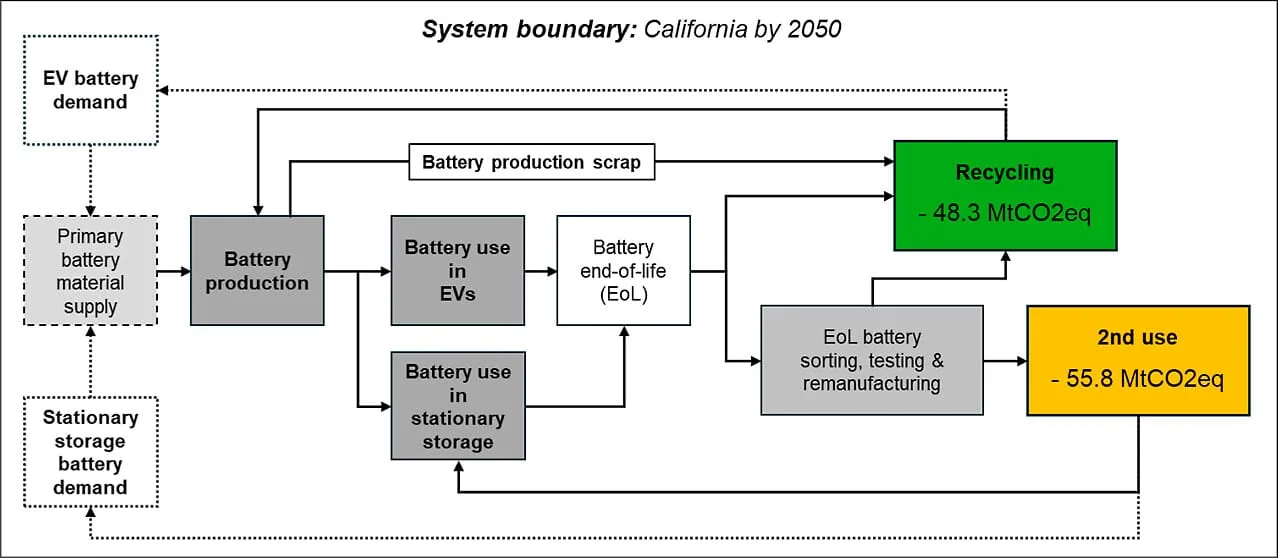
Recycling enables the recovery of materials that are crucial for battery production and can significantly reduce reliance on imports from dominant market players like China. According to the study, by 2050, battery recycling could cover approximately 61% of California’s demand for new electric vehicle batteries.
However, second-life applications offer an alternative path that extends the operational life of batteries beyond their use in vehicles. Although these batteries may no longer perform at peak levels, they remain suitable for less demanding tasks such as stationary energy storage. The study estimates that by 2030, repurposed EV batteries could meet all of California’s projected needs for stationary storage. This is especially true for lithium iron phosphate (LFP) batteries, which are more durable and use fewer critical raw materials.
When comparing the two approaches from a carbon emissions standpoint, second-life use shows a greater potential for greenhouse gas reductions. The researchers estimate that deploying used EV batteries in stationary storage could prevent approximately 55.8 million tonnes of CO₂-equivalent emissions by 2050—more than the emissions savings projected from recycling alone, which stands at 48.3 million tonnes.
Despite the advantages of second-life use, the study emphasizes the importance of developing robust recycling infrastructure. Once demand for stationary applications is met, surplus batteries will need to be processed to recover valuable materials. A coordinated strategy that includes both reuse and recycling is seen as the most sustainable path forward for managing the lifecycle of EV batteries.
With examples of second-use systems already in operation at locations such as airports and manufacturing facilities in Europe, the researchers point to regions like California as having the potential to lead in implementing circular battery economy practices that reduce environmental impact across the entire EV lifecycle.
Source: pubs.acs.org, uni-muenster.de